The post said he failed a background check for classified briefings. The law names members of Congress as exempt from that process.
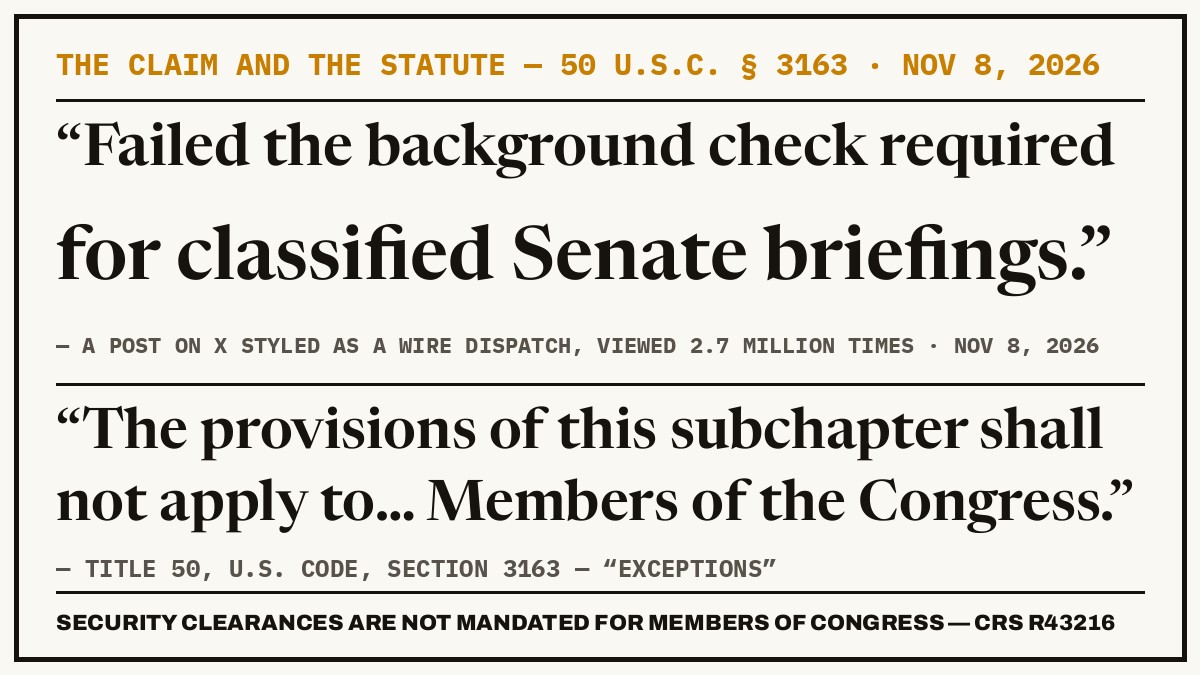
A post on X styled as a wire dispatch, viewed 2.7 million times, says Michigan's senator-elect Abdul El-Sayed “failed the background check required for classified Senate briefings” and is blocked from any session involving sensitive national security information. The process it describes does not exist for members of Congress. The law governing access to classified information carves members out by name, and the Congressional Research Service states that security clearances “are not mandated” for them: officials who hold positions prescribed by the Constitution “are deemed to meet the standards of trustworthiness” by virtue of the office itself.
By SmokeScreen Desk · Toronto
Published Nov 9, 2026 · 3:06 p.m. ET
🎧 Listen to this article
Abdul El-Sayed won Michigan's U.S. Senate race on November 3, 2026, beating Republican Mike Rogers by roughly seven points; he takes his seat in January as the first Muslim elected to the Senate. Five days later, at 9:27 a.m. Eastern on Sunday, November 8, a post went up on X from the account TrumpNews_Baby, presenting itself under the name Jonathan Gregory. It is dressed as a wire dispatch: an all-caps headline — “ABDUL EL SAYED FAILS BACKGROUND CHECK FOR CLASSIFIED SENATE BRIEFINGS” — a byline, and a dateline, “Washington, DC - November 8, 2026.” Its text, as two fact-check desks reproduced it in full, reads: “Abdul El Sayed has failed the background check required for classified Senate briefings. The denial blocks him from any session that involves sensitive national security information. Officials who conduct the clearances reported that the review did not meet the standards necessary for access to restricted materials.” It goes on: “Senators who receive classified briefings must clear the same process before they can attend. El Sayed's rejection means he cannot participate in those meetings.” And it closes: “The clearance failure stands as the official record until any appeal produces a different outcome. The standard remains the same for every member of the chamber.” The X counter put the post at 2.7 million views as the checks began citing it, and a Community Note is visible beneath it.
The account is a known one to this desk, and that is stated once, straight. The same account posted the November 3 dispatch claiming an FBI raid of a Houston storage-locker warehouse had uncovered more than 20,000 fraudulent ballots, all for Democrats — the claim checked in this desk's story on the Houston FBI-raid post, where the FBI's Houston office told fact-checkers no election-related operation occurred. WhatTheFact's account check adds that Lead Stories has documented a Facebook page under the same “Jonathan Gregory” name as a recurring source of invented, news-styled stories. The crediting rule of this desk is claims, not creators; the history is on the record because the format is the claim's costume — a dispatch, with a dateline, written to be mistaken for reporting.
Start with the statute, because the statute is where the described process would have to live. Title 50 of the United States Code, section 3163, is headed “Exceptions,” and its single sentence reads: “Except as otherwise specifically provided, the provisions of this subchapter shall not apply to the President and Vice President, Members of the Congress, Justices of the Supreme Court, and Federal judges appointed by the President.” The subchapter it names is the one governing access to classified information — the personnel-security framework under which executive-branch clearances are granted and denied. Members of Congress are not inside it. They are carved out of it, by name, in the text of the law itself. A senator-elect cannot fail a clearance process that the statute says does not apply to senators.
The Congressional Research Service describes the same system in plain terms. Its report R43216, “Security Clearance Process: FAQs,” asks the question directly — “Are Constitutional Officers (e.g., the President, Members of Congress) Required to Hold Security Clearances to Access Classified Information?” — and answers it in the first line: “Security clearances are not mandated for the President, the Vice President, Members of Congress, Supreme Court Justices, or other constitutional officers.” The report gives the reason: “The criteria for election or appointment to these positions are specified in the U.S. Constitution, and, except by constitutional amendment, no additional criteria (e.g., holding a security clearance) may be required.” And it states the working rule: “by tradition and practice, United States officials who hold positions prescribed by the Constitution of the United States are deemed to meet the standards of trustworthiness for eligibility for access to classified information.” Access follows the office. It is not applied for, investigated, or denied.
The clearances in the record belong to a different group of people: the staff. The same CRS report notes that congressional staff are required to hold security clearances to gain access to classified information, and that the Office of Senate Security requires staff to obtain the appropriate clearance and sign a nondisclosure agreement. The post's premise runs the system backwards. In the Senate as it actually operates, the aides are vetted and the members are not — because the members' eligibility is the office the voters conferred. There is no gate of the kind the dispatch describes: no review a senator-elect sits for, no standard he can fall short of, no appeal because there is no decision to appeal.
Two fact-check desks examined the post the following day, November 9, and their findings agree with the documents and with each other. MEAWW found no reports of any failure or denial, no statements from the Senate or any security agency describing El-Sayed as barred from anything, and states the mechanical point: “newly elected Senators don't undergo any formal clearance process or background checks to access classified information.” WhatTheFact reached the same place by the same road: “Senators are not screened through an executive-branch clearance process at all, so a senator-elect cannot 'fail' one,” and its searches for the alleged denial returned only the original post and copies of it. WhatTheFact also records how the process is described by voices that are not the senator-elect's allies: the National Republican Senatorial Committee said before the election that El-Sayed would be guaranteed a clearance if he won; Senator Ted Cruz made the same point; and Fox News and the Washington Examiner describe senators' access as automatic. When a politician's opponents describe the procedure in terms that make a damaging story impossible, the procedure is not in dispute.
What would settle the claim the other way is easy to name, because a real exclusion would leave real paper. A senator-elect actually barred from classified sessions would be an institutional event: a statement from the Senate, a word from an agency, coverage in the Washington press — the same record that documents every genuine clearance fight. None of it exists. The post's only sourcing is a phrase — “officials who conduct the clearances” — attached to no name, no agency and no document, describing officials performing a function the statute does not assign them over members of Congress. There is no denial to produce because there is no process to produce one.
So the file sorts the way this desk sorts every file. Documented: a dispatch-styled post, viewed 2.7 million times, asserting that a senator-elect failed a background check and stands excluded from classified sessions; a statute, Title 50, section 3163, exempting Members of Congress from the classified-access subchapter by name; a Congressional Research Service report stating that clearances are not mandated for members, who are deemed to meet the standards of trustworthiness by virtue of their constitutional office; clearance requirements that do exist in the record, applying to congressional staff through the Office of Senate Security; and two independent checks, published November 9, that found no record of any denial and no process of the kind described. Not in the record: a denial, a review, a failed standard, an appeal — or any document any of them could attach to. Claimed: by the post alone, which dressed an invented procedure in a dateline and reported its outcome as “the official record.” The claim is scored in The Count, on the same documents listed below. Read the receipts. Decide for yourself.
Think we got this one wrong?
Good. That's the job — yours and ours. Bring your own receipts, and if you're right, the correction runs on this story, in the open, with credit.
Challenge this story