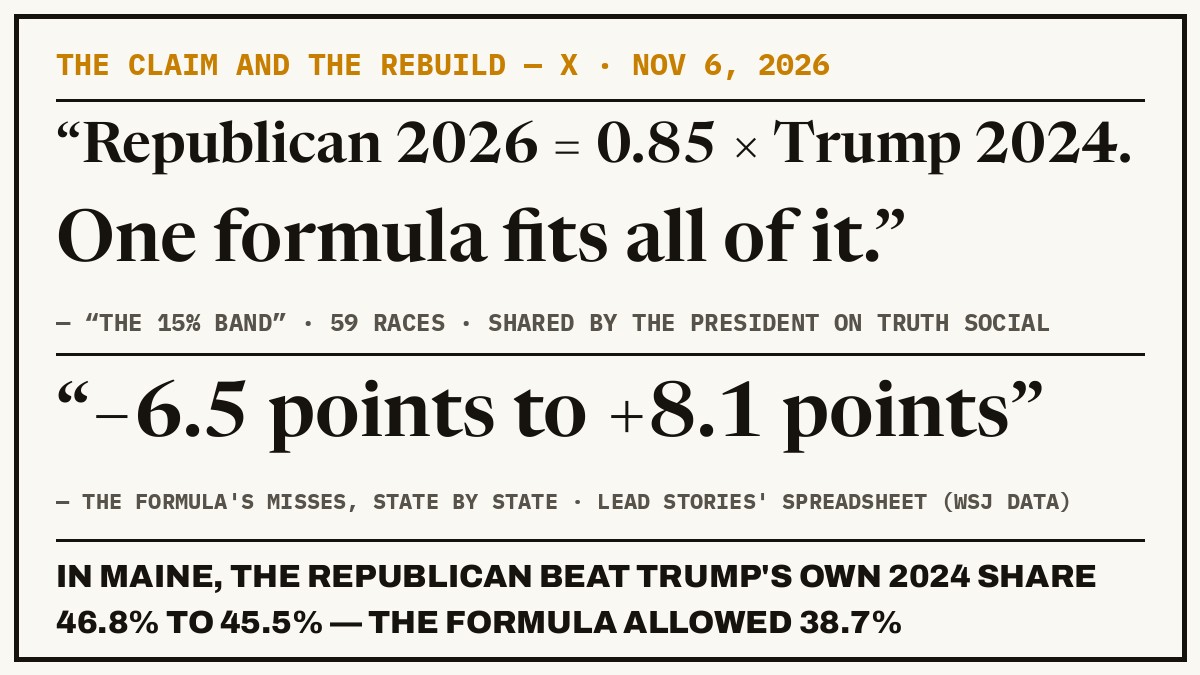
The chart said Democrats “materialized” 20 million votes. Its own footnote calls the 2026 bars a projection.
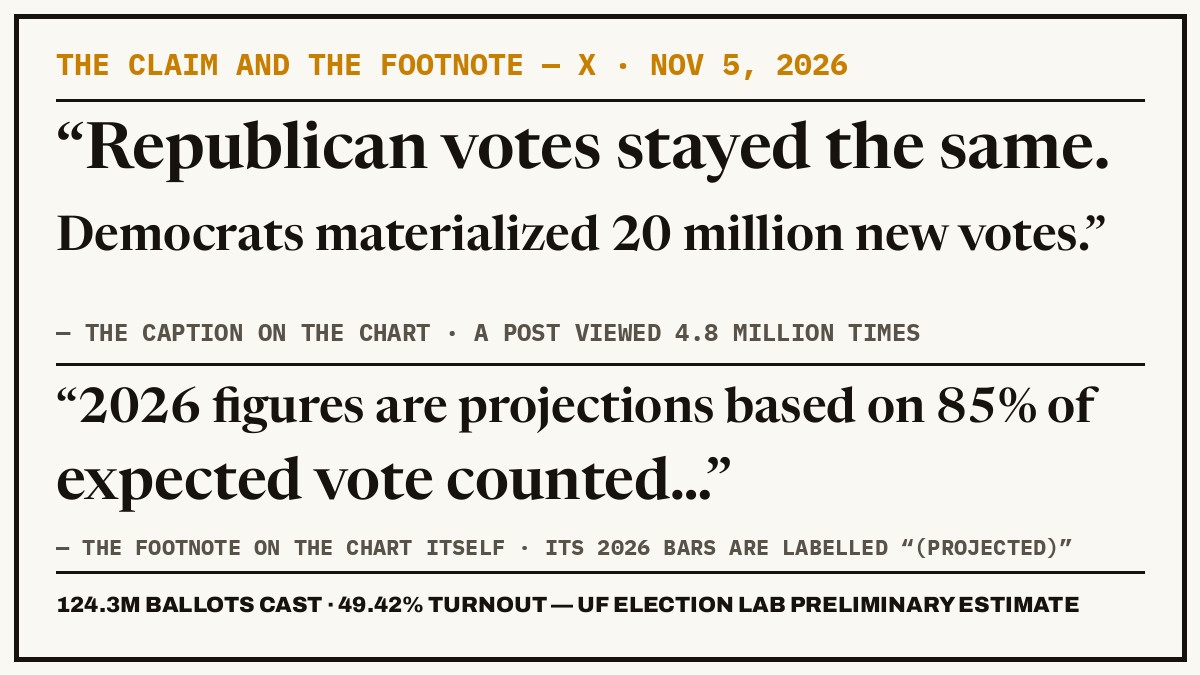
A post on X, viewed 4.8 million times and shared by the President on Truth Social, pairs a House popular-vote chart with a two-line caption: “Republican votes stayed the same. Democrats materialized 20 million new votes.” The chart's 2022 bars match the certified totals. Its 2026 bars are labelled “(projected)”, and the footnote under them describes a projection built on 85 percent of the expected vote. The turnout estimate underneath — 124.3 million ballots, a 49.42 percent midterm rate — is the University of Florida Election Lab's, and it is the second-highest since 1914.
By SmokeScreen Desk · Toronto
Published Nov 8, 2026 · 1:20 p.m. ET
🎧 Listen to this article
The post went up on X on Thursday, November 5, 2026, from the account of Kevin Bass. It is a bar chart — “U.S. House Popular Vote by Party Midterm Elections” — and two lines of text: “Republican votes stayed the same. Democrats materialized 20 million new votes.” The X counter put it at 4.8 million views as the checks began citing it. President Trump shared the chart on Truth Social, and it moved through the amplifiers this desk credits once and moves on: Dave Rubin, Liz Harrington, Joe Hoft and Matt Gaetz among them. The argument the caption makes is not in the bars. It is in one verb — “materialized” — which asks the reader to hear that the extra Democratic votes appeared without voters behind them.
Start with what the chart gets right, because the checks are unanimous that it gets the baseline right. The 2022 bars — Republicans 54.2 million, Democrats 51.3 million — match the certified national House popular vote in the Clerk of the House's statistics: 54,227,992 Republican and 51,280,463 Democratic votes. The chart's author did not invent his starting point, and no checker disputes it.
The 2026 bars are a different kind of number, and the chart says so itself. Both carry the label “(projected)”. The footnote underneath reads, in full: “2026 figures are projections based on 85% of expected vote counted and remaining ballots continuing at current rates (R 43.5% / D 55%)”. The 70.4 million Democratic votes in the headline comparison are not a count. They are the output of an assumption — that the ballots still uncounted when the chart was made would break the same way the counted ones had. Certified 2026 House totals do not exist yet; states are still counting, and no national certified figure has been published.
The count that does exist points to a smaller gap. Cook Political Report's unofficial tracker, read on Friday morning, November 6, had counted 62,073,677 Democratic House votes — about 10.8 million above the party's 2022 total, with millions of ballots still outstanding — and 48,254,756 Republican votes, about 6 million below 2022 with the same ballots outstanding. View from the Gallery, which rebuilt the comparison from the Clerk's table and Cook's tracker, projects the final Democratic gain nearer 15 million than 20 — and notes that the chart's 85-percent premise implies more House votes in total than the number of ballots the turnout estimate says were cast.
Underneath both numbers sits the turnout document. The University of Florida Election Lab's preliminary estimate, published by Michael McDonald on November 4, puts 124.3 million ballots cast — 49.42 percent of eligible voters, the second-highest midterm turnout rate since 1914, behind only 2018's 50.05 percent. The 2022 midterm drew about 112 million ballots. An electorate that grows by some 12 million ballots and breaks the way NBC News measured it — Democrats 55.3 percent, Republicans 43.3 percent of the national House vote — produces a lopsided rise in one party's total as a matter of arithmetic. The checks make the same point with the exit data: first-time midterm voters backed Democrats 64 to 34.
Swings of this size between midterms are in the Clerk's own table. Democratic House votes rose from 35.4 million in 2014 to 60.3 million in 2018 — an increase of about 25 million, larger than the one the caption treats as impossible, in an election whose count is not in dispute. And the pool the 2026 projection draws on is documented: Democratic House candidates won 70,571,330 votes in the 2024 presidential cycle. A projected 70.4 million sits inside a total the same party recorded two years earlier.
WhatTheFact's check of the post, published today, separates the number from the verb: the size of the Democratic increase is real; what the word “materialized” adds — “that these ballots appeared without voters behind them” — is contradicted by the record. Its summary line: “The caption is a factual number attached to a false inference.” What would settle the remaining question is the document that does not exist yet: certified state totals, which will fix the final gain at a figure the counters can argue about precisely. Until they land, the counted figures are the ones in hand on Friday morning — 62.1 million Democratic votes — and the chart's own label for the rest: projected.
So the file sorts the way this desk sorts every file. Documented: a chart whose 2022 bars match the Clerk's certified totals; a “(projected)” label and a method footnote on its 2026 bars; a preliminary turnout estimate of 124.3 million ballots at 49.42 percent, the second-highest midterm rate since 1914; a running count that had Democrats 10.8 million above 2022 on Friday morning with millions of ballots still out; and a 25-million-vote Democratic rise between the 2014 and 2018 midterms in the official table. Not in the record: any certified 2026 total, any official or court allegation of fabricated ballots, and any document behind the word “materialized”. Claimed: by the caption alone — two lines over a chart whose own footnote describes a projection. The claim is logged in The Count, on the same documents listed below. Read the receipts. Decide for yourself.
Think we got this one wrong?
Good. That's the job — yours and ours. Bring your own receipts, and if you're right, the correction runs on this story, in the open, with credit.
Challenge this story