The auction had a second price nobody bid: what the unsealed Amazon complaint alleges
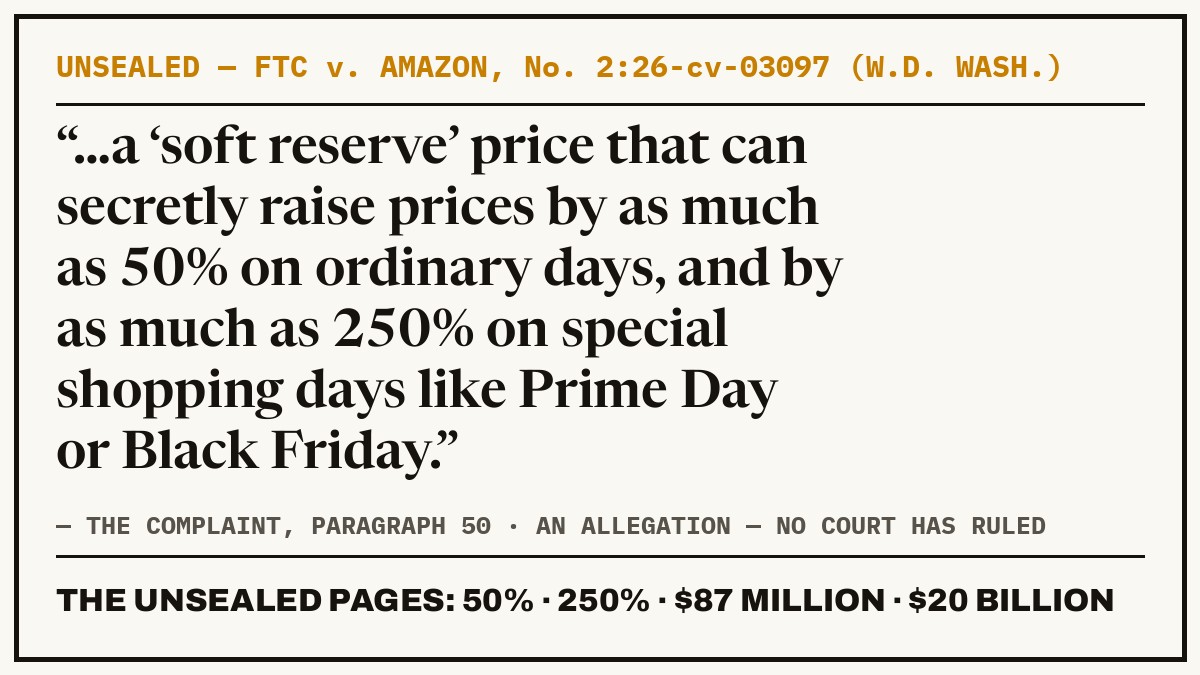
The FTC and 22 state attorneys general sued Amazon in August over how its Sponsored Ads auctions really set prices — and the figures were redacted. The updated complaint, unsealed this week, puts numbers on the allegation: a hidden “soft reserve” that could raise prices as much as 50% above auction results on ordinary days and 250% on Prime Day and Black Friday, more than $87 million added in one holiday season, and a $20 billion total the complaint says was taken from 1.2 million advertisers. Amazon says the claim “fundamentally misunderstands how advertisers operate” and that no advertiser pays more than its bid. These are allegations in a pleading. No court has ruled.
By SmokeScreen Desk · Toronto
Published Nov 8, 2026 · 8:58 a.m. ET
🎧 Listen to this article
On August 31, 2026, the Federal Trade Commission and the attorneys general of 22 states filed a 181-page complaint against Amazon in federal court in Seattle — Federal Trade Commission et al. v. Amazon.com, Inc., No. 2:26-cv-03097-JHC, in the Western District of Washington. The suit was public from the day it was filed. What the public could not read were the numbers: the passages describing how much Amazon's advertising auctions had allegedly been raised, and by what mechanism, were redacted. This week the coalition filed an updated version of the complaint with those passages unredacted, and on November 5 the FTC announced what they contain. The complaint's own first paragraph states the allegation plainly: since 2019, it says, Amazon “has secretly and systematically overcharged its approximately 1.2 million advertising customers by manipulating the ‘auctions’ that it uses to set the price of ads on its platform,” and, based on internal documents describing “hidden” “surcharges,” the scheme “has likely illegally extracted over 20 billion dollars from its unwitting advertising customers.” That is the plaintiffs' figure, in the plaintiffs' document. Amazon disputes the case in full, and its answer is in this story at the same length.
The mechanism the complaint describes starts from what Amazon told advertisers their auctions were. Since it began selling search ads around 2012, Amazon has represented that its Sponsored Ads prices are set by “second price” auctions: ads are ranked by bid and relevance, and the winner pays only the minimum necessary — in the complaint's summary of the representation, “one cent more” — to beat the next-ranked advertiser. The unsealed paragraphs allege a second step underneath that description. Paragraph 50 of the complaint, citing Amazon's internal documents, says Amazon calculates the cost-per-click “in two stages”: it runs the auction to produce a price, then “transforms” that price into the final charge by calculating a “soft reserve” price “that can secretly raise prices by as much as 50% on ordinary days, and by as much as 250% on special shopping days like Prime Day or Black Friday.” The next paragraph alleges the auction data shown back to advertisers is aggregated and was described inside Amazon as “opaque,” leaving customers “unable to verify auction results and how prices are set.” The three products named are Sponsored Products, Sponsored Brands and Sponsored Display — the paid placements at the top of Amazon's search results.
The unsealed pages then attach the mechanism to specific seasons, in the complaint's telling. During the 2021 holiday shopping period, the complaint says (paragraph 228), Amazon's Sponsored Products team lifted its surcharge constraints in early December, and “the average CPC increased by 20% and, in some instances, advertisers' CPCs increased by more than 200%.” For the 2022 holidays, the complaint quotes an internal Sponsored Products memorandum (paragraph 250): the reserve prices were kept “dialed up at a lower allocation,” which “prevented advertisers from seeing confusing steep increases in their CPCs at any point,” and the memorandum “touted the team's success,” noting that “the effort resulted in more than $87 million in increased revenue worldwide, with ‘no advertiser escalations.’” For Prime Day 2023, the complaint quotes an internal Amazon report (paragraph 253) on one large food and beverage advertiser whose campaigns “saw significant CPC increases and ROAS decreases destroying campaign performance” — return on ad spend falling as the charges rose. The advertiser's own account manager, in an internal message the complaint quotes, asked whether U.S. grocery costs-per-click were “much higher this prime day than last,” reporting the client was “seeing 90%+ increases killing RoAS.” The FTC's release puts that advertiser's Prime Day 2023 increases at more than 100%.
The complaint also alleges the surcharges were used as a revenue lever, and quotes the email it rests that on. In 2023, after noting that Display Ads was going to “miss” its then-current financial “plan by $40MM,” the head of Amazon Ads wrote to Amazon's senior vice president of ad products and technology: “I'd like to pull out all of the stops (without doing unnatural acts) to close our gaps to plan. I suspect that the entire gap won't be closed, so whatever can be done with reserves (ideally at least $40MM would be helpful).” New York Attorney General Letitia James, whose office is one of the 22 state plaintiffs, framed the coalition's case in consumer terms when the suit was filed: “Consumers across the country are likely paying more for everything from groceries to electronics because Amazon has wrongfully inflated its ad prices.” The New York release states the coalition's version of the mechanism directly — that beginning in 2018 Amazon manipulated the auctions “by submitting fake second-place bids” — and puts the affected advertisers at “more than 1.2 million advertisers, including hundreds of thousands of small and medium-sized businesses,” overcharged, in the coalition's figure, “more than $20 billion.” Those are the plaintiffs' characterizations, advanced in their own releases and pleading, and they have not been tested in court.
One passage of the unsealed complaint is not about prices but about what advertisers were told. On December 16, 2021 — days into the holiday spike the complaint describes — an advertiser wrote to his Amazon account manager (paragraph 241): “It seems much more like that something has changed with respect to the second price auction process, either by design or mistake.” The account manager's December 21 reply, quoted at paragraph 242, assured him Amazon had not changed its auction process: “After reaching out to the product specialist team we were informed there is not a bug, or a change in auction style, so no worries there. This year the marketplace is even more crowded than any year previous, and we are seeing the spike in CPCs as a direct reflection.” The complaint characterizes that answer as a false representation — the second-price process had, on its account, already been changed. The advertiser is not named in the complaint, and neither is the account manager.
Amazon's response, given to Dow Jones on November 5, the day the unsealing was announced, runs at full strength here. “We strongly disagree with the FTC's claims,” an Amazon spokesperson said. “The FTC's claim fundamentally misunderstands how advertisers operate.” Amazon says advertisers adjust bids based on real-world performance, not on descriptions of auction mechanics. It says average winning bids fell 50% from 2019 to 2025 on Sponsored Products search ads, that roughly 92% of placed ads are not given to the highest bid — because relevance, not price alone, ranks them — and that advertisers do not pay more than their bid. That last point and the complaint's central allegation are not, on their face, the same measurement: the complaint's claim is that advertisers paid more than the auction result — more than the second-price amount they were told the system charged — not that any advertiser was charged above its own maximum bid. The distance between those two statements is, in large part, what the case will be about.
So the file sorts the way this desk sorts every file. Documented: the suit exists; it was filed August 31, 2026, by the FTC and 22 states; an updated, unredacted version was filed this fall and announced on November 5; and the unsealed text contains the figures and quotations above, each traceable to a numbered paragraph. Alleged, in that text: that Amazon secretly raised Sponsored Ad prices above its auction results for more than seven years — up to 50% on ordinary days, up to 250% on the biggest shopping days — applied the surcharges to hit revenue targets, told advertisers the spikes were competition, and took more than $20 billion from 1.2 million advertisers in the process. Denied, by Amazon, in terms as broad as the allegation: the claim misunderstands how advertisers operate, winning bids fell by half over the period, and no advertiser pays more than its bid. What would settle it is the thing neither side's document is: a ruling, on a record that includes Amazon's own auction data. Until then, the most that can honestly be said is that the pages the public was not allowed to read in August are readable now — and they are below. Read the receipts. Decide for yourself.
Think we got this one wrong?
Good. That's the job — yours and ours. Bring your own receipts, and if you're right, the correction runs on this story, in the open, with credit.
Challenge this story