The FBI seized 20,000 ballots in a Houston raid, the post said. The FBI says no operation occurred.
The Election Day post had it all: a warehouse, a raid the night before, and a number — over twenty thousand fraudulent ballots, every one marked for Democrats, seized by the FBI in Houston. The FBI answered in writing the same day: “no election-related operation occurred.” The county office that runs Houston's elections says the information is false. And the number is real — in California, where the Justice Department spent the election's last week asking courts, up to the Supreme Court on Monday, to set aside some twenty thousand mail ballots it says may have been cast by noncitizens. No warehouse in the record. A court file, one state over.
By SmokeScreen Desk · Nov 4, 2026
🎧 Listen to this article
The post went up on Election Day, written as a news dispatch. Its headline, in capitals: “OVER TWENTY THOUSAND FRAUDULENT BALLOTS UNCOVERED IN FBI RAID OF HOUSTON STORAGE LOCKER WAREHOUSE ALL FOR DEMOCRATS.” Under a dateline — “Houston, TX - November 3, 2026” — it reported that an FBI raid of a storage-locker warehouse “last night” had uncovered “over twenty thousand fraudulent ballots all marked in favor of Democratic candidates,” seized after tips led agents to the facility, with the discovery sending “shockwaves through the election system” and investigators examining “any connections to political operatives or campaigns.” It carried three photographs. The post was published on X on November 3 by the Jonathan Gregory account (@TrumpNews_Baby), and the same item ran on the account's Facebook and Instagram pages; the X post had been viewed 473,586 times when this desk captured it, and the claim was circulating in Spanish-language feeds as well.
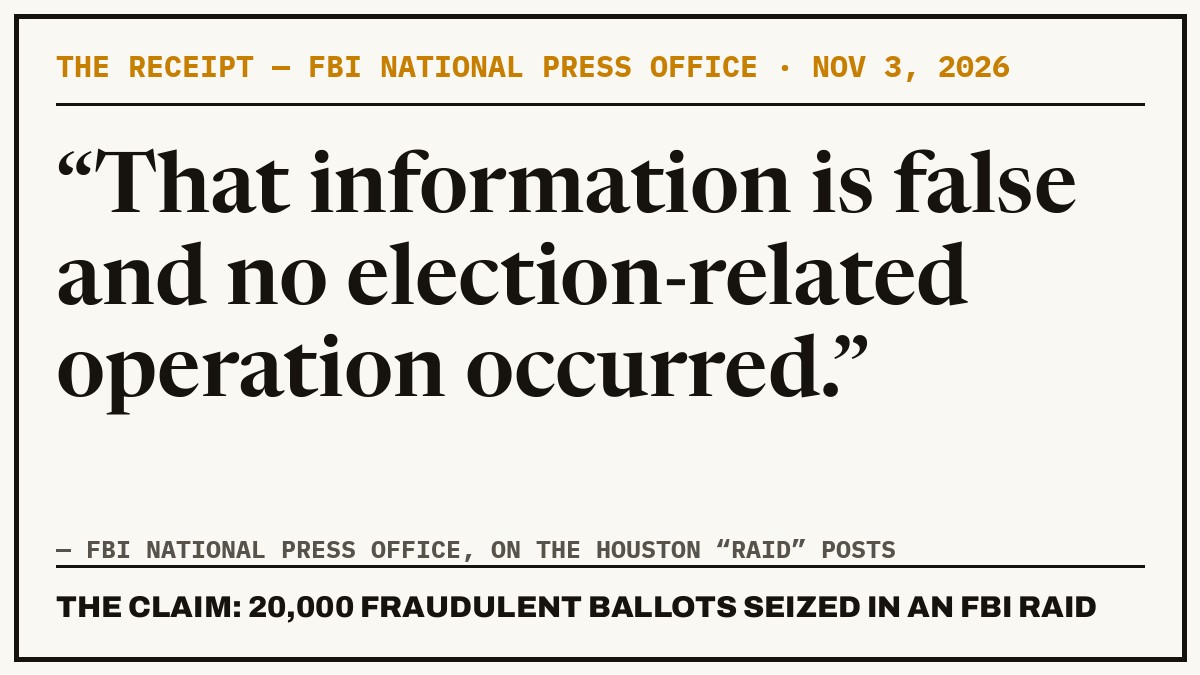
The FBI answered the same day, in writing, twice. In a statement from its National Press Office, emailed to the fact-checking site Lead Stories on November 3, the bureau addressed the posts directly: “FBI Houston is aware of social media posts claiming the office conducted an election-related 'raid' that 'uncovered fraudulent ballots' on November 2, 2026. That information is false and no election-related operation occurred.” Connor Hagan, the public affairs officer for the FBI's Houston division, gave AFP the same answer in a November 3 email: “That information is false and no election-related operation occurred.” Lead Stories also searched Google News and Yahoo News for a report of such a raid from an established news outlet, and found none.
The office that runs elections in Houston answered the same way. Rosio Torres-Segura, a spokesperson for the Harris County Clerk's Office — the office that administers voting in the county that contains Houston — told Snopes: “The information circulating on social media is false.” The checks that followed reached the same point. PolitiFact and Factchequeado, checking the claim as it reached Spanish-speaking audiences, confirmed that no raid or ballot seizure had occurred, as the Digital Democracy Institute of the Americas recorded in its Election Day monitoring report.
The photographs do not hold up as a set, either. Lead Stories traced all three: the picture with the crime-scene tape shows a truck with “FBI Atlanta” written on its side; another shows mail-ballot envelopes bearing the return address of the City and County of San Francisco's Department of Elections; the third — the only one connected to Houston — is a storage company's own listing photograph, from the Public Storage website, for a facility at 9710 Plainfield Road. And the account that published the dispatch lists its own Facebook page under the category “comedian”; Lead Stories notes it has previously debunked several fabricated news stories that originated from the same page. None of that labelling travels with the post as it is shared.
Which leaves the number, and the number is the tell, because twenty thousand ballots genuinely were in dispute on the day the post appeared — in California, in court. On October 15, the Justice Department sued the state (United States v. California), demanding that California set aside the mail ballots of more than twenty thousand registered voters the department said were likely noncitizens, drawn from a list it had delivered to Los Angeles County. The department's figure is an allegation, not a finding, and the list behind it is contested: an analysis by UCLA's Voting Rights Project found the list carried 20,930 names, of which 8,880 — about 42 percent — did not match anyone in California's voter file. U.S. District Judge David O. Carter refused to order the ballots segregated on October 28, writing that the demand “would wreak havoc and disrupt the election that is already underway, create a chilling effect on election workers and voters alike, and discount the votes of United States citizens,” and questioning the reliability of the methodology behind the list. A divided Ninth Circuit panel refused again on October 30: “We decline the United States' invitation to contravene the Elections Clause by undermining the Constitution's plain text.” On Monday, November 2, Solicitor General D. John Sauer took the demand to the Supreme Court, and the Court disposed of it the same day in a single unsigned sentence: “The application for injunction pending appeal presented to Justice Kagan and by her referred to the Court is denied.” No reasons were given and no dissents were noted. The order settled only the emergency request; the underlying lawsuit continues, with a further hearing set for November 13, and the California ballots were counted under the state's normal procedures.
Set the two side by side and the construction shows. In the California case: real ballots, cast by registered voters whose eligibility the Justice Department questions and no court has adjudicated; a number the department itself put at “more than 20,000”; a demand — refused by a district judge, refused by an appeals court, refused by the Supreme Court the day before the election — to hold those ballots aside uncounted. In the Houston post: the same number and the same bureau, transplanted to a Texas warehouse and converted — ballots a court was asked to set aside became fraudulent ballots already seized, “all for Democrats,” in a raid the bureau says never happened. What is documented is everything except the raid: the post, the bureau's denial in writing, the county clerk's denial, the photographs' real origins, and a week of California court filings ending in one sentence from the Supreme Court. The receipts are below. Read the receipts. Decide for yourself.
Think we got this one wrong?
Good. That's the job — yours and ours. Bring your own receipts, and if you're right, the correction runs on this story, in the open, with credit.
Challenge this story