Hungary put 60,000 secret-police names online. The archive says a name is not a verdict.
The launch coverage calls it an informer list. What actually went online at nyitottaktak.hu is a secret police's registry paperwork — cards, journals and a tape-era dataset in one undifferentiated pool, where the difference between an officer, an informer, a person approached and a person who refused sits inside the record, in a two-digit code. The files that would show the circumstances arrive by February.
By SmokeScreen Desk · Nov 4, 2026
🎧 Listen to this article
At 9:30 on Wednesday morning, at the Budapest headquarters of the Historical Archives of the State Security Services — the ÁBTL — Prime Minister Péter Magyar and Minister Zoltán Tarr switched on nyitottaktak.hu, and Hungary's communist-era security registry went public: free to anyone, no registration, no reading room, no application. Magyar, whose Tisza party ended Viktor Orbán's sixteen years in power at April's election on a promise of regime change, framed it as that promise kept, thirty-six years late: “We are implementing now, after 36 years … what was the promise of the change of regime,” he told the briefing, putting the number of names now public at some 60,000. The date was chosen. November 4 is the anniversary of the Soviet intervention that crushed the 1956 uprising.
The 60,000 is not one list. It is the overlap of three surviving registries, counted by their carriers: roughly 25,000 No. 6 registry cards, roughly 25,000 names in the B-journals, and about 55,000 records in the “H” network dataset recovered from magnetic tapes the service kept in the 1970s — with the same person potentially appearing in all three. Against that, the archive's director general, Gergő Bendegúz Cseh, estimates that across the Rákosi and Kádár eras some 150,000 to 160,000 network persons may have operated, with data surviving for roughly 60,000. What went online is what survived: files were destroyed in 1956, and again in 1988–89. The archive's homepage says so in plain language — these registries “never were and never will be complete,” and everything from them that did reach the archive is published in full.
The three record types are paperwork, and they differ. The No. 6 card is the registry card opened on a network person — identity details on the front, the essentials of the engagement on the back; the site explains it field by field. It records that the service registered someone. It does not record whether they reported, what they reported, or on whom. The B-journals, of which five survive from 1956 to 1962, are narrower than the wire shorthand “recruitment registers”: per the site's own explainer, they are the filing registers used when the dossiers of excluded or dormant network persons were archived — beside a name they can carry the reason for the exclusion, and sometimes a note that the dossier itself was later destroyed. The H dataset is the tape-era index, published under the law as non-classified descriptive data only. The records that would show circumstances — the roughly 9,000 recruitment dossiers, the B-dossziék, with their background studies and signed undertakings — are not in this launch. Under the law they are being uploaded continuously, anonymised where they touch people who were not agents, handlers, professional staff or public figures, with a final deadline of February 25, 2027.
None of that structure is visible where it matters most: in the search results. The “network person” search takes a name, a birth-year range, a birthplace, a mother's name, a cover name, an opening number or a B-dossier number, with a filter by record type; a query drawn too broadly is refused with a “too many results” message until it is refined. The results table gives a name, a birth date, a mother's name, a cover name, a birthplace — and the record type. That is all. There is no column that says officer, recruited agent, candidate approached, or target. The distinction exists only inside the record: the data sheet shows the registry engagement code as a two-digit number with its meaning spelled out — one published example reads “07 – excluded network person” — and the site's glossary decodes the registry codes for anyone who goes looking. A card opened on a failed recruitment — the service tried, the person refused — carries no flag, no filter and no banner at the level where a neighbour, an employer or a journalist will actually search. The field-level picture in this section is drawn from AKTUM's hands-on walkthrough of the live interface and the archive's official FAQ; this desk did not run a name search.
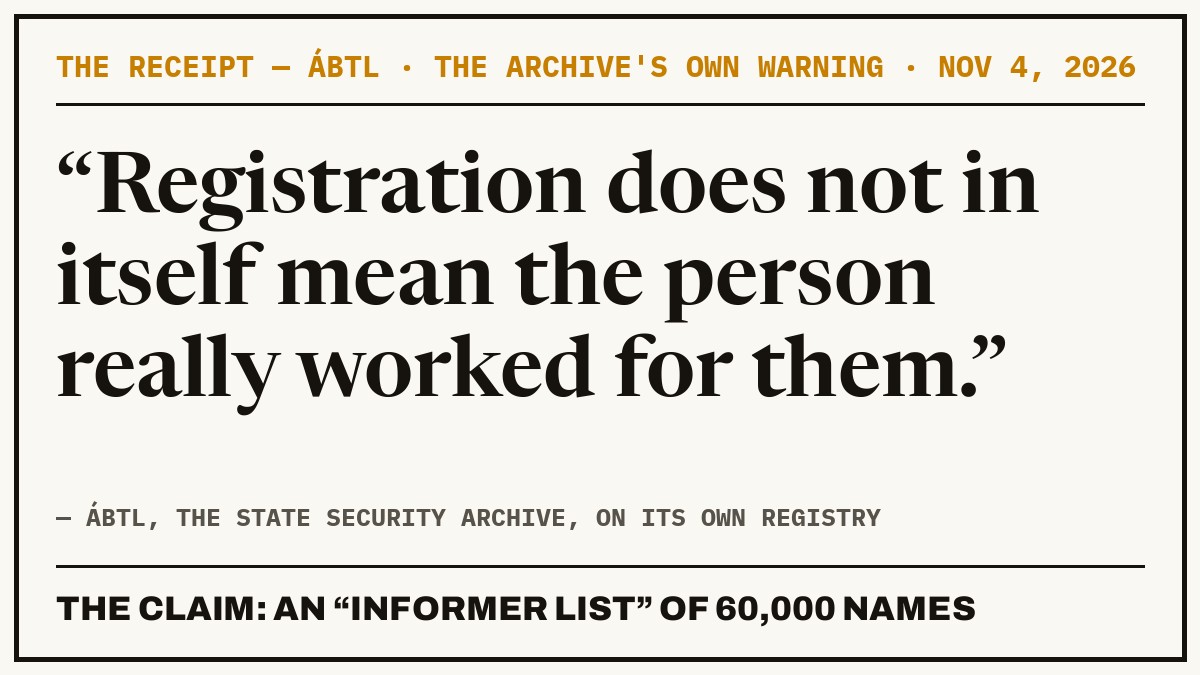
The archive knows the risk, and the safeguard it ships is textual. Its warning, carried in its official material, deserves quoting at length because it is the most important sentence attached to this database: registration “does not in itself mean the person really worked for them.” Even proving a record is genuine takes a step most readers will never take. Downloaded documents carry a visible watermark, but the official FAQ states the visible signature or stamp image is not itself proof of authenticity — it is easily copied. The authentication is the PDF's embedded electronic signature and timestamp, verifiable through a government service or a signature-capable reader. A screenshot of a card circulating on social media therefore proves nothing, even about itself; the verifiable original lives only on the official site.
The legal frame is Act LI of 2026, adopted on September 15 by 149 votes to none with 35 abstentions, published in Magyar Közlöny 2026, no. 135; a second act, Act LX of 2026, moved the launch from October to November 4. Section 14 fixes the online set — the reports files, the M-dossziék, are not in it — and for the tape dataset the act mandates publication of the non-classified descriptive data only. Classified material goes through a declassification review in which, under the narrowed criteria reported by Bloomberg when the bill was debated, harm to relations with the European Union, the European Economic Area or NATO is now the only external-relations ground for keeping secrecy — Russia was explicitly removed as a ground. An advisory committee of 13 members is involved, and the final decision, as a November 4 analysis by Revans noted, does not sit fully in independent civil hands. The act does build in one remedy for a name read wrongly: under section 9(7), a person named may attach a supplementary statement to their record, which the archive files with it and, where the record is published, publishes alongside it, page for page — the original document unchanged. Who may file such a statement on behalf of a deceased relative, and by when, is not clear from the act, as AKTUM's legal reading flags.
The archive's own people have been careful in a way the launch headlines mostly were not. Cseh has said repeatedly, including on launch day, that the files' contents are “not necessarily true in every case and certainly very incomplete” — the paperwork of a dictatorship's police, written by officers with institutional reasons of their own. Most of the names, he said on Wednesday, are “kisemberek” — ordinary people, caretakers and drivers among them. The archive's access-request backlog already runs seven to eight months and is expected to grow. A name in this database establishes exactly one thing: that the state security services opened registry paperwork on a person. Everything beyond that — agreement, cooperation, harm — lives in documents that, for the great majority of names, either no longer exist or arrive by February.
The coverage split along precisely the line the documents draw. Reuters' launch-day report ran under an “informer files” headline, but its body was careful: “names linked to the former state security services,” collaborators drawn “often via blackmail, threats or rewards.” Agence France-Presse carried the 50,000–60,000 estimate with the incompleteness attached. The Guardian's pre-launch account, published November 2, flattened the distinction in its headline layer — “'Traitors in every family': Hungary to unmask communist-era informants.” Rapporteur, on launch day, printed the sentence the registries themselves support: the records “primarily establish registration not actual collaboration,” and a No. 6 card records recruitment details “without necessarily revealing whether someone cooperated, resisted or ever submitted reports.”
The flattening was demonstrated before the site even opened, at the highest level, and it is worth printing in full because both halves are documented. On November 3, Miklós Németh — Hungary's last communist prime minister — said that in March 1990 his defence minister had shown him three handwritten intelligence reports bearing Viktor Orbán's name and signature, containing observations about fellow soldiers from Orbán's compulsory military service in the early 1980s. Németh said he believed he recognised the handwriting, could not verify the documents' authenticity, and returned the originals without making copies; the account surfaces in investigative journalist Szabolcs Panyi's forthcoming book. Orbán answered the same day on Facebook, publishing secret-service documents from 1982 and the late 1980s: “During the early part of my military service, they attempted to recruit me, but I refused, so the attempt proved unsuccessful,” he wrote. “Later, I, my wife, and my fellow opposition members were kept under constant surveillance. We were all targets of the state party's secret investigations.” Historian Krisztián Ungváry — no ally of Orbán's governments — publicly cautioned that appearing in military counter-intelligence records does not in itself prove recruitment or cooperation. An allegation, a documented refusal, and a historian's warning, all attached to one name in the records: that is the whole argument of this story, played out in public a day before the database opened.
The inventory, then. Published: a dictatorship's registry paperwork — cards, exclusion journals and a tape index — covering some 60,000 names, incomplete by the archive's own account, and labelled at the point of search with nothing that separates an officer from a man who said no. Not published in this launch: the recruitment dossiers that show circumstances, arriving by February 25, 2027; the reports files, not at all under this act. Supplied by the archive itself, in writing, in advance: the warning that none of it is a verdict. The receipts are below. Read the receipts. Decide for yourself.
Think we got this one wrong?
Good. That's the job — yours and ours. Bring your own receipts, and if you're right, the correction runs on this story, in the open, with credit.
Challenge this story