Westchester counts the bagged ballots under a consent decree. The man who lost on them conceded first.
The fraud posts moved within hours of the scanner failure on Election Day: massive fraud nationwide, Democrats cheating, voters turned away, 250,000 ballots. The paper trail that formed overnight reads differently — a court-ordered consent decree, a police-escorted move to Ardsley, an 11 a.m. count under the commissioners’ oversight, and a Republican incumbent who told voters there were “no shenanigans” before conceding a race the Associated Press still had not called.
By SmokeScreen Desk · Nov 4, 2026
🎧 Listen to this article
By Wednesday morning, the ballots that spent Election Day in orange emergency bags had a paper trail of their own. In a statement issued late Tuesday night, the Westchester County Board of Elections laid out what happened to them after the polls closed at 9 p.m.: the ballots were secured and transported under police supervision from polling locations across the county to the board's facility in Ardsley, where they would remain under continuous police protection until counting began. The handling follows a consent decree ordered by New York State Supreme Court Justice Paul Marx. Every ballot cast, the board said, "has been secured and remains under bipartisan control to ensure its integrity throughout the process." Counting was scheduled to begin at 11:00 a.m. Wednesday, "under the direction and oversight of the Board of Elections Commissioners." Its message to voters: "Every lawful vote will be counted."
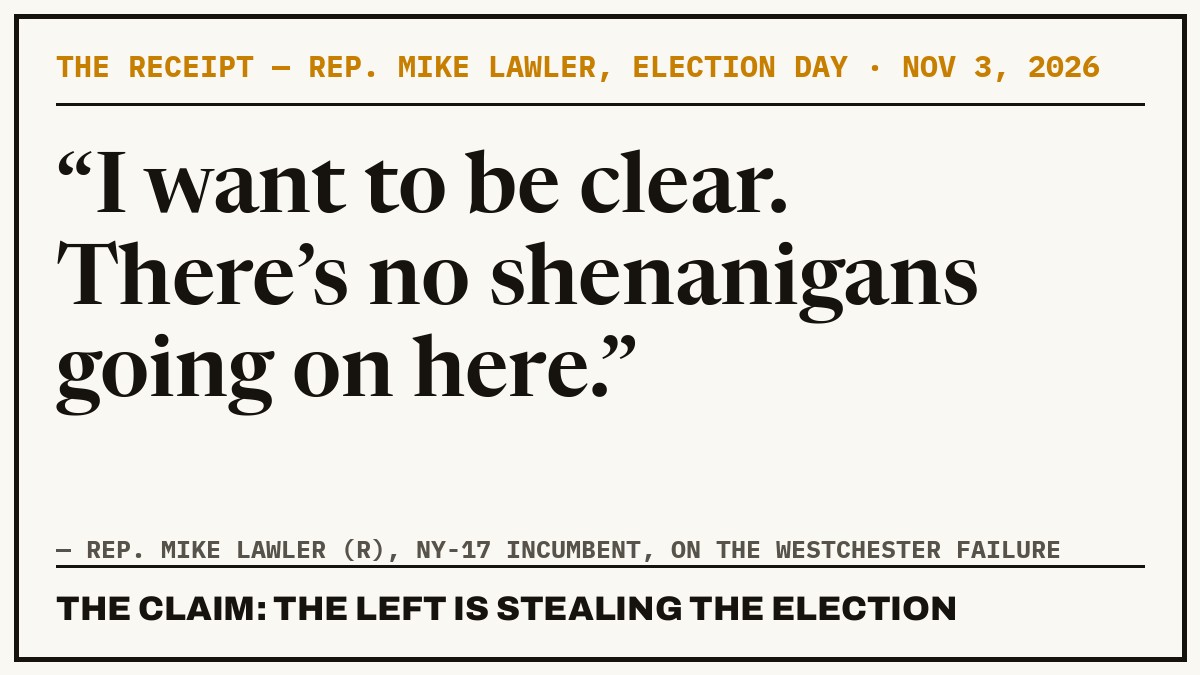
The count proceeds in the shadow of a race its own loser has already settled. The Associated Press had not called New York's 17th Congressional District as of Wednesday morning: with about 61 percent of the expected vote counted, Democrat Cait Conley led Republican Rep. Mike Lawler, 133,219 votes to 121,881. Lawler conceded late Tuesday anyway. "When all of the votes are counted tomorrow in Westchester," he said, "it's going to be pretty clear that we will be short." And on the failure itself, at an Election Day news conference, the incumbent whose seat was most exposed to the uncounted bags said this: "I want to be clear. There's no shenanigans going on here."
The theft framing had a full day's head start on that record. At 9:02 a.m. on Election Day — three hours after Westchester's scanners began refusing ballots, before any cause had been established anywhere — Joey Mannarino posted on X: "MASSIVE AMOUNTS OF VOTER FRAUD BEING REPORTED ALL OVER THE COUNTRY!" The post offered no evidence, no data and no sources. Rep. Claudia Tenney, responding to a report of the Westchester malfunction, wrote: "No surprise. The Democrats in NY will do anything and everything to cheat." Katie Miller wrote that the Westchester problems showed "how the Left steals elections," and claimed voters were being turned away. No official account of Election Day in Westchester reports voters being turned away; the county's instruction, repeated all day, was the opposite — stay, fill out the ballot, and it would be bagged, secured and counted.
What the claims did not mention is how the ballots' custody was arranged: in the open, by agreement, under a judge. Lawler told voters on Election Day that the two campaigns had agreed on a procedure for counting the emergency ballots, to be submitted to a judge that afternoon; the consent decree followed. The Associated Press described the overnight move: bags transported under police escort to be scanned and counted "under the supervision of representatives of political parties." The county board's statement adds the standing police protection in Ardsley and the commissioners' oversight of the count. None of that makes the underlying failure acceptable — County Executive Ken Jenkins called it "unacceptable" and has promised a bipartisan review — but it is the documented shape of the count the fraud posts described as a theft in progress.
Then there is the number. On Election Day, Jenkins put the ballots caught up in the failure at the affected locations — 332 polling places — at as high as 250,000. That is an exposure figure: every ballot cast where a scanner had failed, in a county where working machines were restored location by location through the afternoon. In the retelling it changed meaning. ZeroHedge's headline read "'Technical Glitch' Impacts 250,000 Ballots"; another account upgraded the sourcing itself, reporting that "officials estimated the problem affected as many as 250,000 ballots." Exposure had become impact, and impact travels as votes in doubt. The harder number on the record is smaller: Commissioner Douglas Colety put the ballots that could not be scanned right away — the ones actually placed in emergency bags — at more than 57,000. The county has published no final total of the bagged ballots; the first one will come out of the count itself.
The cause, on the record from Tuesday, is unchanged: the New York State Board of Elections says a contest change in the village of Ardsley required updated election programming that reached the early-voting machines and Ardsley's own machines but not the county's other Election Day machines, which "could not recognize and accept the ballots"; the scanners, the state board said, "rejected ballots they could not properly recognize rather than incorrectly tabulating them." The county board's first explanation — ballot "thickness" — was withdrawn twenty-one minutes after it was issued. No official statement alleges that anyone intended any of it.
What remains open is narrow and checkable: the final count of the bagged ballots, the Associated Press's call in the 17th District, and where the promised bipartisan review lands the fault — the county board, or the ballot printer, Fort Orange Press. The fraud claims made their case in capital letters on Tuesday morning. The count is making its case in documents: a consent decree, a police escort, a bipartisan table, and a concession from the man with the most to lose. The receipts are below. Read the receipts. Decide for yourself.
Think we got this one wrong?
Good. That's the job — yours and ours. Bring your own receipts, and if you're right, the correction runs on this story, in the open, with credit.
Challenge this story