“The war is over,” the post announced. Neither government has announced a settlement.
The post carried two flags, a siren and a White House video: President Trump “has just announced” that the United States and Iran “have reached a SETTLEMENT” — “THE WAR IS OVER!” As of this evening, neither government has announced any such thing. The Secretary of State's most recent word on the talks, on Saturday, was that they “have actually never stopped.” Tehran says its seven conditions for reopening the Strait of Hormuz are unmet, and calls Washington's latest reply “not convincing.” And the video under the announcement is from June 11 — footage from the first run of this script, when an agreement was announced in June, and later collapsed.
By SmokeScreen Desk · Toronto
Published Nov 4, 2026 · 5:45 p.m. ET
🎧 Listen to this article
The post went up at 11:52 a.m. Eastern on Wednesday, November 4, 2026, on the Veiled Leaks account (@veiledleaks) on X. Its text, in full: “🚨BOMBSHELL ANNOUNCEMENT: 🇮🇷🇺🇸 President Trump has just announced that the United States and Iran have reached a SETTLEMENT. THE WAR IS OVER!🔥👏” Under the text runs a video of President Trump at a White House signing ceremony, framed by a White House stream banner. When this desk captured the post, at 5:29 p.m., it had been viewed more than 84,000 times and was still climbing.
As of 5:45 p.m. ET on November 4, 2026, nothing in the public record matches the announcement. Neither the United States nor Iran has announced a settlement today. No settlement text has been published. No signing has taken place, and none is scheduled in any statement from either government, from the White House, or from the mediators. The video is not from today, either: the identical claim, carrying the identical video, was fact-checked on November 2, and a reverse image search of its key frames dates the footage to June 11, 2026 — when Trump said a signing could come within days. What the record holds instead of an announcement is a negotiation that both sides describe as unfinished.
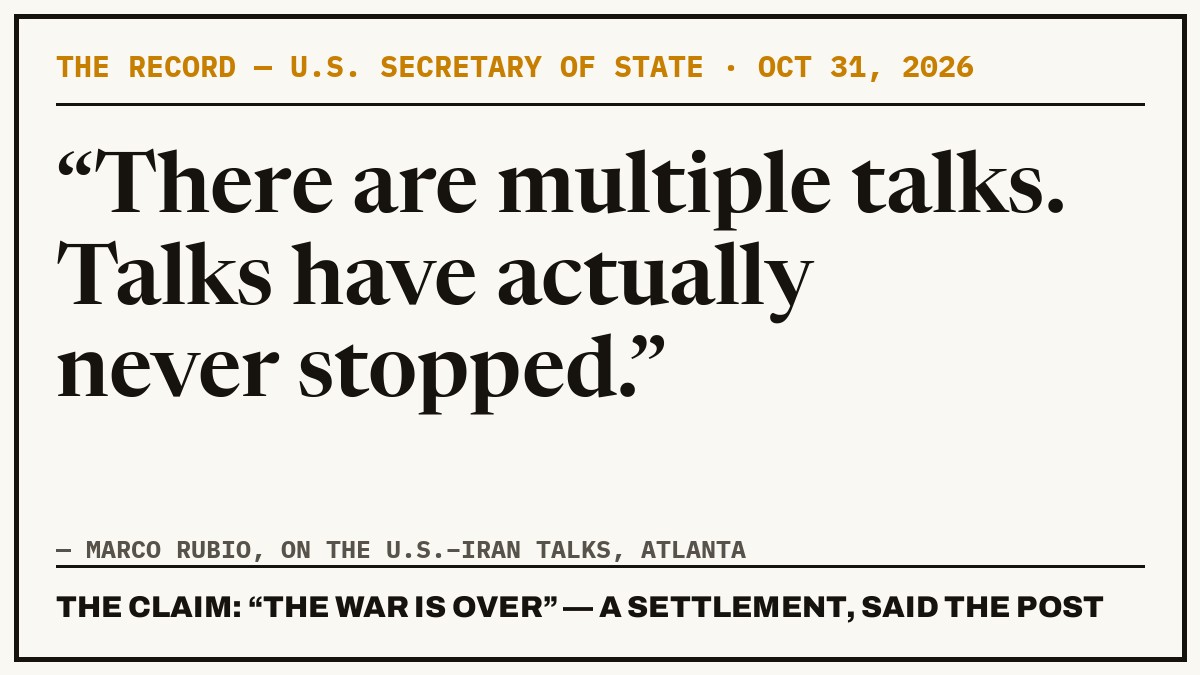
Washington's most recent on-record description of the talks came on Saturday, October 31, in Atlanta, at a G20 foreign ministers' meeting. “There are multiple talks. Talks have actually never stopped,” Secretary of State Marco Rubio said, describing contacts with Iran held in some cases directly and often through intermediaries. He declined to set a timeframe for the talks. He said the president had not decided whether to launch new strikes against Iran, and that Trump would “prefer to solve it diplomatically.” By Tuesday morning, the summary of the diplomacy read: “No ceasefire agreement had been announced as of Tuesday morning.”
Tehran's public position, as its state news agency IRNA reported it on Monday, November 2, is a conditional one. Foreign Minister Abbas Araghchi said Iran had presented “a clear plan and fair conditions” for a diplomatic exit, and he tied the reopening of the Strait of Hormuz — and the full resumption of talks — to Washington's unconditional acceptance of those conditions. The conditions number seven, and they reach well beyond the strait: as set out in the November 4 reporting, they include lifting sanctions and ending the U.S. naval blockade, and Iran's proposal would reopen the waterway over two days if Washington meets them.
The week of the announcement opened with fire, not signatures. President Trump has confirmed that U.S. forces struck an Iranian anti-aircraft facility — Iranian media placed the target on Qeshm Island, near the strait — and, speaking to Fox News, he described the strike as a “minor attack” and said it “wasn't war.” U.S. officials, speaking to U.S. media, described the action as defensive, following Iranian fire at an American aircraft, and said Central Command had prepared options for further strikes that could allow attacks as early as Wednesday, November 4. Iran's security chief, Mohsen Rezaei, said Washington's response to Tehran's conditions was “not convincing.” Deputy Foreign Minister Kazem Gharibabadi states Iran's position without qualification: Iran remained in a state of war, he said, and retained the right to defend itself. The channel, at least, is open: Qatar's foreign ministry spokesperson, Majed al-Ansari, said Qatar is facilitating “a real-time exchange of proposals,” and that both sides remained committed to negotiations.
The announcement is familiar because it has been made before — in earnest, in June. Then, it was Pakistan that announced the news: the United States and Iran had reached an initial agreement to end their war and open the Strait of Hormuz, and a signing would occur on Friday in Switzerland. “Congratulations to all!” Trump wrote on social media, adding: “I hereby fully authorize the toll free opening of the Strait of Hormuz, and, simultaneously herewith, authorize the immediate removal of the United States Naval blockade.” Iran's deputy foreign minister — the same Gharibabadi — confirmed the agreement on state television, and said Iran would not start implementing it until it was signed on Friday. The interim agreement reached in June later collapsed amid renewed military action and disagreements over the Strait of Hormuz. The timeline around it: the war began on February 28, 2026, when the United States and Israel launched strikes on Iran; a ceasefire was reached on April 7; and on October 8, Trump said the United States would not attack Iran before the November 3 midterms — a statement of American intent with an election date on it, which expired yesterday. It was not, on its own, a settlement, and the reporting of the time said so.
The words ran once more in between. Reports of an October 21, 2026 exchange at the White House carried a sentence nearly identical to today's post: “We just made a great settlement of the war with Iran. The war is over.” The same reports recorded that the U.S. naval blockade of the strait would remain in place until a formal agreement was completed. No formal agreement has been published since — not in June's wake, not in October's, and not today.
None of this establishes that a settlement cannot come. It establishes what the record holds on the evening the post declared one: talks that, in the Secretary of State's words, have never stopped; seven conditions Tehran says are unmet; a strike the president confirms and minimizes in the same breath; and a video from June. What would settle the question is the ordinary furniture of an actual agreement — a text, published; a signing, held; matching statements from both governments. If a settlement is announced, this story will be updated, and the update will be noted on our Corrections & updates page. Until then, the receipts are below. Read the receipts. Decide for yourself.
Think we got this one wrong?
Good. That's the job — yours and ours. Bring your own receipts, and if you're right, the correction runs on this story, in the open, with credit.
Challenge this story