Google Documents an AI Exploit Pipeline That Runs Without a Human in the Loop
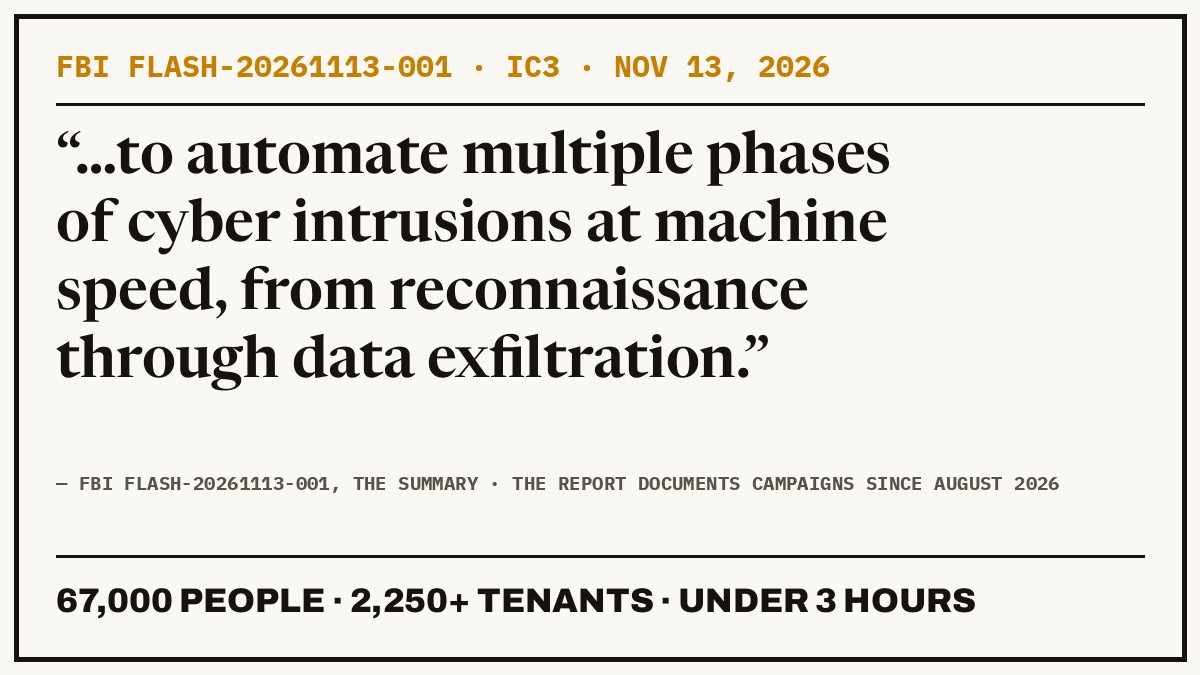
In its AI Threat Tracker update of November 16, 2026, Google’s Threat Intelligence Group and Mandiant report the first observed framework built to run the whole chain — study a new patch, find the flaw it fixed, draft an exploit and execute it — with no human in the loop. The same update documents the agentic frameworks ARTEX, CAIRN and PentAGI in live intrusions, and a companion report records intrusions reaching deep system access in as little as 15 minutes. Who is running the pipeline, the report does not say.
By SmokeScreen Desk · Toronto
Published Nov 16, 2026
🎧 Listen to this article
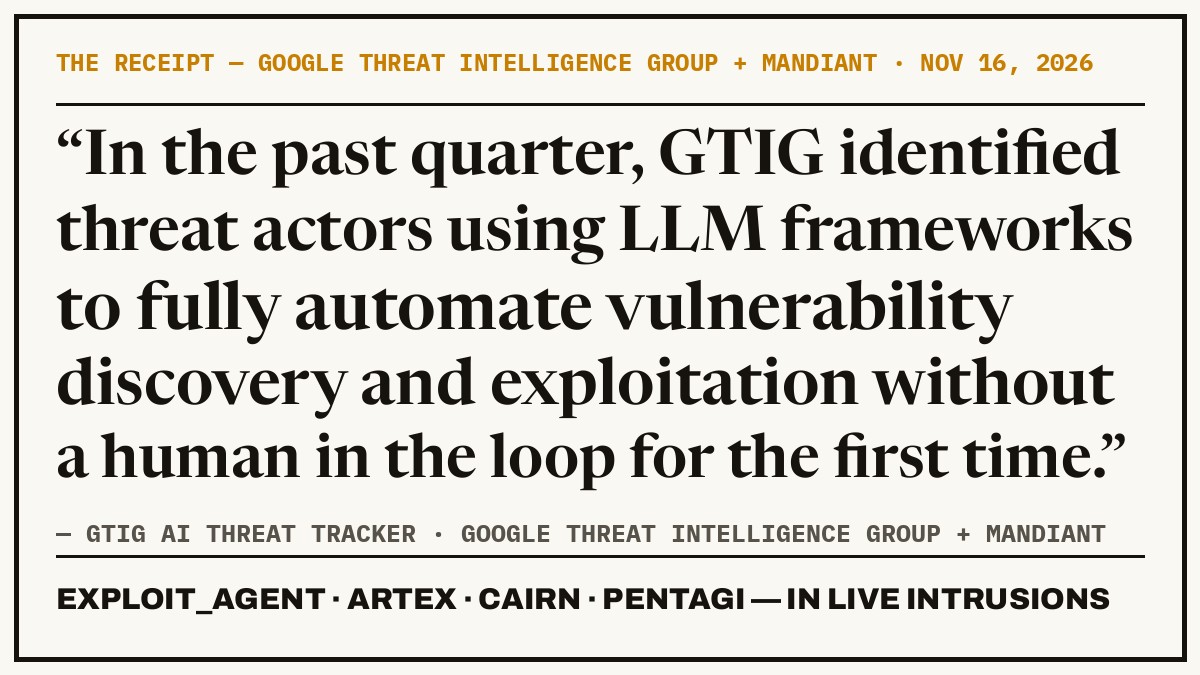
On November 16, 2026, Google Threat Intelligence Group (GTIG) and Mandiant published “GTIG AI Threat Tracker: Agentic Threat Activity Crosses a Significant Threshold,” the latest update in GTIG’s quarterly tracking of adversarial AI use. It is written by Aurora Blum, Kelli Vanderlee, Jess Xia and David Mainor, and it states what it is built on: “telemetry from frontline Mandiant incident response engagements, global threat actor tracking, and live platform defenses.” Its headline finding is a first. “In the past quarter,” the report states, “GTIG identified threat actors using LLM frameworks to fully automate vulnerability discovery and exploitation without a human in the loop for the first time.”
That sentence is the step-change, and the report marks it against its own record. Its previous report, published in September 2026, had documented “nascent efforts” — partially automated vulnerability scanning and exploitation sequences, with a human still directing the work. This update describes the human removed from the chain: a framework that studies software, finds the flaws and runs the attacks end to end.
The case at the centre of the report is a framework GTIG calls exploit_agent, found hosted on an exposed staging server. The report describes it as a “multi-agent vulnerability research and weaponization framework” that “integrates with multiple frontier and local LLMs” and “is set up to conduct continuous differential analysis of popular web application software. It compares code before and after patch announcements, analyzes findings to identify potential vulnerabilities, drafts exploits, and automatically executes them without human intervention.” Alongside the pipeline, investigators found scripts for what comes after a break-in, “including internal reconnaissance, brute-forcing, installing webshells, and removing other attackers’ webshells.”
What the server held, beyond the tooling, was victim telemetry. “Victim telemetry on the server suggests the operator was specifically interested in targeting French websites associated with the media and entertainment industries, as well as the education sector,” the report says. The framework’s configuration files carry comments in Russian, which the report prints alongside translations — including one that reads, in its translation: “LLM API keys for auto-exploitation (exploit_agent pilot). Enter the keys yourself — right here, not in the chat. Both lines are required.” The report draws no conclusion from the language about who the operator is, and it names no group behind exploit_agent.
The method is aimed at a known weakness in how software gets fixed. When a vendor ships a patch, the patch itself shows where the flaw was. The report explains the economics: an attacker working from “a finite set of source materials” — comparing source code versions, examining release notes, security research and proof-of-concept code — can move faster than one hunting unknown zero-day flaws, so threat actors “can dramatically reduce the window between patch disclosure and weaponized exploitation.” The same passage carries the report’s own caveat about noise: the lower barrier “has fueled a wave of LLM-generated exploits that are claimed to work but don’t, creating additional verification work for defenders.”
GTIG’s September 2026 analysis of vulnerability statistics, cited in the update, found that overall disclosures and exploits “nearly doubled between January and August 2026,” while zero-day exploits “rose only marginally from a 2025 average of 8 per month to 11 per month in 2026—before spiking to 22 in the month of August.”
The update offers one public corroboration of the compressed timeline. In late August 2026, attackers exploited two vulnerabilities in PaperCut print management servers as zero-days that, chained together, allowed unauthenticated remote code execution. Using LLMs, security researchers and the cybersecurity company Huntress generated working exploits “within a day of disclosure.” GreyNoise then reported a campaign four days after the initial disclosure “in which a threat actor likely used LLMs to build and test exploits for these vulnerabilities, assemble a target list, and execute a widespread exploitation campaign against hundreds of organizations.” The “likely” is the report’s word, and it stands as the report wrote it.
The second half of the update inventories the agentic frameworks now documented inside live intrusions. GTIG says it has “independently observed open source tools CAIRN and PentAGI deployed in the wild, and has seen experimentation with CyberStrikeAI and HexStrike AI.” CAIRN — a multi-agent framework that works through an observe, orient, decide, act loop — was “used in intrusion activity against targets including in the aerospace sector in the US.” Between late August and early October 2026, GTIG tracked a threat actor running “a customized attack orchestration platform built off of the open source version of PentAGI” against “a wide range of organizations in Asia.” ARTEX — the open-source framework the FBI documented in its FLASH report of November 13, 2026 — appears throughout, and the report notes that several actors, including “suspected espionage threat actors with a PRC nexus,” are experimenting with the frameworks, and that one PRC-nexus group “was developing its own automated attack framework for likely use in cyber espionage operations.” SmokeScreen’s story on the FBI’s ARTEX report is in the receipts below.
A companion GTIG and Mandiant report published the same day goes deeper on the frameworks inside incident-response engagements. It records ARTEX execution sequences running “in compressed bursts of roughly 2 to 25 seconds” — in one operation, “27 events in 23 seconds of active burst time” — and an intrusion moving from “their first compromised account to deep system access in around four hours and in one case as rapidly as 15 minutes.”
Two things the report does not contain are worth naming. It attributes exploit_agent to no group and no state, and it gives no success rate — no count of how many of the pipeline’s drafted exploits actually worked. And GTIG itself flags the trade-off these frameworks currently make: they “currently trade stealth for velocity. Unrestricted autonomous execution generates forensic traffic, relies on recognizable identifiers, and leaves behind distinct code-level traces.” Those artifacts, in the report’s assessment, increase “the likelihood of detection and mitigation,” even while the tools “remain highly capable of achieving operational objectives.”
The defensive material published alongside the reports is deliberately unglamorous. Google Security Operations has deployed specialized detection rulepacks aimed at ARTEX use, and Mandiant Consulting’s hardening guide rests on what the companion report calls “long-standing security best practices” — control-plane isolation, short-lived credentials, least privilege, segmentation and behavioral detection. The documents’ shared point is narrower than the headlines the report will generate: the automation is documented, the operator behind its most advanced example is not, and the receipts for both halves of that sentence are below.
Think we got this one wrong?
Good. That's the job — yours and ours. Bring your own receipts, and if you're right, the correction runs on this story, in the open, with credit.
Challenge this story