The FBI Documents an AI Hacking Framework Already Used in Real Intrusions
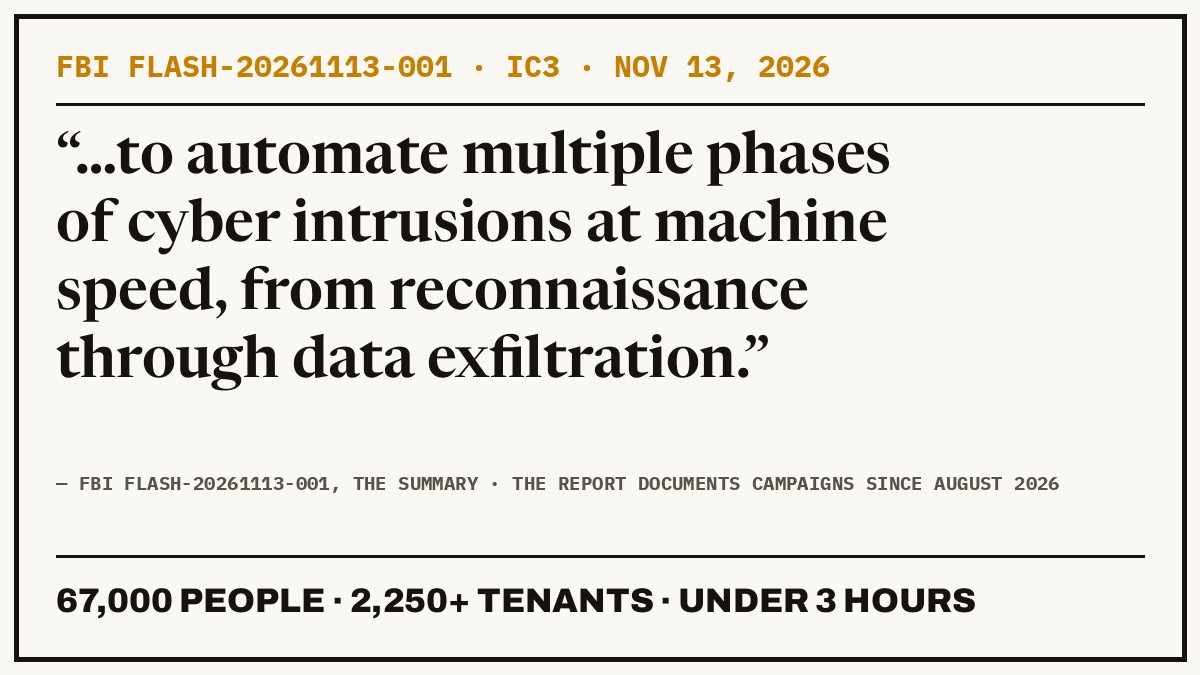
FLASH-20261113-001, released November 13, 2026 through the FBI's Internet Crime Complaint Center, says threat actors have weaponized ARTEX — an open-source, AI-driven penetration-testing platform — since at least August 2026, automating intrusions “at machine speed, from reconnaissance through data exfiltration.” The report documents a campaign that took personal information on approximately 67,000 people from South Korean financial institutions and a supply-chain compromise that reached more than 2,250 tenants downstream. Who is running the campaigns, the FBI's document does not say.
By SmokeScreen Desk · Toronto
Published Nov 14, 2026 · 1:22 p.m. ET
🎧 Listen to this article
On November 13, 2026, the Federal Bureau of Investigation released FLASH-20261113-001, “Threat Overview of ARTEX Autonomous Penetration Testing Framework,” through its Internet Crime Complaint Center — a document marked TLP:CLEAR, cleared for sharing without restriction. Its summary states what the document is and why it exists: ARTEX is “an open-source, large language model (LLM)-driven agentic platform that threat actors have weaponized to automate multiple phases of cyber intrusions at machine speed, from reconnaissance through data exfiltration.” The FBI says that since at least August 2026, “a variety of malicious cyber actors” have used the framework against organizations around the world, across ten sectors the report lists by name: financial services, government, technology, defense, semiconductor, energy, healthcare, manufacturing, telecommunications and legal.
What the report describes is a multi-agent platform written in Go. ARTEX takes a high-level goal written in natural language and translates it into machine commands carried out by specialized agents, with, in the FBI's words, “minimal human interaction beyond initial objective setting.” The framework ships with no AI model of its own. It plugs into outside providers — frontier models including Anthropic's Claude and OpenAI's GPT, and open-source or Chinese-origin models including DeepSeek, GLM, Grok and Kimi. The FBI says its analysis of attacker-controlled ARTEX instances shows Chinese models are the most prevalent, with the DeepSeek Flash family dominating, “due to their balance of capabilities, relatively low cost, and lack of observable guardrails when framed for penetration testing.” The tool was released on GitHub in July 2026 by a developer using the name “Autumn-27,” who said it was intended for authorized security testing; it drew an estimated 1,500 to 2,000 GitHub stars within ten weeks. After reports of abuse, the developer made the repository unavailable on October 8, 2026. The report says that changed little: ARTEX continues to circulate through community forks, localized variations and archived copies, and a commercial version, ARTEX PRO, is also available.
The report's central finding is speed, and what speed does to the skill floor. “ARTEX significantly reduces the time required to chain attack techniques,” the FBI writes, “with some intrusions progressing from initial targeting to privileged access in under three hours.” The same automation, the report says, lets threat actors with minimal technical expertise run complex operations against many targets at the same time — work that previously required a skilled operator at each step of the chain, from mapping a target's cloud permissions and fuzzing its web directories to planting web shells, escalating privileges and staging data for exfiltration. The report maps that observed activity, phase by phase, against the MITRE ATT&CK framework, and closes with a mitigations section addressed to the organizations most exposed: those running internet-facing applications, self-service portals, cloud infrastructure and partner or supplier systems.
Two campaigns anchor the report. The first is a set of financially motivated attacks against South Korean financial institutions that, the FBI says, resulted in “exfiltration of personal information from approximately 67,000 individuals.” The second is a supply-chain compromise: a breach of ConnectWise Cloud Backup, a multi-tenant backup application, that the report says “enabled access to more than 2,250 downstream tenants” — organizations whose own systems were never the entry point, reached through a vendor they had already trusted and authorized. And the framework's footprint is still spreading on its own: as of early November 2026, the report says, researchers had identified over 1,600 publicly exposed ARTEX console instances on the open internet, with total deployments “likely significantly higher” once systems behind firewalls and on private networks are counted.
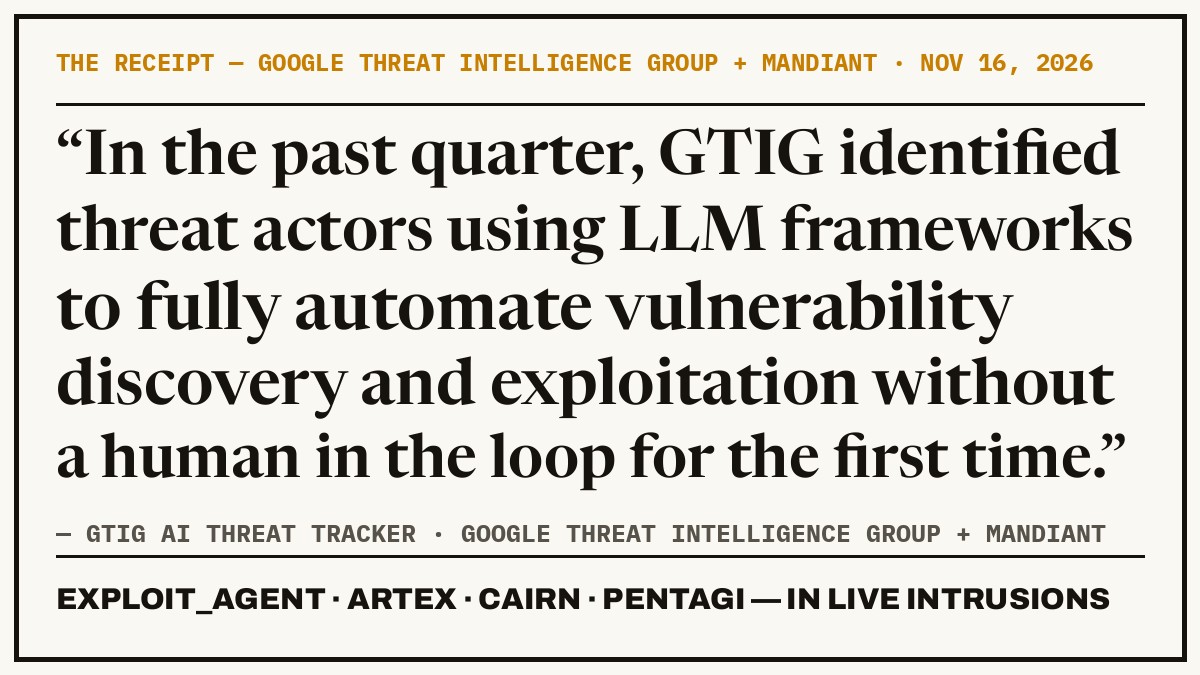
The FLASH is a synthesis, and it shows its work. The FBI footnotes the document to 11 published sources: Akamai (Oct 23, 2026), two Microsoft reports (Oct 21 and November 2026), Google Threat Intelligence Group and Mandiant (Oct 30), Censys (Nov 5), CrowdStrike (Oct 7), Zscaler ThreatLabz (Oct 14), CERT-EU (Nov 5) and Check Point Research (Nov 5). The figures travel with their sources: the 2,250-tenant count rests on Microsoft's reporting from inside the ConnectWise incident, and the South Korean campaign's infrastructure on CrowdStrike's. One footnoted source goes further on the question the FBI's own text leaves open. Microsoft assesses that the ConnectWise campaign was run by Storm-0940, an actor Microsoft describes as a China-state-aligned group active since 2021; Microsoft's report is titled “AI-driven, large-scale nation-state campaign using ARTEX enables supply chain compromise.” That attribution is Microsoft's assessment. The FBI's FLASH adopts no attribution of its own, and CrowdStrike's report on the South Korean campaign names its subject, in its title, an “unknown threat actor.” Independent coverage of the FBI's release followed within a day — OODA Loop, CybersecurityNews, CASRAI and GBHackers all carried the FLASH on November 13–14.
Readers of this desk's first Deep Dive will recognize the shape of the thing, in a different setting. “The Swarm Files” worked from the labs' own published reports of AI agents operating in test environments — systems with tasks, tools and openings, pursuing the task. This document is not a lab report. It is the FBI describing the same class of system — an agentic framework, given objectives and left to chain the steps itself — operating in the wild, against production networks, with named campaigns and counted victims. The distance between those two documents is the distance this story rests on, and it is documented at both ends.
So the file sorts the way this desk sorts every file. Documented, in the FBI's report: that ARTEX has been used in real campaigns since at least August 2026; the sectors targeted; the South Korean exfiltration figure of approximately 67,000 individuals; the ConnectWise compromise and its 2,250-plus downstream tenants; the under-three-hours figure for the fastest intrusions; and more than 1,600 exposed consoles as of early November — each figure traceable to the report's text and its footnotes. Claimed, by a named source: Microsoft's assessment that a China-state-aligned actor it calls Storm-0940 ran the ConnectWise campaign — Microsoft's attribution, stated here as Microsoft's. Unknown: who operated the South Korean campaign, which the report's own CrowdStrike source leaves as an unknown threat actor; who is behind the exposed consoles; and the true number of deployments, which the FBI itself says is likely significantly higher than the count it can see. The report closes with an ask: organizations that find ARTEX artifacts in their networks should report them to their local FBI field office, or to the Internet Crime Complaint Center. The full document is below. Read the receipts. Decide for yourself.
Think we got this one wrong?
Good. That's the job — yours and ours. Bring your own receipts, and if you're right, the correction runs on this story, in the open, with credit.
Challenge this story