Westchester blamed the paper. Then it took the word back.
Ballot scanners refused paper ballots across Westchester County from the moment polls opened on Election Day. The county Board of Elections' first statement, at 8:16 a.m., blamed the ballots' thickness; its corrected statement, twenty-one minutes later, did not. By afternoon the state board and the county executive were offering two different explanations, fraud claims had run ahead of both, and more than 57,000 ballots were sitting in orange emergency bags, waiting for the polls to close.
By SmokeScreen Desk · Nov 3, 2026
🎧 Listen to this article
The failure was visible from the first hour. Polls opened at 6 a.m. on Tuesday, November 3, and scanners at polling locations across Westchester County, New York, would not accept the paper ballots voters had just filled in. County Executive Ken Jenkins, in a video statement at about 10 a.m., put it plainly: "There is a countywide issue at all of the polling locations where the ballot is not going through the scanner." The county Board of Elections told voters to keep voting anyway: ballots that could not be processed by voting machines "will be placed in designated orange emergency ballot bags, which will remain secure and monitored. These ballots will subsequently be counted." By the county executive's later count, the failure touched 332 polling locations.
The first official explanation arrived at 8:16 a.m. In its first statement, the county Board of Elections said it was aware of "an issue involving the thickness of paper ballots" that was preventing voting machines from accepting ballots at polling locations throughout the county. At 8:37 a.m., twenty-one minutes later, it issued a corrected statement: the word thickness was gone, replaced by "an issue involving paper ballots." The thickness account travelled anyway. Rep. Mike Lawler, whose district covers much of northern Westchester, repeated it to CNN — "There was an issue with the thickness of the ballot and the formatting of the machines" — and Gov. Kathy Hochul told reporters the problem stemmed from "wrong size paper," in NBC New York's reporting. Neither paper explanation survived the day.
Into the hours when no cause had been established, the fraud claims moved first. Rasmussen Reports posted that the ballots "aren't 'too thick.' They were ordered months ago. The machine settings most likely have been adjusted to reject them." A Libs of TikTok post announced that ballot scanners were down "because the paper ballots are too thick for the machine." Both are claims, made before any official cause existed; neither offered evidence about machine settings or about the paper. What officials had established by then was narrower: the ballots were being rejected, they were being bagged under procedure, and they would be counted.
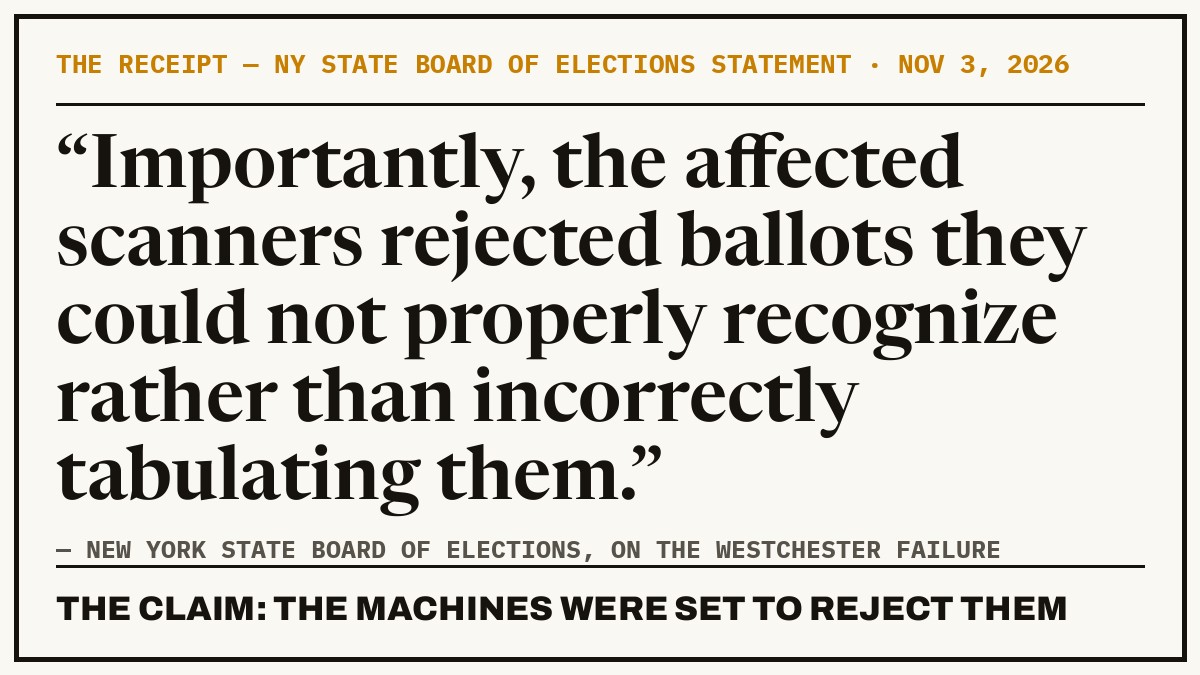
The fuller official account came from the New York State Board of Elections at 1:36 p.m., in a statement reported by lohud and CBS News. A change affecting a contest in one municipality — later identified by the county's Republican election commissioner, Douglas Colety, as the village of Ardsley — had required updated election programming after the county's Election Day equipment was prepared and tested. The updated programming was tested and deployed for early voting and for Election Day machines in that municipality. "However," the state board said, "Election Day machines elsewhere in the county continued to use the original programming and therefore could not recognize and accept the ballots being used for Election Day." The board said it had identified no problem with the ballot paper or any other physical characteristic, and it made the distinction the day turns on: "Importantly, the affected scanners rejected ballots they could not properly recognize rather than incorrectly tabulating them." Rejected, not miscounted. The fix was replacement election media carrying the updated programming, with a stated priority of at least one working scanner at every polling location; machines were brought back municipality by municipality through the afternoon.
The county executive's account, given at an afternoon news conference, points at a different link in the chain. Jenkins said the cause was an error in the barcodes printed on the preprinted Election Day ballots: "It was just a straight error in the bar coding of it," and, to WAMC, "There was some kind of glitch in that from our printer." He said the accessible machines at polling places were being reprogrammed to read the barcodes as printed, and he ruled two things out in terms: it was not a software issue, and the machines had not been hacked. The two official accounts — a programming update deployed unevenly, and a barcode printed wrongly — may yet turn out to describe one failure from different ends, but as stated on Tuesday they are not the same explanation, and no official has reconciled them. Colety said an investigation will decide whether the fault lay with the county Board of Elections or with the ballot printer, Fort Orange Press; the county board itself, later in the afternoon, described the problem as resulting from a programming update. Jenkins has promised a bipartisan review. In a written statement he called the situation "unacceptable" and said Westchester voters "deserve better."
The stakes are measurable, and so, in part, is the damage. Westchester covers roughly 30 percent of New York's 17th Congressional District, where Lawler faces Democrat Cait Conley in one of the country's most closely watched House races. Jenkins put the number of ballots caught up in the failure at the affected locations as high as 250,000. The bagged ballots are a smaller and harder number: by late afternoon, Colety put the ballots that could not be scanned right away at more than 57,000, held in secure bags, to be counted after polls closed at 9 p.m., with the count expected to run into Wednesday. A final count of the bagged ballots had not been reported while polls remained open on Tuesday evening. Attorney General Letitia James said her office was monitoring the issue and told voters: "Westchester voters can still safely fill out and turn in their ballots at their polling locations. Your votes will count." Both candidates urged voters to stay and vote, in the same terms.
What the record does not contain is any evidence of intent. No official statement alleges that anyone set machines to reject ballots; the county executive said the opposite about the machines, and the state board's account describes a deployment failure, not a tampering finding. What remains open: which link in the chain — the printing, the programming, or the handoff between them — the promised review will land on, and the final count of the ballots that spent Election Day in orange bags. The explanations officials gave, in the order they gave them, are in the receipts. The receipts are below. Read the receipts. Decide for yourself.
Think we got this one wrong?
Good. That's the job — yours and ours. Bring your own receipts, and if you're right, the correction runs on this story, in the open, with credit.
Challenge this story