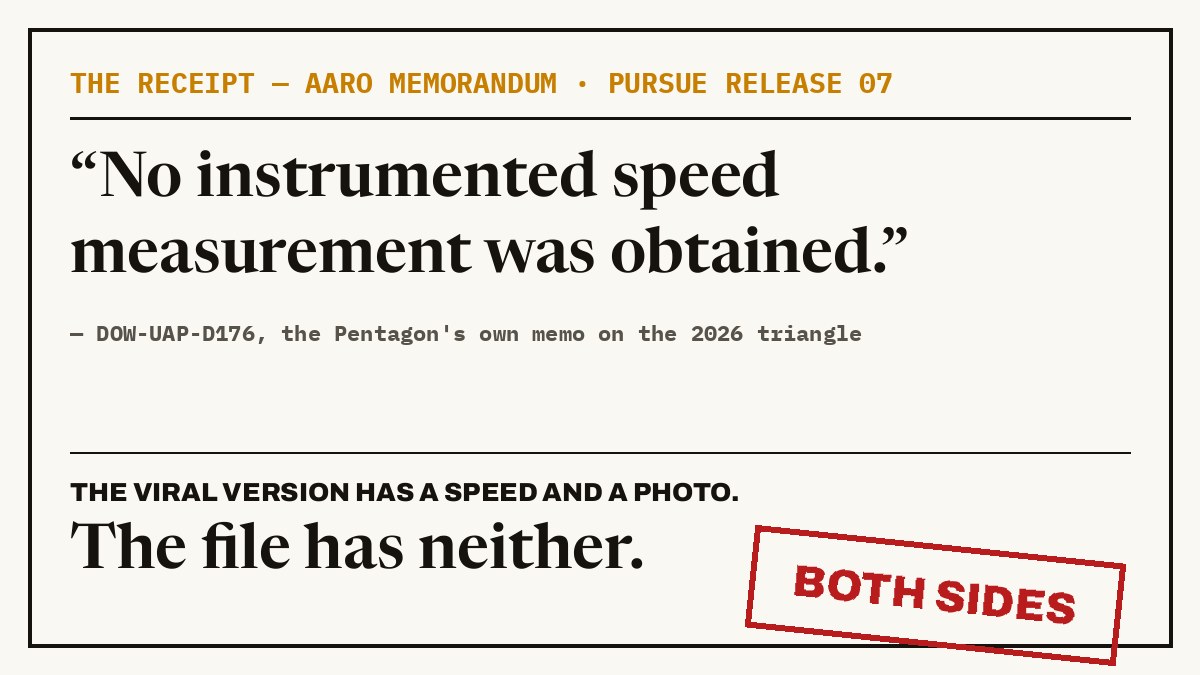
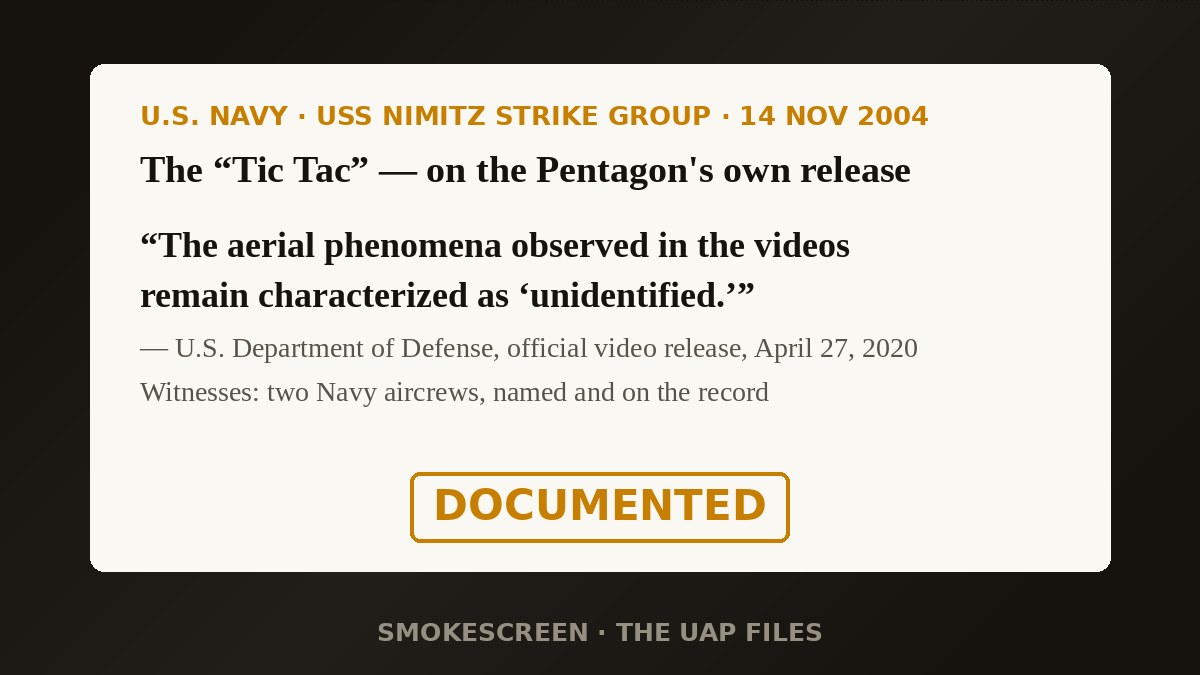
It was called a mothership, on a schedule. The telescopes published chemistry.
In the second half of 2025, Harvard astrophysicist Avi Loeb argued that the interstellar comet 3I/ATLAS might be alien technology — a “technological mothership” whose trajectory would carry it to the edge of Jupiter's gravitational domain on March 16, 2026, where it could seed the planet with devices. The date was specific, and it has passed. The comet made the pass at almost exactly the predicted distance, and no observatory reported a probe, a deployment or a signal; the radio telescopes that listened heard only interference, and Loeb himself, after the comet's closest approach to Earth, said he would agree it is “most likely natural.” What the telescopes have published through 2026 is the comet's chemistry: methane carrying the heaviest load of heavy hydrogen ever measured in the solar system, ice grains like the worlds beyond Neptune, and nitrogen that says the comet was born below 33 degrees above absolute zero — around another star.
By SmokeScreen Desk · Toronto
Published Nov 4, 2026 · 6:47 p.m. ET
🎧 Listen to this article
The object arrived on July 1, 2025, in the survey logs of the ATLAS telescope at Río Hurtado, Chile, and its orbit gave it away almost immediately: it was not orbiting the Sun at all, but passing through. Designated 3I/ATLAS — the third confirmed interstellar object, after 'Oumuamua in 2017 and 2I/Borisov in 2019 — it crossed the inner solar system on a hyperbolic path, passed closest to the Sun on October 29, 2025, and is now outbound, past the orbit of Saturn, on a trajectory it will never repeat. Estimates of its nucleus still span a wide range, from hundreds of metres to a few kilometres across. What the comet is made of, and where it was made, has been published piece by piece ever since. What it was claimed to be was published faster.
The claim arrived within weeks, in a paper. In July 2025, Harvard astrophysicist Avi Loeb, with Adam Hibberd and Adam Crowl, posted “Is the Interstellar Object 3I/ATLAS Alien Technology?” — a study that worked through the early observations and argued the possibility of an artificial object, a lightsail or a probe, should remain on the table until natural causes were ruled out. Loeb described the exercise in print as largely pedagogical. The conversation that followed was not.
The anomalies accumulated in public, in lists. The comet's retrograde path runs within about five degrees of the plane of the planets — a geometry Loeb put at less than two-tenths of one percent by chance. Its jet pointed sunward. Its gas carried nickel with little sign of iron, which Loeb noted would be consistent with industrial nickel alloys. It held very little water for a comet, polarized light the wrong way, and arrived from a direction on the sky roughly aligned with the source of the 1977 “Wow!” signal. It also accelerated, slightly, beyond what gravity alone predicts; the acceleration “might be produced by an engine,” Loeb wrote, while noting in the same body of work that the excess was not significant. On October 27, 2025, he put a number on the whole file: a 40 percent likelihood that the object is alien technology. On November 4, on Fox News, he described evidence of an “engine-driven propulsion system.”
Then the claim acquired a date. In a Medium essay on November 23, 2025, Loeb organized 13 anomalies by likelihood and ranked at the top the comet's alignment with Jupiter: the trajectory, refined by the object's non-gravitational push, would bring it to a closest approach on March 16, 2026, at a distance matching Jupiter's Hill radius — the boundary of the giant planet's gravitational domain — to within, in his phrase, one part in a thousand. A day later he set out the inference: the object could release probes — “satellites” — at that boundary, where a released device can enter Jovian orbit cheaply, seeding Jupiter with technological devices. By November 25 he was using the words “technological mothership” outright, over an amateur telescope image he described as a sharp-edged core with a blue halo.
The University of Washington's Center for an Informed Public counted what the claim did online. In a study published December 3, 2025, researcher Mert Can Bayar analyzed roughly 700,000 English-language posts about 3I/ATLAS on X between July 1 and November 21. Almost 280,000 of them — about 40 percent — invoked aliens or alien technology. About 130,000 mentioned Loeb himself, and more than 260,000 mentioned at least one of the anomalies his writings popularized. The study's exhibits include a fabricated video of glowing lights, labeled as the comet and corrected under a Community Note — a spaceship that existed only as a caption.
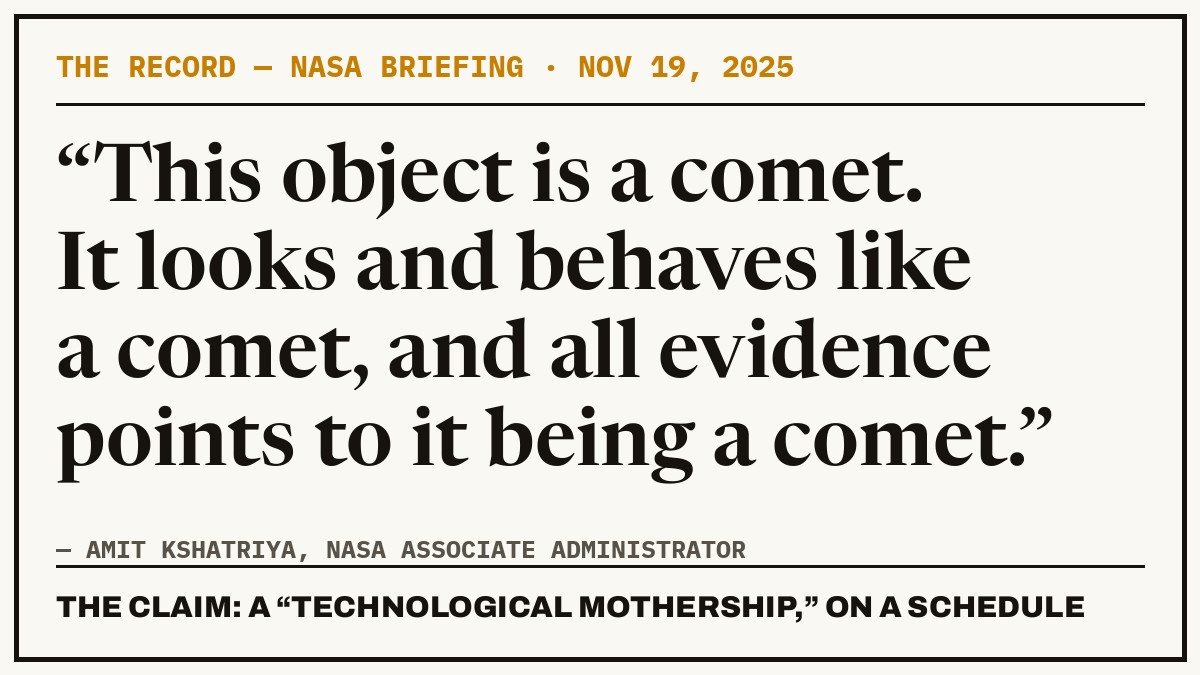
NASA's answer came on November 19, 2025, at a briefing in Greenbelt, Maryland, its release of images delayed by the 43-day federal shutdown. The agency had turned more than a dozen platforms on the comet: the Lucy spacecraft, outbound to Jupiter's Trojan asteroids, had imaged it on September 16, 2025; the Mars Reconnaissance Orbiter's HiRISE camera took the closest look on October 2, as the comet passed the Mars fleet. Associate Administrator Amit Kshatriya opened by addressing what he called the rumors: “This object is a comet. It looks and behaves like a comet, and all evidence points to it being a comet.” Tom Statler, NASA's lead scientist for solar system small bodies, added the sentence the claim had made necessary: “We certainly haven't seen any technosignatures or anything from it that would lead us to believe it was anything other than a comet.” The comet, NASA said, was probably even older than our solar system — and no danger to Earth, passing no closer than about 170 million miles.
The listening was done properly, and it is in print. On December 18, 2025, the Breakthrough Listen program pointed the 100-metre Green Bank Telescope at the comet for five hours across 1 to 12 gigahertz. The pipeline logged 471,198 candidate signals; after filtering, nine events remained; all nine were classified as interference. The team's paper, in the Research Notes of the American Astronomical Society, reports a nondetection of candidate signals down to the 100-milliwatt level. The SETI Institute's Allen Telescope Array listened for more than seven hours across 1 to 9 gigahertz; roughly 74 million narrowband hits resolved to a few hundred candidates, every one traced to transmitters on Earth or to our own satellites. Its paper, published in The Astronomical Journal in June 2026, caps any radio transmitter on or near the comet at 10 to 110 watts — on the order of a household appliance. The next day, December 19, the comet made its closest pass by Earth. Loeb had suggested it might maneuver near that pass, or send devices toward Earth from behind the Sun. It did neither. “So far, so good,” he told NewsNation afterward. “3I/ATLAS did not maneuver or display any unusual activity when it came closest to Earth.” And then the sentence that re-ranked his own file: “At this point, given all the data that we have, I would agree that it's most likely natural, but there are still a lot of things we don't understand about it.” His anomaly essays continued into 2026, and he kept the object at no higher than 4 on the scale he invented for the purpose — 0 for confirmed natural, 10 for confirmed technology.
Which left the date on the calendar: March 16, 2026. JPL's orbital solutions, refined as the observations piled up, put the comet's closest approach to Jupiter at about 53.6 million kilometres — against a Hill radius of about 53.5 million. The near-match that anchored the mothership argument survived refinement, to a fraction of a percent; the final solutions placed the pass a hundred thousand kilometres or so outside the boundary rather than inside it. And then the comet simply made the pass. It crossed Jupiter's gravitational frontier on the trajectory gravity and its own outgassing had written, and continued out of the solar system. No observatory reported a probe, a deployment, a separation, or any object leaving it. No agency announced a detection. The mothership's appointment, in the record, is an ordinary line in an ephemeris: perijove, March 16, 2026, 0.358 astronomical units — after which the visitor kept going. It is past Saturn's orbit now, moving away at more than 60 kilometres per second, and it is never coming back.
What the telescopes published instead of an anomaly is a chemistry set — and it is the part of the file where the documents confirm the extraordinary claim underneath the claim: this thing really is from somewhere else. NASA's Swift observatory caught hydroxyl, the chemical fingerprint of water vapor breaking apart in sunlight, while the comet was still nearly three times Earth's distance from the Sun. The SPHEREx telescope recorded dust, water, organic molecules and carbon dioxide in its coma in December 2025. On June 1, 2026, NASA reported that the Webb telescope had collected the first mid-infrared chemical fingerprint of an interstellar object, directly detecting methane — buried, the team concluded, beneath the comet's surface until the Sun's heat reached it — in results published in The Astrophysical Journal Letters.
Webb's near-infrared spectra, taken in August and December 2025 and again in April 2026, show the comet's ice arriving as grains of about a micron — water ice blended with dark, rocky material — in a study led by Silvia Protopapa of the Southwest Research Institute, published in The Astrophysical Journal Letters. The grains' signatures differ from those of solar-system comets but resemble the icy worlds beyond Neptune. In October 2026, a team led by Nathan Roth of American University and NASA's Goddard Space Flight Center published the methane measurement in Nature Astronomy: a deuterium-to-hydrogen ratio of about 3.2 percent in the comet's methane, some 13 times the ratio measured in comet 67P — the only other comet in which deuterated methane has been detected — and, in the authors' words, a value that “exceeds any other value for methane measured in the solar system.” Deuterium concentrates in molecules in deep cold; the paper reads the ratio as the signature of ices formed in an intensely cold environment with relatively few heavy elements. The nitrogen says the same in a different instrument: from the William Herschel Telescope on La Palma, Lea Ferellec of Northumbria University and her colleagues measured the comet's plasma tail and found it unusually rich in nitrogen — a ratio that holds only if the ice formed below about 33 degrees above absolute zero. Galactic-dynamics studies model the source as a low-metallicity star system and the comet's age at more than three billion years.
So the file sorts the way this section sorts every file. Documented: an interstellar comet, the third of its kind, whose trajectory, composition and formation temperature are published in peer-reviewed journals. Claimed: a technological mothership, advanced by one Harvard astrophysicist in dated papers and broadcasts, on a schedule he himself published. Unknown: the star it came from, which no study has identified, and the residue of the anomalies — the nickel, the polarization, the fine print of the acceleration — still being worked through the journals, where some have already been matched to models of ordinary outgassing. The deadline in the claim has passed. The comet kept its appointment and filed no flight plan. The receipts are below. Read the receipts. Decide for yourself.
Think we got this one wrong?
Good. That's the job — yours and ours. Bring your own receipts, and if you're right, the correction runs on this story, in the open, with credit.
Challenge this story