Skinwalker Ranch: the documents versus the television
It is television's most famous paranormal property — seven seasons of experiments on History. But the ranch also sits inside a real government paper trail: a Pentagon contract, a refused Senate request, and the contractor's own field report, released on October 23, whose only laboratory result came back as dog and raccoon hair.
By SmokeScreen Desk · Nov 2, 2026
🎧 Listen to this article
On October 23, 2026, the Department of War published the seventh batch of declassified UAP files under PURSUE — the same release series that carried this section's black-triangle case. Buried in Release 07, between old Air Force reports and contractor studies, is a 60-page field report from 2010: “Utah Ranch Investigation,” written by Bigelow Aerospace Advanced Space Studies — BAASS — the company that then held the Pentagon's contract for studying advanced aerospace threats. Its subject, on the file's own markers, is a ranch in Utah's Uintah Basin that television audiences know as Skinwalker Ranch. The ranch is the rare paranormal-TV subject with a genuine government paper trail — thirty years of it. As always in The UAP Files, SmokeScreen sorts it the way the section demands: what is documented, what is claimed, and what is unknown.
DOCUMENTEDthe story starts on paper, in 1996. The ranch, between Fort Duchesne and Randlett in Uintah County, was bought in 1994 by Terry and Gwen Sherman. On June 30, 1996, staff writer Zack Van Eyck reported their accounts in the Deseret News: UFOs, lights emerging from circular “doorways” in midair, three cows mutilated and several others disappeared, unusual soil impressions and circles of flattened grass. The coverage was contemporaneous — printed while the Shermans were still living the story, not reconstructed decades later. Van Eyck's follow-up, on October 20, 1996, records what happened next: Las Vegas entrepreneur Robert Bigelow offered “to buy the ranch for about $200,000. The deal closed in September.” Terry Sherman stayed on to maintain the ranch, employed by Bigelow — and, the paper reported, he had signed a nondisclosure agreement. A pair of scientists and a veterinarian were installed on the property, with observation around the clock.
DOCUMENTEDthe NIDS years, and their own bottom line. The research was run by the National Institute for Discovery Science — NIDS — which Bigelow had formed in October 1995 to study UFOs, animal mutilations and other anomalous phenomena. Its scientists included John B. Alexander, formerly a director of non-lethal weapons testing at Los Alamos; its deputy administrator, Colm Kelleher, led the ranch investigation. Kelleher's description of the mission: “We don't study aliens, we study anomalies.” The team monitored the ranch for years. Their public bottom line, on the record: “difficulty obtaining evidence consistent with scientific publication.” No peer-reviewed study of the ranch was ever published. NIDS was disbanded in October 2004, and the era's public output is a book — Hunt for the Skinwalker (2005), by Kelleher and Las Vegas reporter George Knapp, whose two-part Las Vegas Mercury series of November 2002 was the first reporting based on access to the NIDS investigation. It is the principal account of those years, and it is an insider account. SmokeScreen labels it that way.
DOCUMENTEDthe Pentagon program. In the Defense Appropriations Acts for fiscal years 2008 and 2010, Congress set aside $22 million for the Defense Intelligence Agency to assess long-term foreign advanced aerospace threats — an appropriation secured by Senate Majority Leader Harry Reid, with Senators Ted Stevens and Daniel Inouye. DIA's solicitation drew exactly one bid. In September 2008, the contract went to BAASS, Bigelow's company. On June 24, 2009, Reid wrote to Deputy Secretary of Defense William Lynn asking that the program be designated a restricted special access program; the request was refused, on the recommendation of Under Secretary of Defense for Intelligence James Clapper that such a designation was not justified. The program — the Advanced Aerospace Weapon System Applications Program, AAWSAP — commissioned 38 technical papers, the Defense Intelligence Reference Documents, on subjects from advanced propulsion to “Traversable Wormholes, Stargates, and Negative Energy.” DIA released 37 of the 38 under FOIA on March 25, 2022. All of that is paper: an appropriation, a contract number, a signed letter, a refusal.
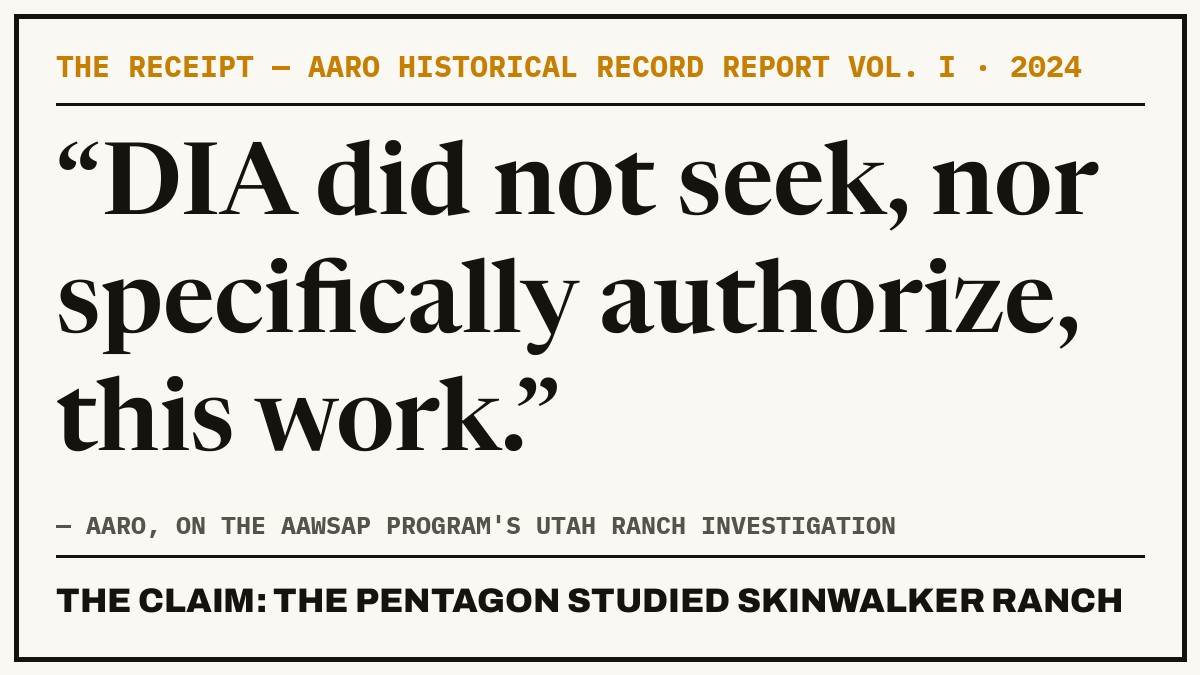
DOCUMENTEDwhat the government's own history says. In March 2024, AARO — the Pentagon's UAP investigation office — published Volume I of its Historical Record Report. It confirms that AAWSAP “also investigated an alleged hotspot of UAP and paranormal activity at a property in Utah — which at that time was owned by the head of the private sector organization — including examining reports of ‘shadow figures’ and ‘creatures,’ and exploring ‘remote viewing’ and ‘human consciousness anomalies.’” Then the sentence this story's receipt card carries: “DIA did not seek, nor specifically authorize, this work.” AARO adds that investigating UFOs was not specifically outlined in the contract's statement of work, though the contractor “conducted UFO research with the support of the DIA program manager,” and that it has yet to uncover any other substantive UAP case work conducted by the program. One more fact about the report, verifiable by anyone with the PDF: across its 63 pages, the words “Skinwalker,” “Bigelow” and “BAASS” appear nowhere. The government confirms the ranch investigation happened. It declines to name the ranch.
DOCUMENTEDthe contractor's own report, now public. DOW-UAP-D174 is BAASS's “Utah Ranch Investigation,” written in 2010 and released on October 23, 2026. A five-person “Utah Task Force” — two investigators, two scientists and a director — deployed to the Fort Duchesne area twice, March 22–26 and April 19–23, 2010, and interviewed more than 25 local residents, ranchers, business owners, law-enforcement officers and tribal members. The report's stated aims included “games, puzzles, and other strategies in order to establish communication with the source/origin of reported anomalies” — among them a padlocked puzzle box built from Fibonacci tiles. No result is recorded. Seven Moultrie game cameras were deployed; the report contains no image of any creature. And the file's only laboratory result: four hair samples, collected after a reported “Skinwalker” sighting, were DNA-tested. Three exhibited a canine sequence the lab reported as common in domestic dogs. The fourth matched raccoon. BAASS accepted the results. The radio-frequency spikes the team logged fell in the 1164–1240 MHz bands — which the report itself notes are allocated to satellite radio-navigation.
One honesty note, printed where it belongs. The released report never names the ranch — it is styled “[AAP Person 4] Ranch.” SmokeScreen's identification rests on the file's own markers: BAASS's authorship, the Fort Duchesne location, the Department's AAWSAP tagging of the file, and BAASS's companion capability report (DOW-UAP-D175), which cites the DIA contract number and lists a “Utah Ranch Database” among the databases in its data warehouse. That is a strong inference, and this section prints it as one — not as a name the document itself uses.
CLAIMEDthe television layer. The Secret of Skinwalker Ranch, produced by Prometheus Entertainment, premiered on History on March 31, 2020; it has run seven seasons. The property has been owned since 2016 by Brandon Fugal, through Adamantium Real Estate LLC — Fugal publicly identified himself as the owner in March 2020 and declined at the time to disclose what he paid. The program's headline phenomena are presented by Fugal's team as open anomalies: the Bubble, a dome-like zone over the ranch's Triangle area which the team says affects instruments and objects passing through it; a solid, metallic-appearing object the team says its ground-penetrating radar and drilling indicate is buried in the mesa; recurring narrow-band signals around 1.6 GHz, which lead investigator Travis Taylor says he detected surging within his first hour on the property in 2019; and GPS and equipment anomalies over the Triangle, from impossible altitude readings to rockets deviating from their expected paths. SmokeScreen files each exactly where it sits: claimed, by the team, on air. None of it has been independently verified, and no raw dataset behind any of it has been published — no spectrum captures with timestamps, no geophysical survey data, no borehole logs, no lab reports on the recovered fragments. That absence is not a verdict on the claims. It is the current state of their paper.
CLAIMEDthe argument over what the program was. Even the program's name is contested, by the participants, in public, incompatibly. AARO's history says AATIP “was never an official DoD program” — a name an informal community of interest kept using after AAWSAP was cancelled, without dedicated personnel or budget. The Pentagon's own 2009 memorandum, released under FOIA, calls AATIP the “Unclassified Nickname” for the AAWSAP contract. Pentagon spokesperson Susan Gough said in 2019 that “neither AATIP nor AAWSAP were UAP related,” and that Luis Elizondo — who maintains he directed AATIP as a UAP-investigation effort — “had no responsibilities with regard to the AATIP program” while he worked in the Office of the Under Secretary of Defense for Intelligence. Reid, on the record, said the opposite: “AATIP was my program… it was for only one purpose — to study UFOs.” Jay Stratton's 2026 memoir adds a further version: that he coined the cover term himself, for his own working group layered over AAWSAP. What is not in dispute is narrower, because the paper shows it: one DIA contract, one appropriation, one Senate letter. The same split runs through the ranch's lead investigator. In June 2022, Taylor confirmed on camera to George Knapp that he had worked for the UAP Task Force and been referred to as its chief scientist, recruited by Stratton, its director. The Pentagon's written calibration, from spokesperson Susan Gough days later: Taylor was a U.S. Army Space and Missile Defense Command scientist provided to the task force “on a time-limited basis” — “It was not a full time assignment; he remained an employee of SMDC” — and Stratton had “informally referred to Dr. Taylor as his chief scientist.” Both sides confirm the underlying facts: Taylor did task-force science work, at Stratton's invitation, from 2019 to 2021. They disagree about the title.
UNKNOWNthe missing report, and the rest of the open file. The insiders' book Skinwalkers at the Pentagon (2021) states that BAASS delivered to DIA a 360-page report — “Utah Ranch Investigation: August 2009–February 2010” — in April 2010. That document has never been released; secondary reporting says a FOIA request for it drew a DIA “no responsive documents” response. It is not the document released on October 23: D174 covers March–April 2010 in 60 pages. Where the 360-page report is, and whether DIA ever held it, is unresolved. Also unresolved: when the program actually ended — AARO says DIA terminated it in 2012; histories drawing on the insiders date the shutdown to December 2010 — and what Fugal paid in 2016, which he has never disclosed (the New York Times reported around $500,000 in January 2021; higher figures circulating online carry no cited source). And a counterweight this section will not skip: skeptical writer Robert Sheaffer reported in Skeptic in May 2020 that the Myers family, who owned the ranch for the sixty years before the Shermans, said no supernatural events of any kind occurred there. That is attributed commentary, not a finding — but a receipts-first story prints it.
So the record, sorted. Documented: a family's accounts printed as they happened in 1996; a purchase, a nondisclosure agreement and a research institute on the property within the year; a $22 million DIA program, a sole-bid contract, a refused Senate request; a government history that confirms the ranch work and disowns authorizing it; and the contractor's own field report, public since October 23, whose cameras caught no creature and whose one laboratory result was dog and raccoon. Claimed: seven seasons of anomalies, presented on television, with no published data behind them — and a program whose own participants cannot agree on what it was called or what it was for. Unknown: what, if anything, has ever happened on that ranch that the documents cannot hold. The television will keep running its experiments. The paper trail is below.
Think we got this one wrong?
Good. That's the job — yours and ours. Bring your own receipts, and if you're right, the correction runs on this story, in the open, with credit.
Challenge this story