The FBI's black triangle: two official documents, two different sightings
The Pentagon's seventh declassified UAP release includes a 2026 black-triangle sighting reported by FBI personnel. The viral version has a photograph and a measured speed. The file has neither — and its two centerpiece documents contradict each other on the time, and on how long the thing was even in the sky.
By SmokeScreen Desk · Nov 1, 2026
🎧 Listen to this article
On October 23, 2026, the Department of War published the seventh batch of declassified UAP files under PURSUE — the Presidential Unsealing and Reporting System for UAP Encounters. Twenty-eight PDFs, bringing the public archive at war.gov/UFO to 478 files since the releases began in May. Most of Release 07 is history: 1950s Air Force reports, old contractor studies. But its newest case is from this year — a matte black triangle, watched by federal agents at a sensitive national-security site in the western United States. As always in The UAP Files, SmokeScreen sorts the case the way the section demands: what is documented, what is claimed, and what is unknown.
DOCUMENTED — the sighting as filed. The case rests on two documents. The first is an AARO memorandum for record (DOW-UAP-D176), written after a joint debrief of the witnesses. The second is the FBI's own FD-302 report (FBI-UAP-D043), which carries a written statement co-signed by two special agents. Both describe the same object: a matte black, non-reflective triangle, estimated at roughly 9 to 15 feet across, with no visible engines, exhaust or lights, and no sound at any point. In the AARO memo's account, it climbed vertically for about ten seconds to a few hundred feet, hovered for about twenty seconds, then crossed into fast horizontal flight and descended into a canyon. A ground search of the canyon the next morning found no wreckage, no scarring, nothing. AARO flags the case as worth further investigation. Neither document concludes what the object was. One detail belongs to the agents themselves: in their own signed FBI statement, they compare what they saw to “a delta wing drone.” That comparison is theirs, in their words, in the file.
DOCUMENTED — the documents disagree with each other. The FBI statement says, in its own words, that “the total duration of the sighting was approximately three seconds.” The AARO memo describes a sequence lasting more than thirty. Coverage comparing the two files also records the logged time an hour apart — about 19:23 in the FBI statement, 20:23 in the AARO memo. Read that again: the same event, written up by the same government, in two official records that do not reconcile on how long it lasted or when it happened. That is not an interpretation. It is on the paper, and it is the part of this release almost nobody is leading with.
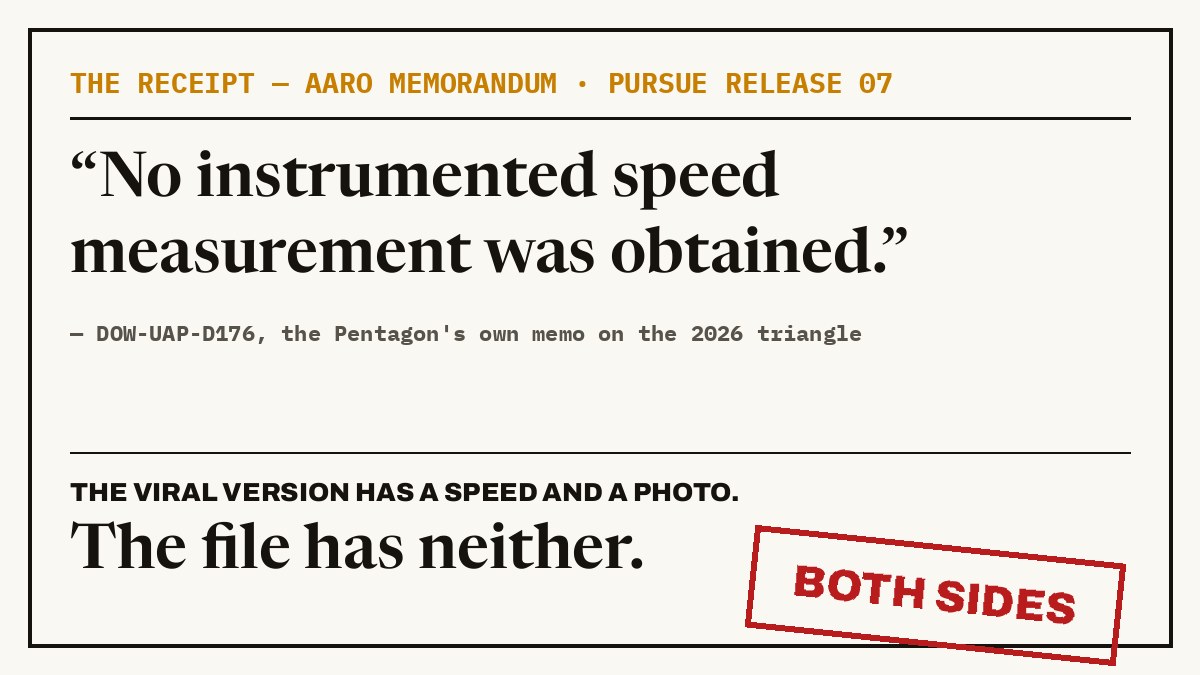
CLAIMED — the viral layer. Online, the sighting travels with a dramatic image of the craft and performance figures to match — fighter-jet speed, in some tellings 1,800 miles per hour. The file does not support either. The AARO memo states, in writing: “No instrumented speed measurement was obtained.” Every speed attached to this case is a witness estimate or a headline's addition. And the images: the striking pictures of the triangle inside the FBI file are computer-generated illustrations laid over terrain photographs. The War Department confirmed to Fox News Digital that the images are illustrations, not photographs of the object. CLAIMED as well, from the other direction: Sean Kirkpatrick, who ran AARO until late 2023, told Fox News Digital on November 1 that Pentagon leadership had ordered his office to strip resolution language from cases before releasing them as “unresolved.” It is a serious allegation. Kirkpatrick named no dates and no leaders, so SmokeScreen files it exactly where it belongs — claimed, unconfirmed, pending a document.
What Kirkpatrick said on the record about this case is checkable, and it is the strongest counterweight in the file. “There's a lot of people that like to point to folks as being credible witnesses and therefore their testimony must be taken at face value,” he told Fox News Digital. “And that is a classic case of authority bias.” His definition of the label on these releases deserves quoting too: “When we say a case is unresolved, it generally means there is no data or there is insufficient data to actually analyze it.” For its part, the War Department told Fox it is providing “no comment or assessment on the files overall or on any specific file, so that the American people can make up their own minds regarding the files.” Files released without conclusions, into a public argument where each side brings its own.
UNKNOWN — what the object was. On the paper that exists, that is the only honest verdict, and this section prints it without flinching. What is documented is narrower and, in its own way, stranger than the headlines: in 2026, trained federal agents reported something they could not identify; the Pentagon chose to declassify and publish their report; and the government's own two records of the event contradict each other on the basic facts of time and duration. A case can be genuinely unexplained and badly documented at the same time. This one, on its own receipts, is both. The receipts are below.
Think we got this one wrong?
Good. That's the job — yours and ours. Dispute the verdict, bring your own receipts, and if you're right, the correction runs on this story, in the open, with credit.
Challenge this verdict