Six Famous UAP Clips, Checked Against the Documents
They have all been shared as proof of something. Two are documented fakes. Two are Navy videos the Pentagon itself still calls “unidentified.” And two now carry official Pentagon assessments that the posts sharing them rarely mention. Clip by clip: what was claimed, what the documents say, and the sort.
By SmokeScreen Desk · Toronto
Published Nov 14, 2026
🎧 Listen to this article
Six clips. Between them they have been watched hundreds of millions of times, and every one of them circulates as proof of something — proof of a craft, proof of a cover-up, or proof of a debunk that supposedly settles it. One was filmed by a Navy jet. One was rendered on a laptop in seventeen hours. One is life under a microscope, dressed up as a comet. And one still has two teams of analysts arguing about it, twelve years on.
This is the check, clip by clip: what is claimed for each video, what the primary receipts say — the documents themselves, not the caption under the post — and the sort this desk gives every story: DOCUMENTED, CLAIMED, UNKNOWN. Some of these clips hold up better than their debunks do. Some don't hold up at all.
1 — GOFAST: the speed that was never in the video
The claim. Thirty-four seconds of infrared — FLIR, Forward-Looking Infrared, heat instead of light — filmed from a Navy F/A-18 in January 2015. In the clip the object appears to skim the ocean at impossible speed, and it has been shared for years as footage of a craft doing exactly that.
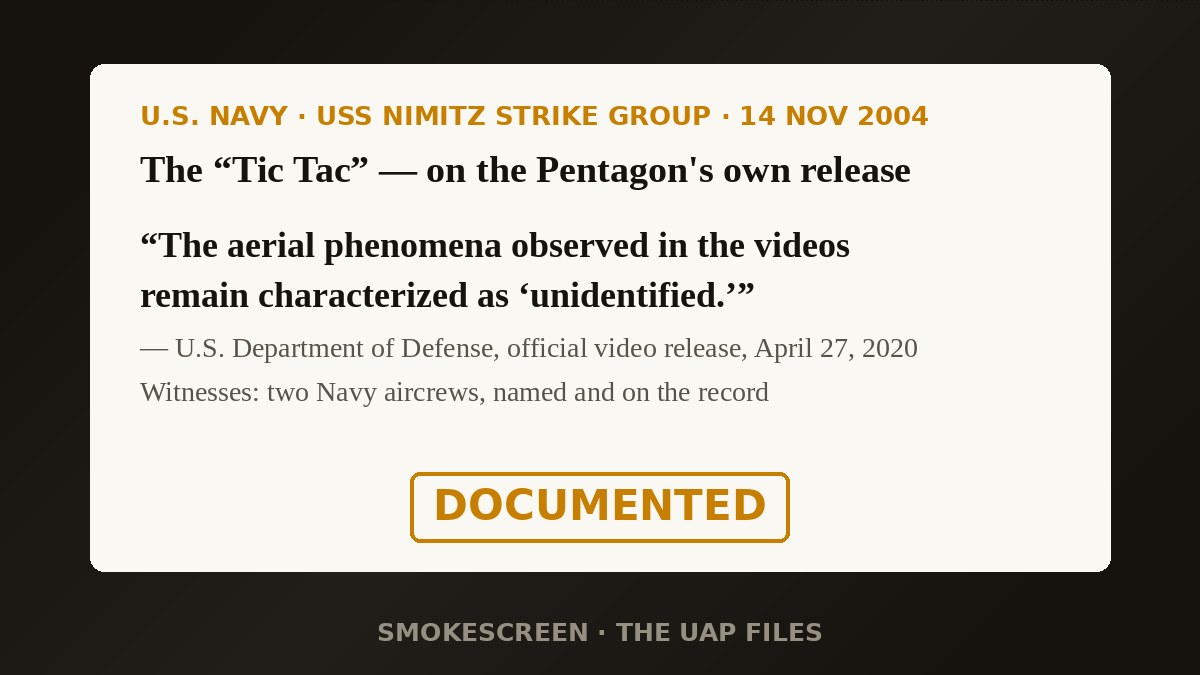
The documents. The Department of Defense released the video officially in April 2020 and characterized the phenomenon as “unidentified.” In February 2025, AARO — the All-domain Anomaly Resolution Office, the Pentagon's UAP office — published its case resolution: the object sat at about thirteen thousand feet, moving somewhere between five and ninety-two miles an hour, and its apparent speed was motion parallax, the fence-post effect seen from a car window. AARO states that it assesses “with high confidence” that the object “did not move at anomalous speeds.” Read the same document to the end, though, and it also says: “AARO cannot definitively identify the object.” The original file no longer exists; the office worked from the same compressed copy that circulates online.
The sort: the footage is DOCUMENTED — real Navy video, and the speed claim is answered by the Pentagon's own analysis. What the object was: UNKNOWN — by the Pentagon's own document.
2 — “UFO Haiti”: the confession
The claim. Posted to YouTube in August 2007 and presented as footage filmed over Haiti: saucers drifting over palm trees at dusk while a woman gasps. For weeks it was the most talked-about UFO video on a young YouTube, on its way to some twenty million views.
The documents. The tell was in the trees — every palm tree in the frame is identical. Then the maker came forward himself. French animator David Nicolas told the Los Angeles Times he had built this clip, and a Dominican Republic twin, in seventeen hours, on a laptop, with off-the-shelf animation software — research for a film about a UFO hoax that spirals out of control. He even made the Times a fresh mini-video to prove it was him.
The sort: DOCUMENTED — as a fabrication. The confession is on the record. Seventeen hours of work; the argument about it has run for nineteen years.
3 — GIMBAL: the debunk that outruns the document
The claim — in both directions. Same month, same carrier group as GOFAST, a different clip: a glowing shape over the clouds that appears to stop and rotate in mid-air, while the crew reacts on the audio — one of them notes a whole fleet of these showing on his display. The video is shared as proof of a craft. It is also shared, just as confidently, as a debunked nothing.
The documents. The Pentagon released GIMBAL in 2020 with the same word as GOFAST: “unidentified.” The settled-sounding explanation — that the shape is the glare of a distant jet, and the rotation is the camera's doing — comes from analyst Mick West, who showed that the targeting pod's own optics can rotate a glare pattern exactly like that. It is real, checkable work, and it may well be right. But it is an explanation published on a debunking site, not a finding by the government. Unlike GOFAST, GIMBAL has no published case resolution from AARO; checked against the office's published resolution list on November 14, 2026, it remains an unresolved case.
The sort: the footage is DOCUMENTED. The glare identification: CLAIMED. What it was: UNKNOWN.
4 — The “3I/ATLAS” comet that is pond water
The claim. Posted on X on November 3, 2026, captioned “3I/ATLAS was not a comet”: a glowing shape drifting through the dark, presented as footage of the interstellar comet 3I/ATLAS. It passed a hundred thousand views within days, and this desk logged it in The Count's claim queue.
The documents. A nearly identical clip went around in October 2025, and the fact-checkers at Lead Stories traced it: it is a paramecium — a single-celled organism, filmed under a microscope. Jack Gilbert, a microbiologist at the Scripps Institution of Oceanography, identified the organism by name. The real 3I/ATLAS is an interstellar comet that telescopes photograph; the claims made for it are covered in this desk's earlier story, linked in the receipts. This clip is not footage of it, from any agency, ever.
The sort: DOCUMENTED — as microscope footage. Pond water, presented as deep space.
5 — The “Jellyfish”: the leak that became an official release
The claim. A thermal video of a dark shape with dangling strands drifting over a U.S. base in Iraq, filmed in October 2017 and released to the public in January 2024 by journalists Jeremy Corbell and George Knapp. The famous version of the story goes further than the clip: the object dove into a lake, stayed under for seventeen minutes, then shot back out of the water and away. None of that appears in any footage the public has been shown; it rests on what the men who released the clip say they were told.
The documents. Asked about the clip in 2024, a Pentagon spokesperson declined to comment on allegedly leaked material — a non-answer that was widely read as confirmation and says no such thing. But that was not the end of it. In April 2025, the Pentagon released the full seventeen minutes itself, through the DVIDS service, as the “Al Taqaddum Object.” That September, AARO published a case resolution on this exact footage (document 25-P-1190), with the incident dated October 23, 2017: the office assesses with high confidence that the object did not exhibit anomalous behaviour, and that what the camera recorded is consistent with a cluster of fully and partially inflated balloons — the dangling strands read as strings and deflated balloons.
The sort: the footage is DOCUMENTED — it is an official release now, and the Pentagon's published assessment is balloons. The water story: CLAIMED, and still not in any released footage.
6 — Aguadilla: the one where the receipts argue with each other
The claim. April 25, 2013, Puerto Rico: a Customs and Border Protection plane's thermal camera tracks a small object across Rafael Hernández Airport, out over the ocean, where it seems to enter the water and come back out — and at one point appears to split in two.
The documents. The study group that analyzed the footage — the Scientific Coalition for UAP Studies — checked it against U.S. Air Force radar data and concluded that no aircraft, bird, balloon or drone of the time explains the movement. Skeptical analysts read the same three minutes as one or two lit balloons on a straight-line track. Then, in March 2025, AARO published its own case resolution on this footage: the office's reconstruction holds that the objects — two of them, throughout — drifted in a straight line at wind speed, about eight miles an hour, and never entered the water at all; the vanishing is the thermal sensor losing them against the ocean. AARO states high confidence that nothing anomalous happened, and moderate confidence that the objects were a pair of sky lanterns. The study group disputes that — their report stands as published, and the argument is live.
The sort: the footage is DOCUMENTED. The lantern identification: DOCUMENTED, as the government's published assessment. The study group's reading: CLAIMED. What it was: officially, lanterns — and this is the one clip of the six where the receipts argue with each other.
Six clips. One confession. One microscope slide. Two Navy videos the Pentagon itself calls unidentified — on one of them, the loudest debunk isn't in the government's own document. And one Puerto Rican night where the receipts argue with each other. That's the whole method: the clip is the beginning of the question, never the answer.
Read the receipts. Decide for yourself.
Think we got this one wrong?
Good. That's the job — yours and ours. Bring your own receipts, and if you're right, the correction runs on this story, in the open, with credit.
Challenge this story