The talks continued during the war: what the unsealed deportation file shows
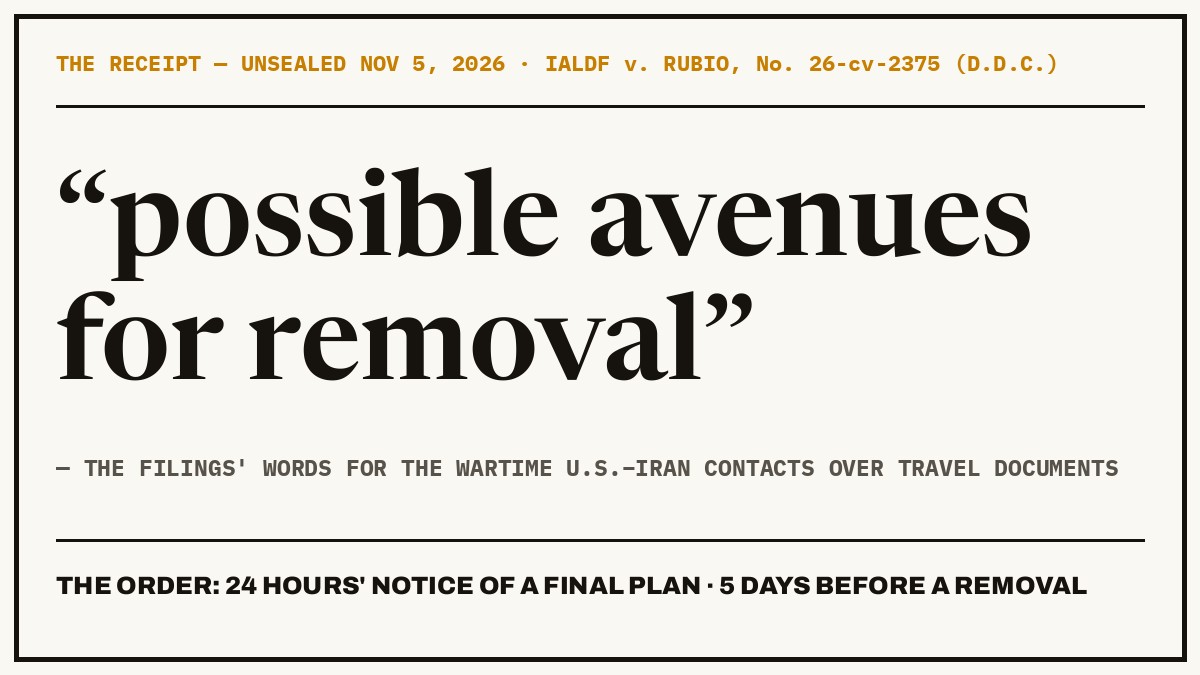
Court documents unsealed on November 5 show U.S. officials in contact with Iran about travel documents and “possible avenues for removal” while the two countries were at war — and a judge's order that now requires 24 hours' notice of any finalized deportation plan and five days' notice before a removal. What the filings show, what the lawsuit alleges and what remains unconfirmed are three different piles. This story keeps them in their piles.
By SmokeScreen Desk · Toronto
Published Nov 6, 2026 · 4:28 p.m. ET
Developing — the Iranian American Legal Defense Fund says at least a dozen detainees were notified in the past week that a removal flight could leave as early as Sunday, November 8, 2026. Under Judge Reyes's order, the government must give the court 24 hours' notice of any finalized plan and five days' written notice before a removal is carried out. No flight had been confirmed as of publication.
🎧 Listen to this article
On Thursday, November 5, 2026, court documents were unsealed in Washington in a lawsuit over the deportation of Iranians — and the documents reach into a war. The United States and Israel went to war with Iran on February 28, 2026. The filings, obtained by the Associated Press, show the administration maintained contacts with Iranian officials during that war over submitting travel documents and figuring out, in the documents' words, “possible avenues for removal.” As recently as mid-October, the government told the court it had plans to deport Iranians through an unnamed third country. It specified no date.
The center of the unsealed material is a transcript: an October 15 hearing before U.S. District Judge Ana Reyes, part of it held in a sealed session from which the plaintiffs' lawyers were absent, released publicly on November 5 by the plaintiffs' counsel, Public Citizen Litigation Group. In it, Reyes reads the situation back to the government's lawyer in the president's own terms: “We are at war with a country where the President of the United States has said, as recently as two or three days ago, if not yesterday, that it is essentially lawless … A country that is an enemy of the United States, according to the current president. A country that, according to our president, murdered tens of thousands of protestors.” Then the question: “And what you're telling me is that the United States of America is going to send individuals back to that region, facing what you and I and everyone who would ever look at this would know would be, at a minimum, a serious threat of certain death.” Justice Department attorney Dimitar Georgiev-Remmel answered: “Yes, your honor. The government is executing lawful orders of removal.” In a second exchange carried in the transcript, Reyes asks, “We are going to remove people in our custody to a country with which we are at war?” — and the answer is the same: “Yes, Your Honor. … the government is executing lawful orders of removal.” Georgiev-Remmel also told the court no specific date had been set for any removals. The “certain death” framing is the judge's. Public Citizen reads the government's “yes” as an acknowledgment of that risk. The transcript itself is linked in the receipts, so the exchange can be read at the length it was spoken.
Reyes went further in the same hearing: “We are talking about sending individuals in our care and custody to a country that we have bombed and we may continue bombing, and is a declared enemy of this country. It is like saying we have individuals in 1942 in this country that we are going to send back to Nazi Germany. That is the equivalent of what you are telling me.” Her order, as reported by AP, requires the government to give the court 24 hours' notice of any finalized plan to deport Iranians — to Iran or to any other country — and five days' written notice before any such deportation is carried out. At the October hearing she warned she would initiate contempt proceedings if the order were violated. In a court filing on Wednesday, the Justice Department answered that the order effectively served as an injunction against the government “given the possibility of sanctions and contempt dangling overhead.”
The wartime contacts were not the start of the channel. In August, hundreds of emails exchanged between U.S. immigration officials — obtained by the National Iranian American Council and made public — showed the two countries working together to arrange the return of more than 100 Iranians on three flights, in September and December 2025 and January 2026, before the war began. Deportations to Iran have historically been rare, AP notes, because the two countries have no diplomatic relations. In June, an Iranian woman was among two dozen migrants the U.S. deported to the Central African Republic — the third-country route, in use. What the unsealed documents add is the timeline: on the filings' account, the contacts did not stop when the war started.
The documents surfaced in Iranian American Legal Defense Fund v. Rubio, No. 26-cv-2375, filed July 7, 2026, in the U.S. District Court for the District of Columbia by the Fund, with Public Citizen Litigation Group, against Secretary of State Marco Rubio, Homeland Security Secretary Markwayne Mullin, acting ICE Director David Venturella and their agencies. The lawsuit alleges that beginning in March 2025 the administration adopted a policy of sharing confidential information from Iranian asylum seekers' immigration files with the Iranian government — including, the complaint says, a list of roughly 150 detained Iranians handed over at a March 2025 State Department meeting, and detainees made to meet Iranian officials who knew details of their claims — in violation of the asylum-confidentiality regulations, 8 C.F.R. §§ 208.6 and 236.1(e). Those are allegations, not findings. The Department of Homeland Security has denied that it is sharing asylum application records with the Iranian government; ICE said when the suit was filed that it used only “established protocols.” Judge Reyes, per AP, said it was possible the government shared the confidential information, but appeared skeptical of claims that DHS has a coordinated policy of sharing those records. The State Department told AP it generally does not comment on pending litigation or private diplomatic discussions, and referred other questions to DHS, which did not immediately respond.
The most time-sensitive claim in the file is also the least settled. The Legal Defense Fund said Thursday that at least a dozen Iranian detainees had been notified over the past week that they were being deported to Iran, some told it could be as soon as Sunday, November 8; that the detainees had been contacted by the Iranian Interests Section — Iran's representative office in the Pakistani Embassy in Washington, which handles consular affairs — about a possible flight to Iran through Pakistan; and that some had also been notified by DHS officials. None of the detainees, the group said, had been given anything in writing. Its executive director, Yasmine Chubin, said one detainee attempted suicide once he learned he might be returned to Iran, and that two people were subsequently moved across state lines to a detention center where detainees are often sent immediately before a removal. All of that is the plaintiff's account, given to AP. No government statement confirms a Sunday flight — and under the judge's order, any finalized plan is supposed to reach the court first.
So the file sorts the way this desk sorts every file. Documented, in the unsealed record: contacts between U.S. and Iranian officials over travel documents and removal routes that, on the filings' account, continued after the war began; a mid-October plan to deport Iranians through an unnamed third country, with no date set; a transcript in which the government's lawyer confirms removals are intended and calls them lawful orders of removal; and a judge's order requiring 24 hours' notice of a finalized plan and five days' notice before a removal, backed by a contempt warning. Alleged, in the complaint: a policy, running since March 2025, of sharing asylum seekers' confidential files with Tehran — denied by DHS, unproven in court. Unconfirmed: a flight this Sunday. The documents are below. Read the receipts. Decide for yourself.
Think we got this one wrong?
Good. That's the job — yours and ours. Bring your own receipts, and if you're right, the correction runs on this story, in the open, with credit.
Challenge this story