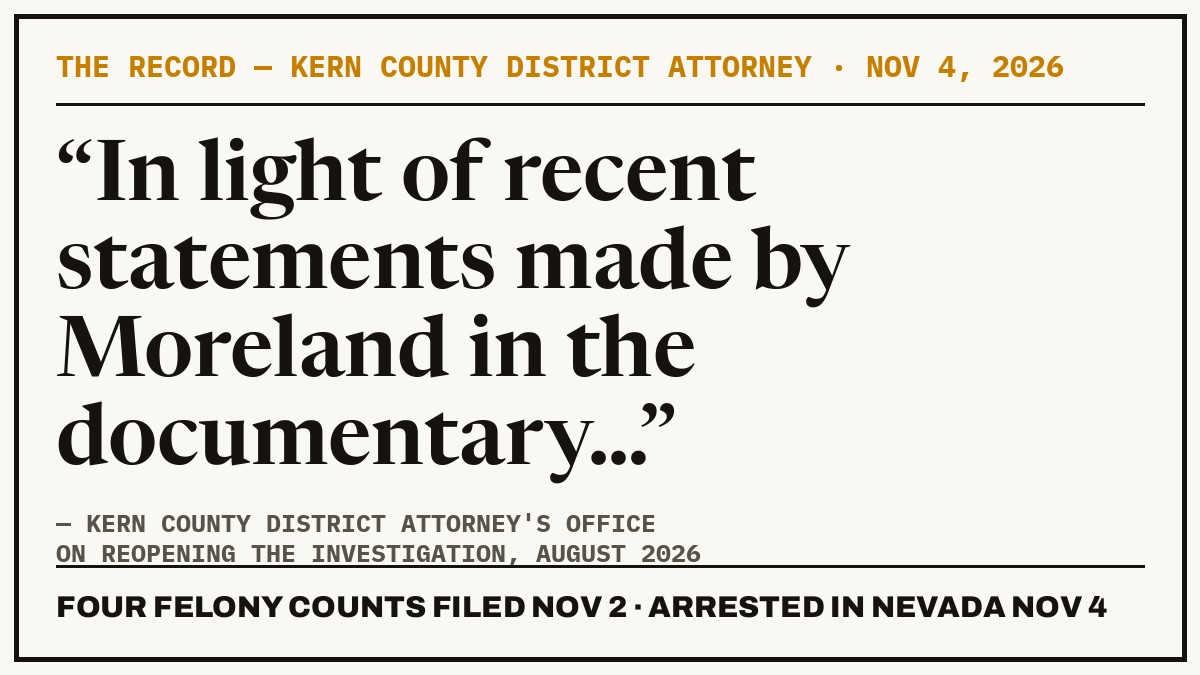
Four strokes and one number: what the Senate record does — and doesn't — say about the cause.
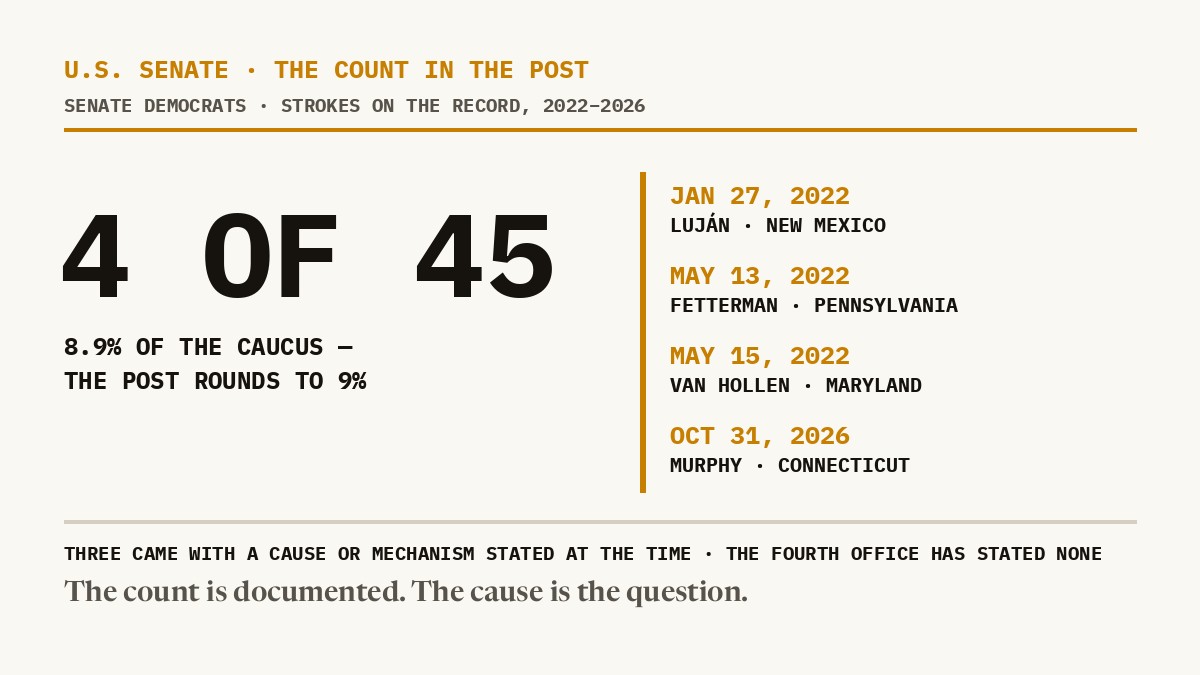
The arithmetic in the post is right: four of the Senate's 45 Democrats have had strokes since 2022. What the record holds for three of them is a cause or a mechanism, stated at the time by the senators themselves, their doctors or their offices. For the fourth — the newest, and the reason the post exists — the senator's office has stated no cause at all. Between the count and the cause is where this story lives.
By SmokeScreen Desk · Toronto
Published Nov 5, 2026 · 8:02 p.m. ET
🎧 Listen to this article
On November 3, 2026, Nicolas Hulscher — an epidemiologist and administrator at the McCullough Foundation — posted a count to X. Its headline: “9% OF SENATE DEMOCRATS SUFFERED STROKES AFTER TAKING COVID SHOTS.” The post names four men: Chris Murphy of Connecticut, 53; Ben Ray Luján of New Mexico, 49; John Fetterman of Pennsylvania, 52; Chris Van Hollen of Maryland, 63. “Two studies explain why,” it says — one reporting mRNA and spike protein “inside the brains of hemorrhagic stroke victims YEARS after vaccination,” the other an “85 million-person study” finding Pfizer recipients face “up to 269% higher odds” of stroke. The post closes: “The mRNA aftermath is unfortunately expected to continue.” The count then travelled. Dr. Peter McCullough had published his own version on November 2 — “Senator Chris Murphy Joins US Senate Premature Stroke Club after COVID-19 Vaccination” — and on November 4 carried the number onto The Joe Rogan Experience: “it was four out of forty-five.” The two men also discussed it on Newsmax; on November 5, InfoWars carried the Rogan exchange. The count is the part of the claim that can be checked against the public record. It checks out.
The four strokes are documented events, each reported when it happened. Luján's came first: on January 27, 2022, the 49-year-old checked himself into a Santa Fe hospital with dizziness and fatigue. Fetterman's followed on May 13, 2022 — he was Pennsylvania's lieutenant governor, four days from winning the Democratic primary for the Senate seat he now holds. Van Hollen announced his own stroke on May 15, 2022, in a statement under his own name. Murphy's is the newest: on Saturday, October 31, 2026, he felt numbness in his arm at his son's hockey game and was taken to a local hospital, where doctors found he had suffered a stroke. When NPR reported the hospitalization on November 1, it noted the same string this desk is counting: in 2022, Luján, Van Hollen and Fetterman “were all hospitalized for strokes.” Four strokes among 45 Senate Democrats, across just under five years: 8.9 percent. The post rounds to nine. On the count, the post and the record agree.
Murphy's case is where the record stops. His chief of staff, Allison Herwitt, said in the office's November 1 statement: “Yesterday afternoon, Senator Murphy started experiencing numbness in his arm while at his son's hockey game. He was taken to a local hospital, where it was discovered he had experienced a stroke. He was transferred to Johns Hopkins for further monitoring and is responding well to treatment.” The statement adds that he is awake and alert, and that the office is optimistic he will make a full recovery. It does not state a type of stroke, and it does not state a cause. Nothing in this story assigns one. What the claim moves past, on its way from the count to the conclusion, is what the other three cases carry: causes and mechanisms put in writing, at the time, by the people treating them.
Fetterman's stroke arrived with its cause attached, in his own words. He had been diagnosed with atrial fibrillation in 2017, after a hospital visit for swollen feet; his cardiologist, Dr. Ramesh Chandra, prescribed medication and asked him to follow up. By Fetterman's own account, he did neither. When the stroke came on May 13, 2022, doctors removed a clot from his brain, and days later he received a pacemaker with a defibrillator. On June 3, 2022, he described it in a statement issued through his campaign: “The stroke I suffered on May 13 didn't come out of nowhere,” and “as a result, I almost died.” His campaign said the stroke was caused by the atrial fibrillation. Chandra, in a letter released the same day, wrote that he had diagnosed the condition in 2017 — and that Fetterman never would have had the stroke had he continued taking the blood thinners prescribed then. That account — a heart condition known for five years, medication not taken — has been on the public record since June 2022.
Luján's office described a mechanism, in writing, within days. His chief of staff, Carlos Sanchez, said on February 1, 2022 that the senator “was found to have suffered a stroke in the cerebellum, affecting his balance,” and that “as part of his treatment plan, he subsequently underwent decompressive surgery to ease swelling.” Luján returned to the Senate on March 3, 2022, to a standing ovation. Van Hollen described his own case himself. In his May 15, 2022 statement, he said he had felt lightheaded, with acute neck pain, while giving a speech in western Maryland; at George Washington University Hospital, an angiogram “indicated a minor stroke in the form of a small venous tear at the back of his head,” and he was told there would be no long-term effects. He was home within the week. Neither statement mentions a vaccine. Each puts a specific medical finding on the record while the event was days old.
The post's two studies, read at the length their authors wrote them, carry less than the post loads onto them. The “85 million-person study” is a meta-analysis by Karimi and colleagues, published in the International Journal of Preventive Medicine in March 2025, pooling 15 studies and roughly 85 million people. The 269 percent figure is in it — as one subgroup estimate among many: an odds ratio of 3.69 for stroke after a first dose of Pfizer's vaccine, where the same paper's overall Pfizer estimate is 2.09. The figure reached this post through a summary that Hulscher himself published in April 2025. The brain study is by Ota and colleagues, in the Journal of Clinical Neuroscience in 2025: 19 hemorrhagic-stroke patients in Japan, in seven of whose artery walls the researchers found spike protein, in some cases up to 17 months after vaccination — the post says “YEARS” — with vaccine-derived mRNA reported in three cases. Every spike-positive patient in that study was a woman. And the paper's own conclusion, in its authors' words, is that “the relationship between hemorrhagic stroke and the expression of spike protein remains unclear.” Hulscher and McCullough's own contribution to the file is a case report on a single patient of McCullough's, reporting vaccine mRNA and spike protein found three and a half years after his shot. None of the three papers studies these four senators, and none examines any of their cases.
The count also carries a timeline problem that needs no study to see. “After taking COVID shots” is true of the four — and of nearly the whole chamber. Senators were vaccinated almost to a person in the first months of 2021, so every medical event in the Senate since then has happened “after” vaccination, in the post's sense. The four cases are spread across almost five years, January 2022 to October 2026, in a caucus of 45 whose members are mostly in their fifties, sixties and seventies. The Centers for Disease Control and Prevention figures cited in coverage of Murphy's stroke put about one in seven strokes in people aged 15 to 49 — and, per the CDC, the chance of a stroke roughly doubles with every decade after 55. A count of four, over five years, in 45 people mostly past fifty, is a real count. What it is evidence of is the part the documents do not settle.
The week also produced a smaller artifact of the same kind. On November 1, an X account whose own bio reads “Parody & satire. Fictional character. Everything is parody” posted a pixelated photograph presented as Murphy in his hospital bed. Lead Stories traced the image to a BBC article dated November 17, 2025: it shows a stroke patient in England. One photograph, like one count, travels faster than the document underneath it.
So the file sorts the way this desk sorts every file. Documented: four strokes, on four dates, in the contemporaneous record; a cause stated for one of them by the senator and his cardiologist in 2022; a mechanism stated for two more, by a chief of staff and by the senator himself, in 2022; and, for the fourth and newest, an office statement that reports a recovery and names no cause. Claimed: that the count itself identifies the cause — resting on one subgroup figure from a pooled analysis, a 19-patient study whose authors say the relationship “remains unclear,” and the claimants' own case report. The count is real. The documents underneath it are below. Read the receipts. Decide for yourself.
Think we got this one wrong?
Good. That's the job — yours and ours. Bring your own receipts, and if you're right, the correction runs on this story, in the open, with credit.
Challenge this story