What's really going on in Antarctica? The treaty is not the part they quote.
The theory file on Antarctica is thick: a Nazi base still running under the ice, an American fleet driven off by flying saucers in 1947, a secret diary, a pyramid, and a treaty read online as fifty-odd nations guarding a locked continent. The document file is thinner and stranger. The Navy's own report lists the 1947 mission's objectives in typed lines; a peer-reviewed study tested the legend against the declassified record; and the treaty's inspection article gives member-state observers the right to enter any station on the continent, at any time. What is actually happening down there in 2026 is a fight over tourists and a survey ship, in meeting papers.
By SmokeScreen Desk · Toronto
Published Nov 5, 2026 · 6:34 p.m. ET
🎧 Listen to this article
No continent collects theories like this one. In the versions that circulate online, Antarctica holds a secret German base — Base 211 — built in the region Nazi Germany named Neuschwabenland and never abandoned, in some versions with Hitler's ashes in an ice cave. Operation Highjump, the United States Navy's enormous 1946–47 expedition, was in this telling an attack on that base, driven off early by flying saucers. Admiral Richard Byrd is said to have flown through an opening at the pole and met a being called the Master, as set down in a secret diary that surfaced decades later. A satellite photograph is said to show a pyramid. And the Antarctic Treaty is read as the lock on the door: dozens of nations jointly guarding a closed continent. The genre's current form is synthetic — a Facebook video posted on November 1, 2026 shows a square hole in the ice and a glowing city beneath it, all generated imagery, with a fake still passed off as a declassified 1947 Highjump photograph.
The seeds are real, and smaller. Germany did send an expedition — the ship Schwabenland, December 1938 to April 1939 — which surveyed part of what is now Dronning Maud Land from the air and claimed it as Neuschwabenland, mainly to protect German whaling. Then, after the surrender, two U-boats arrived in Argentina: U-530 on July 10, 1945, and U-977 on August 17. A Hungarian exile in Argentina, Ladislas Szabo, published the escape story within a week of U-530's arrival, and expanded it in 1947 into a book, Hitler Is Alive, with a submarine convoy and an Antarctic base he called New Berchtesgaden.
Highjump is documented by the people who ran it. Its task force report, held today by the Defense Technical Information Center, lists the objectives set by the commander in chief of the Atlantic Fleet. The first: “Training personnel and testing equipment in frigid zonae” — the report's own typed spelling. The second: “Consolidating and extending United States sovereignty over the largest practicable area of the Antarctic continent.” The force: 13 ships, some 4,700 men and an estimated 1,500,000 square miles sighted. It was also public — eleven journalists sailed with it, and its film, The Secret Land, won an Academy Award in 1948.
Two texts carry the legend's voice, and both shrink on inspection. Byrd's interview in the Santiago newspaper El Mercurio, on March 5, 1947, is quoted by myth writers as a warning of “flying objects which could fly from pole to pole at incredible speeds.” The Spanish text, as the researcher Michael Heiser rendered it in 2015, is more ordinary: in a new war, the United States could be attacked by hostile planes flying over one or both poles, and oceans could no longer be counted on as a guarantee of safety — a Cold War warning about the Soviet Union. The secret diary is weaker still: a text of unknown origin, surfacing decades after the 1947 flight it describes, in which Byrd enters a hollow Earth and meets the Master. The Antarctic field-guide literature assesses the cited diary as fiction, not a genuine record, and the hollow-Earth framing around it traces to a writer using the pen name Raymond Bernard in the 1960s.
The expedition did end early, and the report says why: the Central Group withdrew from Little America IV “two to three weeks earlier than anticipated, due to the unusually heavy pack ice in the Ross Sea,” its ships, not built for the ice, at risk of an early freeze; the other groups stopped near plan. The report's cost line is plain: “There were seven deaths during the operation,” three in a flying-boat crash on the ice, the rest in accidents as far away as Sydney and Panama.
In 2007, the legend was put to the record in print. Colin Summerhayes of the Scott Polar Research Institute and Peter Beeching, in the peer-reviewed journal Polar Record, concluded that the two U-boats could not have reached Antarctica; that there was no secret wartime German base in Dronning Maud Land; and that Operation Highjump “was designed to train the US Navy for a possible war with the Soviet Union in the Arctic, and not to attack an alleged German base in Antarctica.”
The pyramid needs no expedition — only a geologist. The satellite image that went viral in 2016 shows a peak at 79°58′S, 81°57′W in the Ellsworth Mountains. Dr. Mitch Darcy of the German Research Centre for Geosciences in Potsdam, on the image in coverage at the time: “The peaks are clearly composed of rock, and it's a coincidence that this particular peak has that shape.” “By definition, it is a nunatak, which is simply a peak of rock sticking out above a glacier or an ice sheet. This one has the shape of a pyramid, but that doesn't make it a human construction.” Eric Rignot of the University of California put it shorter: “This is just a mountain that looks like a pyramid.”
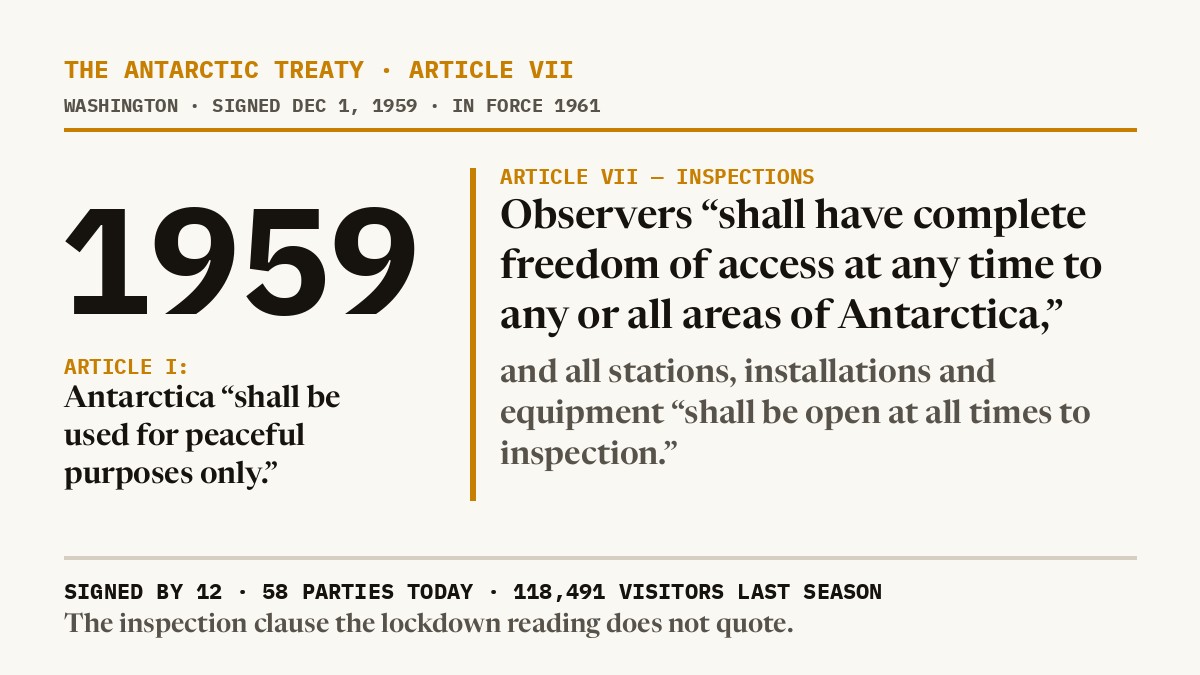
Which leaves the treaty — the document at the centre of the lockdown reading, and the part its readers quote least. The Antarctic Treaty was signed in Washington on December 1, 1959, by twelve countries; it entered into force in 1961 and has 58 parties today. (The “58 nations” of the viral timeline is the modern party count, pasted onto 1959.) Article I: “Antarctica shall be used for peaceful purposes only,” with “any measures of a military nature” prohibited. Article VII is the clause the guard-force reading has to survive. Designated observers, it provides, “shall have complete freedom of access at any time to any or all areas of Antarctica,” and “all areas of Antarctica, including all stations, installations and equipment within those areas… shall be open at all times to inspection.” Inspections under the article have run, cooperatively, for decades. The people are counted, too: the International Association of Antarctica Tour Operators recorded 122,072 visitors in 2023–24 and 118,491 in 2024–25. The strongest true fragment of the lockdown claim belongs here as well: about 98 percent of tourist voyages stay in the Antarctic Peninsula region, and the interior takes a national programme or a private fortune. That is a fact about ships, weather and money — not a guard force.
What is actually going on in Antarctica, on the current record, is administration. Tourism grew from roughly 5,000 visitors a year in the 1990s to more than 120,000; a 2025 report's modelling put it as high as 450,000 a year by 2033 — a forecast the industry contests. It was a headline item at the 48th Antarctic Treaty Consultative Meeting in Hiroshima in May 2026, where proposed binding caps met a consensus rule that has repeatedly slowed them; the enforcement gap the literature names is “rogue tourism,” private expeditions outside the operators' association. And the activity that most resembles prospecting is in a Cambridge journal: the Russian state company Rosgeologia, Antarctic Science reported in 2024, “has undertaken seismic surveying of the Antarctic continental shelf, leading to fears that the Protocol may be at risk” — the 1991 Environmental Protocol, whose Article 7 prohibits mineral-resource activity except for scientific research. The Protocol does not expire in 2048. From January 14, 2048 — fifty years after it entered into force — a consultative party may request a conference to review it, and the prohibition continues unless a binding legal regime on mineral activities takes its place.
So the file sorts the way this desk sorts every file. Documented: a German survey expedition in 1938–39; two U-boats surrendered in Argentina in 1945; a large, public American expedition in 1946–47, ended early by ice at a cost of seven lives; a treaty with the most open inspection clause in international law; a rock peak shaped like a pyramid; and today's tourism-and-survey paperwork fight. Claimed: a base under the ice, a saucer battle, a diary from inside a hollow Earth, a built pyramid, a guard force over a locked continent. Unknown, and smaller than the genre suggests: the bed beneath the deepest interior ice is radar-mapped at coarse scale and directly observed almost nowhere — and an inspection right is not a live feed. The documents do not cover everything. What they cover, they cover in writing, with dates. The receipts are below. Read the receipts. Decide for yourself.
Think we got this one wrong?
Good. That's the job — yours and ours. Bring your own receipts, and if you're right, the correction runs on this story, in the open, with credit.
Challenge this story