The DC blackout post stitches two different election days
A viral midterm-eve bulletin welded a real Washington outage — restored the same afternoon, in a city that was not voting in person that day — to a vote-center outage from Arizona's July primary. Pepco's statements and the county's own bulletin carry both dates.
By SmokeScreen Desk · Nov 2, 2026
🎧 Listen to this article
“ALARMING: Power outage hits Washington, D.C., a day before the U.S. midterm elections.” The post — published on X on November 2, 2026 by Coin Bureau, a widely followed crypto news account — stacks its evidence in dashes: nearly 80,000 customers without power across the U.S.; 1,176 customers dark in Foggy Bottom, “just blocks from the White House”; traffic lights and federal facilities, including the State Department, affected; “a substation failure is the probable cause”; voting sites in Arizona in the dark; check-in devices glitching; officials saying 99% were functioning and no voters were turned away. Read quickly, it is one event. Read against the documents, it is two events — fifteen weeks apart — wearing one date.
The Washington half is real, and it happened on November 2. At about 9 a.m., an outage cut power across part of Foggy Bottom, the State Department's neighborhood. The city's alert system, AlertDC, put the count at 1,176 customers: “PEPCO reports multiple power outages in the Foggy Bottom area of downtown DC affecting 1176 customers.” Traffic lights went dark. State Department facilities lost power, and George Washington University cancelled classes for the day.
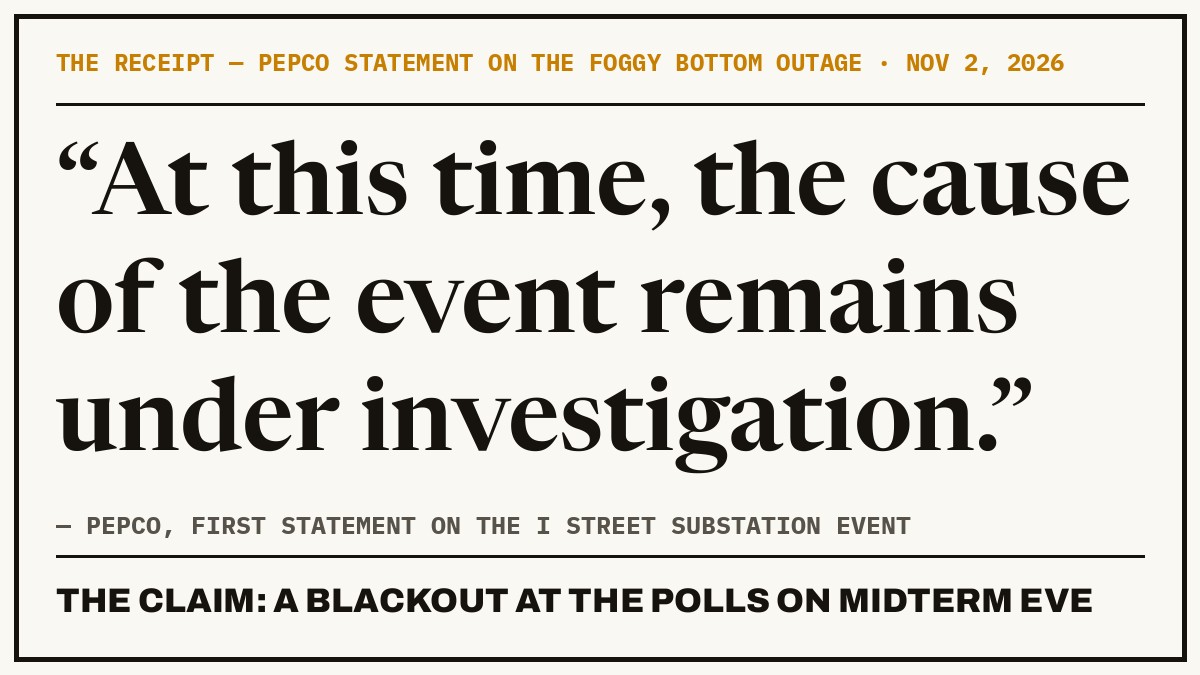
The details begin to drift where the post stops quoting. It attributes the 1,176 figure to Pepco — but that number is the outage-map and city-alert count. Pepco's own statement used a different one: “Pepco is responding to an event at our I Street Substation in the Foggy Bottom area of the District that has resulted in power outages for approximately 1,100 customers.” The post also promotes a word. It calls the cause a “substation failure,” flatly, as the probable cause. Pepco's statement never used the word failure. It said “event,” and left the cause open: “At this time, the cause of the event remains under investigation. Because the situation is still developing, we do not yet have an estimated restoration time.” The word does exist in the record — as a field on Pepco's outage map: “Probably Cause – Failure in our Sub-Station.” A map field became the utility's finding.
Then the afternoon overtook the bulletin. In a 1:46 p.m. update, Pepco said power was expected to be restored to all affected customers by 2 p.m., and added: “The cause of the outage remains under investigation. At this time, there is no indication of foul play.” At 2:12 p.m. it closed the file for the day: “power has now been restored to all impacted customers.” The “no restoration time” line matched Pepco's midday position; by the time the post travelled, the outage was over.
And it never touched a DC ballot. November 2 was not an in-person voting day in the District: DC early voting ran through November 1, and Election Day polls open November 3, from 7 a.m. to 8 p.m. No official tied the outage to a polling place, because none was open. The midterm-eve frame does the work: true of the calendar, empty of consequence. For voting stakes, the post needs its Arizona lines — real, but not from November.
Wittmann and Circle City are vote centers in Maricopa County, Arizona — and they did lose power on an election day. The Arizona Republic, reporting on July 21, 2026, the day of Arizona's primary, recorded: “Power was out at the Wittmann Assembly of God in Wittmann and Friends of Circle City in Morristown voting centers for about 30 minutes on Election Day but has been restored.” Thirty minutes, in July, during a primary. The same two sites appear on Maricopa County's vote-center lists for the November 3 general election — which is how a July fact passes, at scrolling speed, as a November one.
The check-in devices are July's too. On primary day, Maricopa County's electronic pollbooks — the tablets that check voters in, on an AT&T-supplied network — hit intermittent connectivity problems at a limited number of locations. Supervisor Mark Stewart's July 21 bulletin said it in his own words: “I am aware of intermittent AT&T connectivity issues at a limited number of polling locations... I directed county leadership to issue deployment of redundant connection tools from Verizon at all polling locations.” The post-election assessment by the Stanford–MIT Elections Performance Central, published August 25, graded the episode as a “minor issue” with the pollbooks “connecting to the voter registration database, which affected roughly four voters.”
The post's most reassuring line — “Officials said 99% were functioning and no voters were turned away” — is also July's, and it shrinks in the retelling. As reported by azfamily on July 21, the 99% figure came from county spokeswoman Jennifer Liewer, and it was about devices: 99% of the county's more than 1,900 electronic pollbooks functioning during the connectivity problem. The post drops the referent, and 99% of check-in tablets reads, inside a midterm-eve bulletin, as 99% of voting. Two of the post's numbers rest on thinner paper, and SmokeScreen says so: the 99% attribution comes through July reporting traced by the checker who first separated these dates, and the “about 1,800 customers near Morristown” figure traces to the same July coverage, not to a utility record we could inspect. The named vote centers and the thirty-minute outage are confirmed in the Arizona Republic's own report.
Which leaves the headline number. “Nearly 80,000 customers are WITHOUT power across the U.S.,” the post says, citing PowerOutage's data. SmokeScreen could not verify that figure as a November 2 reading, and prints it only as the post's claim. PowerOutage.us is a live national tally of every outage in the country — storms, crashes, maintenance — refreshed every few minutes. A nationwide sum is not an event. Foggy Bottom's 1,176 customers are roughly one and a half percent of 80,000; the rest is the ordinary background hum of a continental grid, recruited into a single alarming sentence.
One caution, owed in both directions. Maricopa County did have a genuine power problem on November 2: its Fast Facts page records that the vote centers at Paradise Community College and Sunset Canyon School closed temporarily over power issues that day, then reopened. Different sites, different facts, nothing to do with the post's July lines. It simply is not the event the post described.
So the record, sorted. Documented: a real substation event in Foggy Bottom on November 2, sized at about 1,100 customers by the utility and 1,176 by the city's alert, cause under investigation, no foul play indicated, everyone restored by 2:12 in the afternoon — on a day when the District held no in-person voting at all. Also documented: a thirty-minute vote-center outage and a pollbook connectivity problem in Maricopa County, in the Arizona primary, on July 21 — resolved the same day, affecting, by the post-election assessment, roughly four voters. The post's craft was to delete the second date. Every alarming element it carries about voting is from July; every element from November is an outage that ended before the workday did, in a city that votes tomorrow. The receipts are below. Read the receipts. Decide for yourself.
Think we got this one wrong?
Good. That's the job — yours and ours. Bring your own receipts, and if you're right, the correction runs on this story, in the open, with credit.
Challenge this story