No nuclear explosion near Iran. The monitors that can't miss one heard nothing.
A post with 728,000 views asked whether a nuclear bomb had just exploded in the sea near Iran, over video of ships waiting on a calm horizon. The video is the run-up to a 1958 American underwater test in the Pacific. And the worldwide network built to catch a nuclear explosion anywhere on Earth — hydrophones listening in the oceans, sensors buried in the ground — recorded nothing: this is the one kind of event that cannot be hidden. Something real did happen off Iran on Monday night. It was not this.
By SmokeScreen Desk · Nov 3, 2026
🎧 Listen to this article
At 7:20 a.m. on Tuesday, November 3, an account posting as @FrontIntelX put the question to the internet. Behind a siren emoji and the words BREAKING NEWS, flanked by the flags of Iran and the United States, it asked Grok, the platform's AI: “Hey @grok, has there just been a nuclear bomb explosion in the sea near Iran?” Then, with a shocked-face emoji: “If this is true, the world could be heading toward another nuclear war. Is this report real? Please confirm.” Attached: a calm blue sea, a line of ships on the horizon, one aircraft overhead — and, ghosted across the frame, the watermark of a film archive. By the time SmokeScreen saw the post, it had been viewed some 728,000 times. The poster asked a question rather than stating a claim, so this story answers it the way the receipts allow: directly.
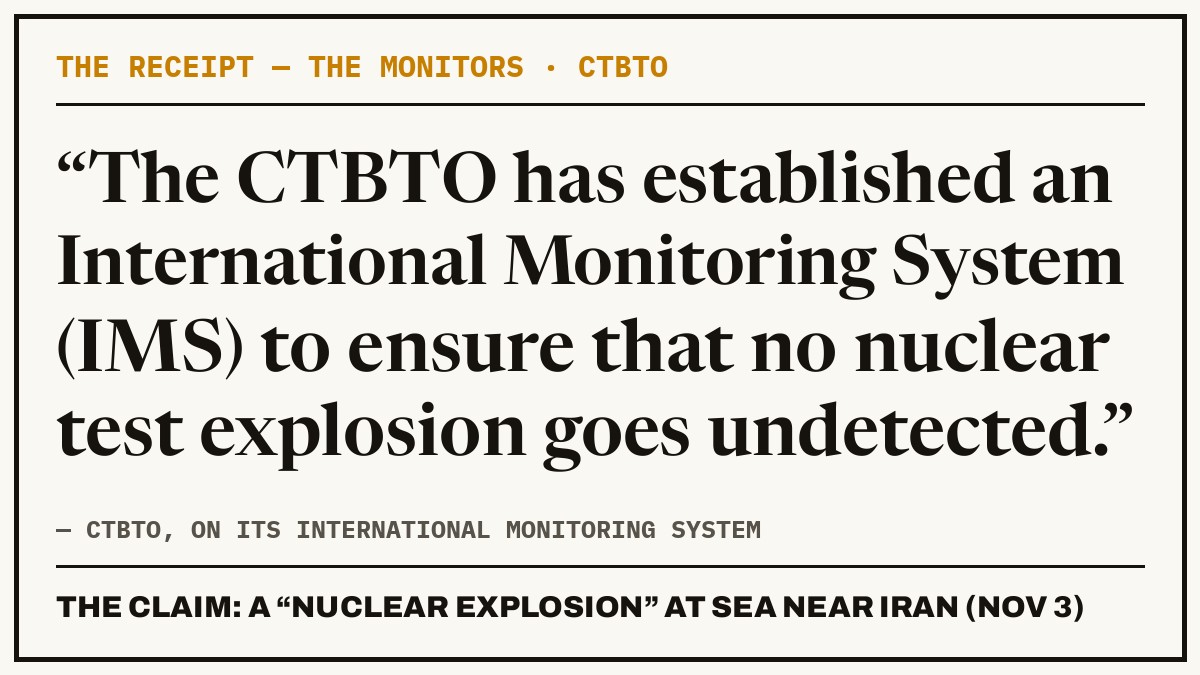
No. And here, “no” is not an editorial judgment — it is what the instruments say. A nuclear explosion at sea is the one event in this genre that physically cannot be hidden. The Comprehensive Nuclear-Test-Ban Treaty Organization runs a planetary listening system, the International Monitoring System: more than 300 stations — seismic, hydroacoustic, infrasound and radionuclide — built for one job. Its executive secretary, Robert Floyd, states the capability in terms: the system “can and will detect any nuclear weapon test explosion anywhere on the planet and has successfully detected all six declared nuclear tests conducted this century.” Sound carries through ocean water farther and faster than through almost anything else on Earth; that is why the hydrophone stations exist. An underwater burst off Iran would have registered within minutes, unmistakably. For November 2 and 3, no monitoring body has reported any such event — and no one else has either: no wire service, agency or state media outlet, Iran's own IRNA included, has reported any explosion at sea near Iran. IRNA's explosion items in the same hours concerned conventional fighting around the Strait of Hormuz and the disposal of unexploded ammunition near Sirik.
What the instruments did record in Iran on Tuesday was an earthquake — an ordinary one, in the wrong place, of the wrong kind. At 17:07 UTC on November 3, the U.S. Geological Survey logged a magnitude 4.1 quake 57 kilometres southwest of Zahedan, in Sistan and Baluchestan province, at a depth of 10 kilometres: inland, hundreds of kilometres from the Gulf, with the signature of rock slipping along a fault, and the day's only notable entry in the country's seismic record. Between that entry and a nuclear detonation at sea there is nothing: no second event, no ocean signal, no anomaly.
The video is the second receipt, and it dates itself. The watermark across the frame belongs to the Atomic Tests Channel, a YouTube archive of declassified American test films — the footage is not pretending to be from 2026 until a caption tells you it is. The composition matches one film in particular: ships arrayed on a flat Pacific horizon, an observation aircraft overhead, a calm sea in the last seconds before the water erupts. On May 16, 1958, off Enewetak Atoll in the Marshall Islands, the United States detonated a Mark 7 bomb — nine kilotons, set 500 feet below the surface — in a test codenamed Wahoo, part of Operation Hardtack I. The ships in the frame are the target array moored around the shot point to measure what the blast would do to a fleet: three destroyers, a submarine, a mockup of a submarine and a merchant vessel. LADbible and Unilad have both illustrated their Wahoo write-ups with the Atomic Tests Channel film, and Unilad captions a still from these exact seconds: “Shortly before the explosion.”
One disclosure belongs here, in the open. The identification of the clip as Wahoo rests on the composition, the watermark and the published stills — a high-confidence match, not a pixel-by-pixel verification performed on a single frame. A sister test, Umbrella, was fired in the same waters on June 8, 1958, against the same target array and filmed the same way, and it cannot be excluded with absolute certainty from one frame alone. What can be stated without qualification is everything the claim turns on: the footage is an American underwater atomic test, filmed in the Pacific in 1958 — 68 years old, and an ocean away from the Strait of Hormuz.
None of this says the water off Iran is quiet in every sense, and this story does not claim otherwise. On Monday night, November 2, something real did happen in the Strait of Hormuz. According to a U.S. official who spoke to Axios, the Islamic Revolutionary Guard Corps fired a surface-to-air missile at an American aircraft over the strait, and a U.S. fighter jet destroyed the launcher on Qeshm Island in what the official described as self-defense. The Wall Street Journal reports the strike as the latest in a series of limited, mostly unannounced American strikes inside Iran over recent weeks — conventional, defensive in Washington's account, and kept quiet on purpose. None of it is a nuclear explosion: no water column, no fallout, no instrument signature — a missile launcher destroyed by a fighter jet, in a strait the two sides have been sparring over for weeks. The real strike is the reason the invented one is believable. It is not evidence for it.
The recipe has been used before — on the same country, with the same ingredients. On March 3, 2026, a post announced that an Iranian “nuclear test” had caused a magnitude 4.3 earthquake near Gerash, In a fact check published March 4, Lead Stories traced the clip: it was the Fizeau shot of Operation Plumbbob, filmed in the Nevada desert in 1957, watermarked by the archive channel @atomcentral, and bolted onto a real earthquake. Real tremor or real tension, archival atomic film, and a question mark standing where the evidence should be. March's version used the desert; November's uses the sea. The question mark is doing the work in both — a post that only asks cannot be caught claiming — and most of this one's 728,000 viewers saw the frame, the flags and the word BREAKING.
The inventory, then. Documented: a global monitoring network that states it can and will detect any nuclear test explosion anywhere on the planet, which has reported nothing at sea near Iran; a single ordinary inland earthquake as the day's seismic record; and a video whose own watermark gives it away — an American test film from the Pacific, 1958. Also documented, and kept separate because it is a different event: a conventional American strike on a missile launcher on Qeshm Island on Monday night. Assembled: the explosion in the post, which exists in no instrument record and no news report — only in a 68-year-old film, under a caption asking someone else to confirm it. The receipts are below. Read the receipts. Decide for yourself.
Think we got this one wrong?
Good. That's the job — yours and ours. Bring your own receipts, and if you're right, the correction runs on this story, in the open, with credit.
Challenge this story