Touchscreens are ‘flipping votes’ again. The paperwork says something narrower.
Early voters in five states say the screens lit up the wrong name. Officials blame calibration and stray touches, the paper record is the backstop — and the most-shared ‘proof’ video was filmed in 2018.
By SmokeScreen Desk · Nov 1, 2026
🎧 Listen to this article
It is the claim that arrives every election, right on schedule. Posts on Facebook, Threads, X and TikTok say touchscreen voting machines in early voting for the November 3 midterms are switching votes from Democrats to Republicans — in the strongest versions, deliberately, as part of a rigging operation. The Associated Press has documented complaints in at least five states: Kansas, Ohio, South Carolina, Tennessee and Texas. The posts have gathered tens of thousands of likes, shares and views. That is the claim. Here is the record underneath it.
The reports themselves are real, and they deserve to be stated straight. In Nashville, Stella Parton posted on October 21 that a touchscreen at the Hermitage Library kept defaulting to Republican Marsha Blackburn — she wrote that she had to “go back three times and correct my vote.” In Texas, voters in Bexar County reported selections registering incorrectly or disappearing, with further reports from Kendall County; in Tennessee, reports concentrated in Williamson and Davidson counties. Notice the thing every account has in common: the voter saw the wrong name on the screen, fixed it, and cast a ballot they had reviewed first. A complaint is a report of something seen on a screen. It is not, by itself, a confirmed machine error — and that distinction is most of this story.
The machines matter here. Most of the counties named use ExpressVote ballot-marking devices made by ES&S: the voter makes choices on a touchscreen, the machine prints a paper record, and the voter reads that record before the ballot is cast. A selection can be changed as many times as needed, a poll worker can help, and a misprinted record can be spoiled and reissued. The paper step exists precisely because touchscreens mis-register touches — for calibration reasons, for finger reasons. The safeguard is not a promise that screens are perfect. It is the review.
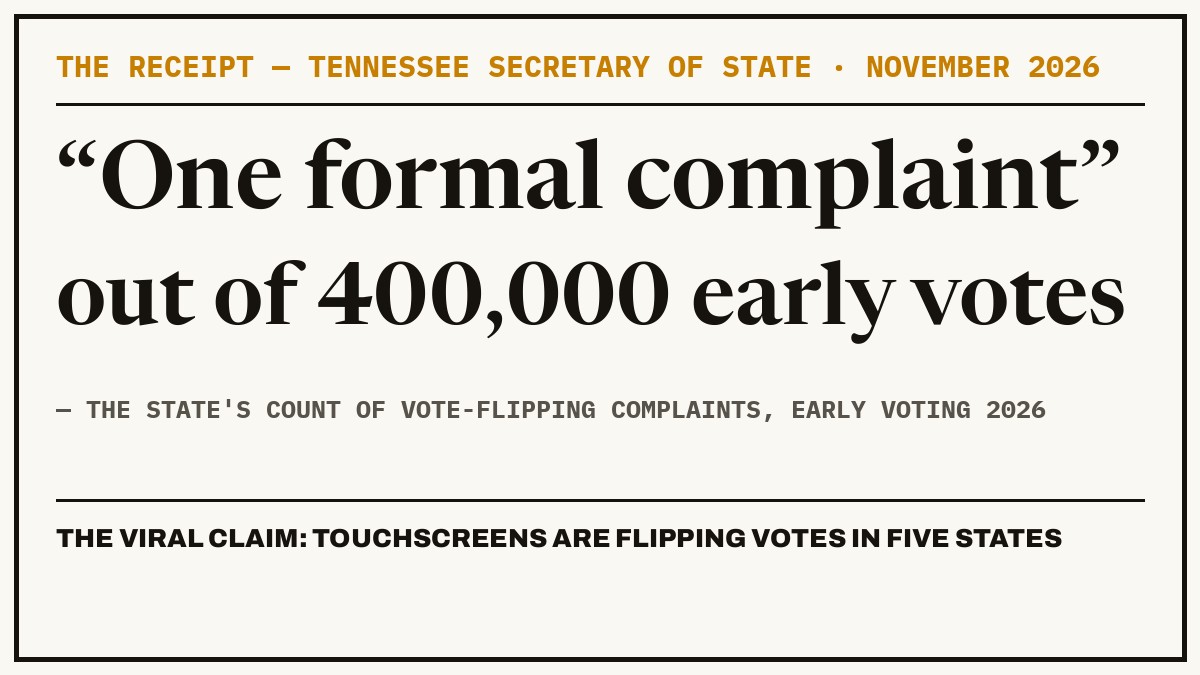
What the officials say, on the record: Tennessee's Coordinator of Elections, Mark Goins, told WSMV the reports “appear to be voter error,” most likely unintended touches on sensitive screens, and that the equipment is tested before elections. The Tennessee Secretary of State's office says that out of roughly 400,000 early ballots cast in the state, it has received exactly one formal complaint of this kind. Williamson County's election administrator, Chad Gray, said officials found no discrepancies in the equipment, and the county now offers styluses at polling places to make touches more precise. In Bexar County, elections administrator Michele Carew put it in writing: “Reports of mismatched selections are almost always due to user touchscreen sensitivity, not machine malfunction.” And officials in several states told AP that complaint numbers this year are not higher than in past cycles. The attention is.
The independent expert line is the same. “Almost all of the claims of vote flipping are understandable human error,” David Becker, executive director of the Center for Election Innovation and Research, told AP. AP also notes the pattern that follows every cycle: genuine voter confusion gets picked up and amplified by accounts whose business is doubt about election results.
Then there is the video problem. The most-shared “proof” clip — a touchscreen marking Republican Jim Baird when the voter taps Democrat Tobi Beck — is genuine footage carrying a false caption. Snopes traced it to the 2018 midterms in Tippecanoe County, Indiana: officials from both parties looked into it at the time, attributed it to touchscreen calibration, and the county clerk logged seven formal complaints on the first day of early voting that year — with no finding of anything widespread or deliberate. AFP found other clips now circulating as 2026 incidents were recorded in 2014, 2018 and 2019. A Tippecanoe County election specialist, Mike Smith, told Snopes the recirculated video is deceptive and the deliberate-switching allegations are “patently false.”
What would prove the strong version of this claim is a document: a verified ballot cast with a selection the voter never approved on review, a machine log, a failed audit. None has been produced. As of November 1, there is no verified count of machines changing votes, and no substantiated finding of coordination between the scattered reports. What remains unknown, SmokeScreen prints plainly: we cannot adjudicate every individual anecdote, and a genuinely miscalibrated screen in a specific polling place is possible anywhere — which is why any voter who sees a wrong selection should stop, fix it, and check the paper record before casting. The verdict the receipts support: voters hitting touchscreen friction is documented. Machines flipping an election is, on the current record, not.
Think we got this one wrong?
Good. That's the job — yours and ours. Bring your own receipts, and if you're right, the correction runs on this story, in the open, with credit.
Challenge this story