The Simpsons 'Great Blackout' vs. FEMA's one-minute test
A viral post says The Simpsons predicted a “Great Blackout” on November 17 — the day FEMA runs a nationwide emergency-alert test it announced back in September. The episode is real, and it really does contain a blackout. The date appears nowhere in it. Here are both paper trails, side by side.
By SmokeScreen Desk · Nov 2, 2026
🎧 Listen to this article
It arrives, as these things now do, as a screenshot. On November 1, a post on X — from an account using the handle @lambdabeta2025 — announced that The Simpsons had predicted a “Great Blackout” for November 17, and told readers to watch the final 15 seconds of a particular episode for the proof. By the time TechTimes captured the post, it showed about 768,400 views. The claim has since been cut into YouTube Shorts and TikToks, and the clip at its center has form: for months it has done duty in ads selling solar power banks, where a cartoon blackout is the pitch and the product is the answer. What the claim has, in other words, is reach. What it needs is a receipt.
The episode is real, and SmokeScreen checked it against the episode record rather than the screenshot. “It's a Blunderful Life” — season 35, episode 7, written by Elisabeth Kiernan Averick — first aired on Fox on November 19, 2023. Its plot, per the published episode summaries: sixty years in the future, an elderly Lisa tells her family, over Thanksgiving dinner, the story of the blackout that nearly destroyed Springfield. In that story, Mr. Burns overloads an outlet at the power plant, starts a fire, and the town loses power days before Thanksgiving; Homer, who didn't do it, takes the blame. The Simpsons Wiki's account of the framing scene has the family lighting candles “in remembrance of the great blackout that almost destroyed the town.” So the viral post is built on something genuine: a Simpsons Thanksgiving episode, framed around a “great blackout,” in which the lights really do go out.
What is not in the episode — anywhere in its published record — is the date November 17, or any date in 2026. The story is set days before Thanksgiving, and framed at a Thanksgiving table decades later. The published summaries describe the ending the viral post points to: the episode closes, per the episode guides, back in the present, with Homer reading Lisa a bedtime story, The Christmas Orange. No date is spoken, shown, or warned about. TechTimes, which examined the claim on November 2, arrived at the same gap from the other side: the post's screenshot “does not independently establish what that sequence shows or whether it references the date,” and nothing presented with the claim links the episode to a real power failure. The November 17 date enters this story from exactly one place — and it isn't Springfield.
November 17 is on the calendar for a documented reason, and the document is mundane. On September 16, 2026 — six weeks before the viral post — the Federal Emergency Management Agency, in coordination with the Federal Communications Commission, published a press release: at approximately 2:20 p.m. Eastern Time on Tuesday, November 17, FEMA will conduct a nationwide test of the Emergency Alert System. Radio and television broadcasters, cable systems, satellite radio and television providers, and wireline video providers will interrupt normal programming to relay a test message. When the test has concluded, the release says, “normal programming will resume.” Nor is the test a response to anything brewing. The IPAWS Modernization Act of 2015 requires FEMA to conduct nationwide tests of the public alert and warning system at least once every three years; the last nationwide test ran in 2023. This one was announced in writing, two months early — FEMA and the FCC shared the date in advance, the release says, “because it is important that the public understands what to expect on the day of the test.”
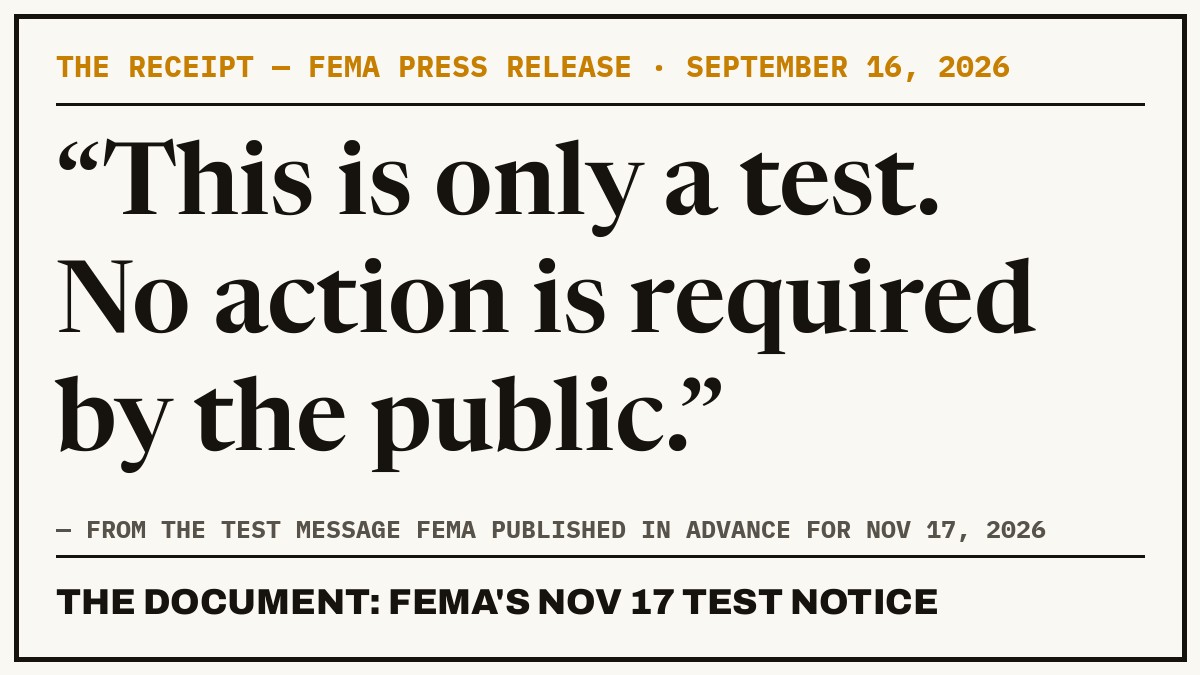
FEMA even published the script. The message stations will relay states, in part: “This is a nationwide test of the Emergency Alert System, issued by the Federal Emergency Management Agency… This is only a test. No action is required by the public.” FEMA's FAQ page for the test fills in the operational details: the interruption is expected to last about one minute; if severe weather or a real emergency intervenes, the backup date is December 3. And it settles the one detail the rumor mill keeps mangling: your phone will not buzz. “Wireless Emergency Alerts were tested in 2023, but they will not be part of this year's test,” the FAQ says — this year FEMA is assessing the broadcast system only. Several secondary summaries of the announcement have nonetheless described the test as sending alerts to cellphones. They are describing a test FEMA is not running. The FAQ is short, public, and linked below.
So November 17 holds two events, and only one of them is scheduled. At about 2:20 in the afternoon, Eastern Time, American TVs and radios will cut away for roughly a minute, announce that this is only a test, and return to normal programming — an event posted in a federal press release in September, required by a law passed in 2015, and run on the same cycle for years. The other event — a “Great Blackout” foretold by a cartoon — rests on a screenshot of a post about the final seconds of an episode whose own record contains a blackout, a Thanksgiving, and no date at all.
None of this requires believing FEMA about anything else. It requires only noticing which of the two claims brought its paperwork. The test published its date, its time, its script and its backup date, two months in advance. The prediction published a view count. On November 17, at about 2:20 p.m., you can watch the documented one happen: it will take about a minute, and it will tell you, in so many words, that no action is required. Read the receipts. Decide for yourself.
Think we got this one wrong?
Good. That's the job — yours and ours. Bring your own receipts, and if you're right, the correction runs on this story, in the open, with credit.
Challenge this story