Operation Northwoods: the false-flag plan the Pentagon actually signed
It sounds like the wildest claim on the internet: in 1962, America's top generals proposed staging attacks and blaming Cuba. This one is not a theory. The memo is declassified, signed, and readable — here is what it actually says, and what it doesn't.
By SmokeScreen Desk · Oct 30, 2026
🎧 Listen to this article
Every fact-checker has a favourite impossible claim, and this is the one that breaks the pattern. The claim goes: the United States government once formally proposed attacking its own people and blaming another country, to manufacture a reason for war. Stated that way, it sounds like the purest form of conspiracy theory. It is also, in one specific documented case, simply what the record shows. The document is called Operation Northwoods, it was classified Top Secret, and you can read it yourself — the receipts are at the bottom of this story.
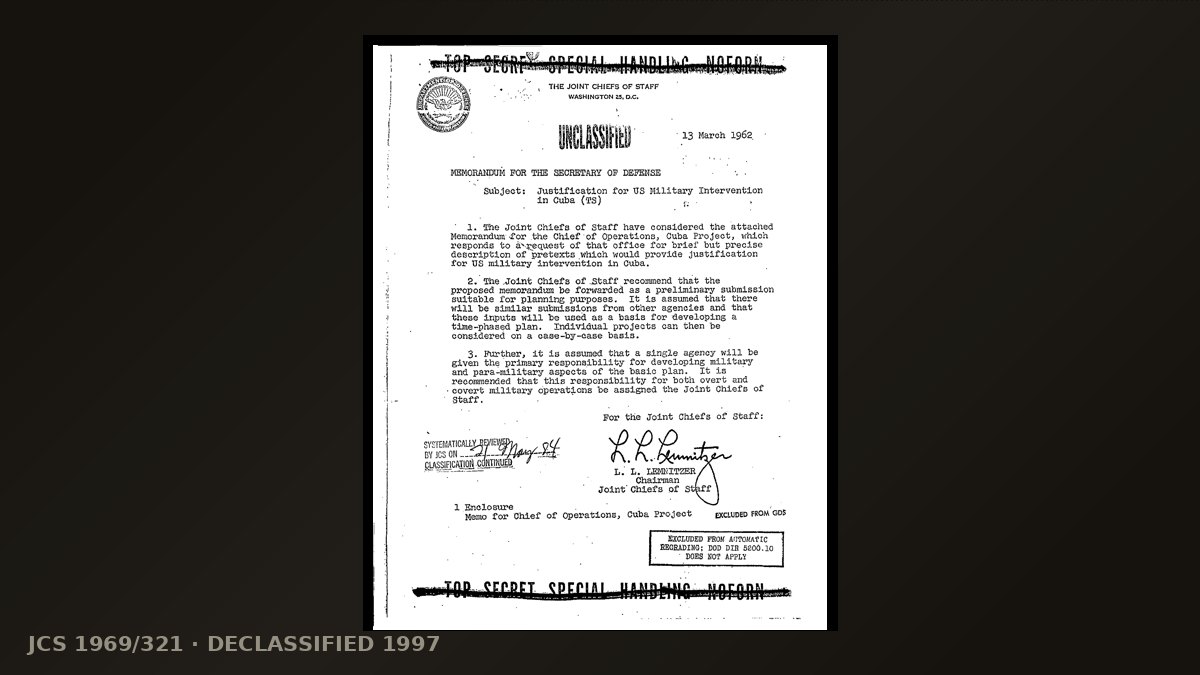
The setting: spring 1962, a year after the Bay of Pigs fiasco. The Kennedy administration was running Operation Mongoose, a covert program to remove Fidel Castro. On March 5, 1962, the Cuba Project's chief of operations, Brigadier General Edward Lansdale, asked the Joint Chiefs of Staff for 'brief but precise description of pretexts' that would justify open US military intervention in Cuba. On March 13, the Joint Chiefs answered — in a memorandum to Secretary of Defense Robert McNamara signed by their chairman, General Lyman L. Lemnitzer. The stated goal, in the memo's own words, was a plan that would 'place the United States in the apparent position of suffering defensible grievances from a rash and irresponsible government of Cuba and to develop an international image of a Cuban threat to peace in the Western Hemisphere.'
Then comes the annex — a menu of staged incidents. Around the Guantanamo base: land friendly Cubans in uniform 'over-the-fence' to stage an attack; blow up ammunition and start fires; sink a ship near the harbor entrance and 'conduct funerals for mock-victims.' Or, in the annex's own phrasing, a 'Remember the Maine' incident: 'We could blow up a US ship in Guantanamo Bay and blame Cuba.' A drone ship version adds the coldest sentence in the file: 'Casualty lists in US newspapers would cause a helpful wave of national indignation.' And beyond Cuba: 'We could develop a Communist Cuban terror campaign in the Miami area, in other Florida cities and even in Washington' — including sinking 'a boatload of Cubans enroute to Florida (real or simulated).'
The most elaborate proposal is the airliner swap. A CIA proprietary aircraft would be duplicated at Eglin Air Force Base — painted and numbered as an exact copy of a real civil airliner. The duplicate would board real passengers 'under carefully prepared aliases,' then land secretly at Eglin and evacuate them, while the original aircraft, converted to a drone, flew the route over Cuba and broadcast a MAYDAY claiming attack by Cuban MIGs — before being destroyed by radio signal. Read that again with fresh eyes: this is not a forum post. It is a planning annex, signed off by the Joint Chiefs of Staff, in the National Archives.
What happened next matters as much as what was proposed. President Kennedy rejected the plan — the proposals were never carried out, and within months Lemnitzer was moved out of the chairmanship to a NATO command in Europe. The file stayed classified for 35 years: it surfaced through the JFK Assassination Records Review Board's releases in 1997 and reached wide public attention with James Bamford's book Body of Secrets in 2001. No part of this story depends on a whistleblower's memory or a leaked screenshot. It depends on a signed government document anyone can download.
Which leaves the discipline SmokeScreen applies to every claim in this section: Northwoods proves exactly what it proves, and no more. It proves that in 1962, at the highest level of the US military, a false-flag program was proposed in writing — and that a president said no. It does not prove that later events were staged, or that any other specific claim is true; each of those stands or falls on its own documents. People who cite Northwoods as proof of everything are making the same error as people who dismiss it as impossible. The memo is real. It is also a receipt for one thing only — and one thing, documented this well, is more than enough.
Think we got this one wrong?
Good. That's the job — yours and ours. Dispute the verdict, bring your own receipts, and if you're right, the correction runs on this story, in the open, with credit.
Challenge this verdict