144 reports, one balloon: the intelligence report that started the modern era
In June 2021 the U.S. intelligence community published nine pages that changed the subject forever: its own accounting of 144 military UAP reports — of which it could explain exactly one.
By SmokeScreen Desk · Oct 30, 2026
🎧 Listen to this article
Most UAP arguments are about videos and witnesses. This one is about a document, and it's the most important document in the modern history of the subject: the Preliminary Assessment: Unidentified Aerial Phenomena, published by the Office of the Director of National Intelligence on June 25, 2021. Congress had ordered it in law. The UAP Task Force and the intelligence community produced it. Nine unclassified pages, no drama — and a number that has never been answered away.
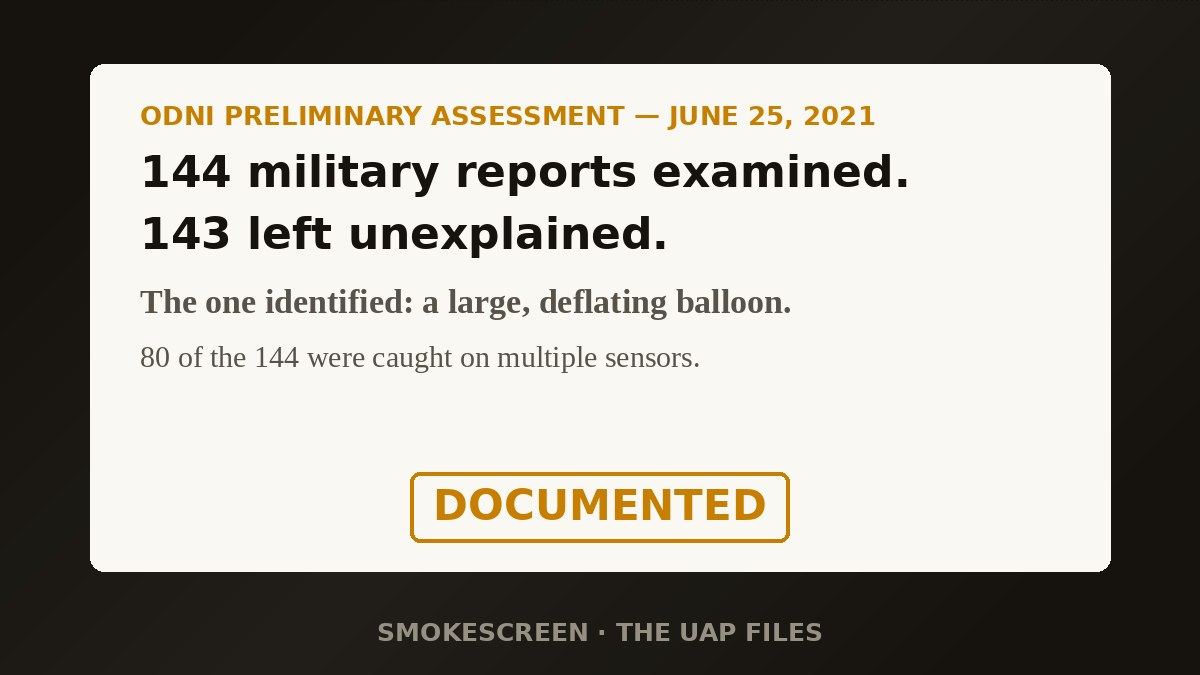
The report examined 144 reports originating from U.S. government sources — mostly military aviators — covering incidents from November 2004 to March 2021. These were not campfire stories phoned in by the public; they were reports collected through official channels, and 80 of the 144 involved observation by multiple sensors — radar, infrared, electro-optical systems — the stack of instruments that is supposed to settle arguments. A smaller subset, 18 incidents, appeared to show unusual flight characteristics: objects remaining stationary in winds aloft, moving against the wind, maneuvering abruptly, or travelling at considerable speed with no discernible means of propulsion.
Then the line the whole report turns on: 'We were able to identify one reported UAP with high confidence. In that case, we identified the object as a large, deflating balloon. The others remain unexplained.' One hundred and forty-three of one hundred and forty-four — unexplained. To its credit, the report is careful about why: with the exception of that one case, it says, 'we currently lack sufficient information in our dataset to attribute incidents to specific explanations.' Unexplained, in the document's own framing, does not mean proven extraordinary. It means the data wasn't good enough to close the files — which is why the report's real subject is arguably the failure of reporting itself: no standardized mechanism for collecting these reports even existed until the Navy built one in March 2019.
Just as important is what the report does not contain. There is no mention of extraterrestrial craft, recovered technology, or aliens — the word games of the internet are entirely absent. The report sorts possibilities into five buckets — airborne clutter, natural atmospheric phenomena, U.S. government or industry developmental programs, foreign adversary systems, and a residual category it calls, simply, 'other' — and frames the whole issue as flight safety and national security. The follow-through is also on the record: in July 2022 the Pentagon stood up a permanent office, AARO, to take the reports; and NASA's independent study team reported in 2023 that it found no evidence UAP are extraterrestrial in origin — and that the data is too poor to settle much of anything.
Verdict: DOCUMENTED, all of it — the count, the sensors, the single balloon, and the official admission that 143 files couldn't be closed. The receipt for this story is the report itself, linked below in full. Read the nine pages. They are more unsettling than any documentary — because everything in them is the government saying, in its own flat prose: we looked, and most of the time, we don't know.
Think we got this one wrong?
Good. That's the job — yours and ours. Dispute the verdict, bring your own receipts, and if you're right, the correction runs on this story, in the open, with credit.
Challenge this verdict