The Earth ends Friday, November 13, said the post. The lab's statement mentioned Mars.
A post on X — translated from Japanese, amplifying a Sputnik Japan item — announces the end of the Earth on Friday, November 13, 2026, on the authority of research from the Russian Academy of Sciences dated October 29. The academy's solar laboratory did issue a statement that day. It reports a giant cloud of gas leaving the Sun — sideways. Here are the statement, the official forecast for November 13, and the four places where the post and the paper part company.
By SmokeScreen Desk · Nov 3, 2026
🎧 Listen to this article
It arrives, as these things do, as a screenshot of a screenshot's cousin. A post on X — an account writing in Japanese, its text machine-translated in the app — carries a siren emoji at each end of the words BREAKING NEWS and a flat announcement: “The Earth will be destroyed on Friday, November 13, 2026.” The post cites research published in a scientific journal on October 29, 2026; it says multiple telescopes have confirmed the appearance of a prominence explosion at a point about 1.5 million kilometers from the Sun's surface; and it attributes to the Solar Astronomy Institute of the Russian Academy of Sciences the assessment that this may indicate a powerful G3–G4 class magnetic storm, which could affect the Earth. The post links onward to an item from Sputnik's Japanese service. The date, the destruction and the numbers are all checkable — because the document underneath the post is real, and it is public.
On October 29, the press service of the Solar Astronomy Laboratory of the Institute of Space Research — IKI, part of the Russian Academy of Sciences — issued a statement, carried the same day by news agencies. Not a journal article: a press message, of the kind the laboratory issues whenever the Sun does something photogenic. Its news was genuine, and by solar standards large. “The emission of a very large prominence about half a million kilometers in size came into view today by several space telescopes,” the statement says. A prominence is a cloud of relatively cold gas held above the Sun's surface by magnetic field lines; the statement notes that such structures can reach hundreds of thousands of kilometers in length, and sometimes grow to a million. This one had been ejected into space.
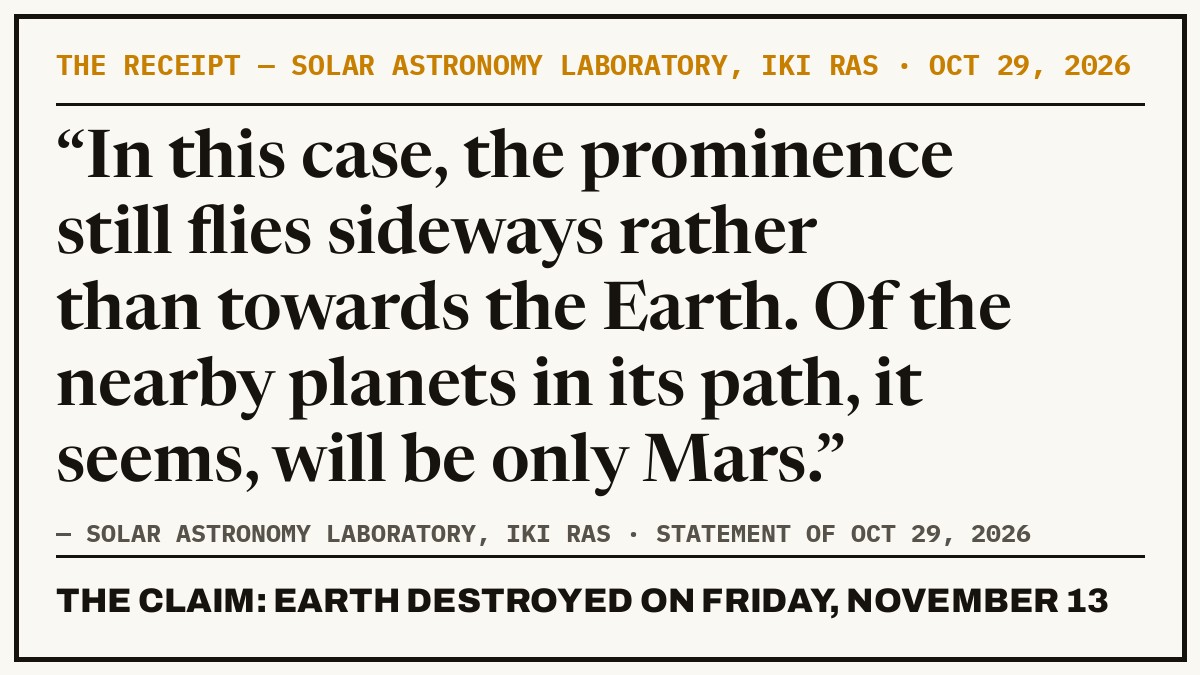
Then comes the sentence the viral post left behind. “In this case, the prominence still flies sideways rather than towards the Earth,” the laboratory wrote. “Of the nearby planets in its path, it seems, will be only Mars. Nevertheless, to touch the Earth edge, albeit with minor consequences, the gas cloud can still.” The statement closes the subject by noting that calculations of the prominence's trajectory were planned to be published on the morning of October 30. That is the whole of the laboratory's position as published: a very large cloud of gas, moving sideways, Mars in its path, and at most a graze of Earth's edge with minor consequences.
The G3–G4 figure in the post comes from a different part of the same statement — the explainer paragraph, where the laboratory describes what prominences do in general: “When a dense gas cloud enters the Earth's magnetosphere, strong magnetic storms of the G3–G4 level can occur.” It is a sentence about a category of event, written for a cloud that actually arrives. On NOAA's geomagnetic storm scale, which runs from G1 to G5, G3 is classed “strong” (Kp 7: aurora pushed to lower latitudes than usual, possible GPS and high-frequency radio degradation, voltage corrections on power systems) and G4 is “severe” (Kp 8). Storms at those levels are real weather — the kind space-weather offices forecast and grid operators plan around — and they recur through every solar cycle. The scale's top rung, G5, is “extreme.” The destruction of the Earth appears at no level of the scale, because the scale measures disturbances to a magnetic field, not the end of the planet hosting it.
For the date itself there is a second document, and it is equally plain. The U.S. Space Weather Prediction Center's 27-day outlook, in its October 26 issue, assigns November 13, 14 and 15 a planetary Kp index of 2, with quiet conditions expected; across the whole outlook, through November 21, it predicts no G3, G4 or G5 storm at all. Kp 2 sits three full steps below Kp 5, the threshold for even a G1 “minor” storm. The center's updated 27-day table, issued November 2, still lists November 13 at Kp 2, and its weekly forecast, issued the same day, describes November 13–15 as days when geomagnetic field activity is “expected to be at mostly quiet levels.” The official forecast for Friday the 13th is, in other words, the quietest line on the chart.
So the distance between the post and the paper is not one error; it is four, stacked. The laboratory's half a million kilometers was the cloud's size; the post picked the number up off the cloud and set it down in space — “1.5 million kilometers from the sun's surface,” a figure that appears nowhere in the statement. The laboratory's general explainer about what arriving clouds can do became, in the post, an assessment of this cloud — the one the same statement says is flying sideways. A press-service statement became “research published in a scientific journal.” And a cloud whose published path leads to Mars acquired a new destination and a deadline: Earth, destroyed, on a date the statement never mentions — November 13, whose only verifiable distinction is that in 2026 it falls on a Friday.
Something did arrive from the Sun that week — the smaller thing the scientists had actually flagged. The same October 29 statement carried a separate warning of possible geomagnetic disturbances on October 29–30 due to a coronal hole on the Sun, with the probability of a magnetic storm estimated as low. NOAA's weekly summary records the field reaching G2 (moderate) levels on October 31 and G1 (minor) levels on November 1, and NOAA's forecast attributed the November 1 disturbance to that coronal hole's high-speed stream — ordinary space weather, arriving on roughly the forecast schedule, a fortnight before the date in the post. No agency's paper connects any of it to November 13. What the record supports is a large cloud of gas, a sideways trajectory, a quiet forecast for Friday the 13th, and a post that improved on all three. The receipts are below. Read the receipts. Decide for yourself.
Think we got this one wrong?
Good. That's the job — yours and ours. Bring your own receipts, and if you're right, the correction runs on this story, in the open, with credit.
Challenge this story