Meta's own documents projected $16 billion from scam ads
Internal documents reviewed by Reuters projected that about 10% of Meta's 2024 revenue — roughly $16 billion — would come from advertising for scams and banned goods, and described a system that charged suspected scammers a premium instead of banning them. Meta calls the estimate “rough and overly-inclusive.” A year on, the projection sits in court filings, a Pulitzer citation and an open federal docket.
By SmokeScreen Desk · Nov 2, 2026
🎧 Listen to this article
In November 2025, Reuters published an investigation built on a cache of Meta's internal documents — financial, lobbying, engineering and safety records created between 2021 and 2025. The headline figure: Meta internally projected late in 2024 that it would earn about 10% of its overall annual revenue — or $16 billion — from running advertising for scams and banned goods. That word matters: projected. The figure is the company's own estimate of money coming in, not an audited count of money earned, and SmokeScreen prints it the way Reuters reported it. One boundary, stated plainly: the internal documents themselves are not public. What exists on the record is Reuters' account of them, Meta's on-the-record response, and the paper trail the reporting has generated since. All three are below.
The arithmetic is checkable against Meta's own filings. In its fourth-quarter and full-year 2024 results, published January 29, 2025, Meta reported total 2024 revenue of $164.50 billion. Ten percent of that is $16.45 billion — the neighbourhood of the reported projection, which the documents put more precisely at 10.1% of 2024 revenue. The category, as Reuters described the documents, covered fraudulent e-commerce and investment schemes, illegal online casinos and the sale of banned medical products.
The documents also counted exposure. One December 2024 document estimated that the company shows its platforms' users an estimated 15 billion “higher risk” scam advertisements — those that show clear signs of being fraudulent — every day, across Facebook, Instagram and WhatsApp. Another late-2024 document put the annualized revenue from that category alone at about $7 billion. A narrower band of ads — those carrying what Meta's own legal assessments treated as higher legal risk, expressly including impersonating a brand or a celebrity — was recording about $3.5 billion every six months, according to Reuters. And a May 2025 presentation by Meta's safety staff estimated that the company's platforms were involved in a third of all successful scams in the United States.
The enforcement machinery the documents describe ran on thresholds. Per Reuters, Meta's automated systems ban an advertiser only when they assess the advertiser to be at least 95% likely to be committing fraud. Below that line, the response was not removal but price: suspected scammers were charged premium rates to compete in the ad auction — a practice the documents called “penalty bids.” Meta's stated rationale, as reported, was that higher prices would discourage the advertisers. The documents also describe guardrails on the enforcers: in early 2025, the team responsible for vetting questionable advertisers was told not to take enforcement actions that would cost the company more than 0.15% of total revenue — about $135 million in the first half of that year — without executive approval. And from early 2025, an employee published a weekly internal report on the “Scammiest Scammers,” the advertisers drawing the most user complaints; Reuters found that some accounts on those lists remained active months later.
The strategy documents, per Reuters, weighed the exposure and chose a pace. Following a meeting with the chief executive, executives settled on trying to reduce the share of revenue attributable to scams, illegal gambling and prohibited goods from an estimated 10.1% in 2024 to 7.3% by the end of 2025, 6% by the end of 2026 and 5.8% in 2027. The documents, as reported, also priced the other side of the ledger: anticipated regulatory penalties were estimated at up to $1 billion, against billions a year in projected revenue from the category. Whether the reduction targets were met is not in the public record; Meta has not published a current figure for the share.
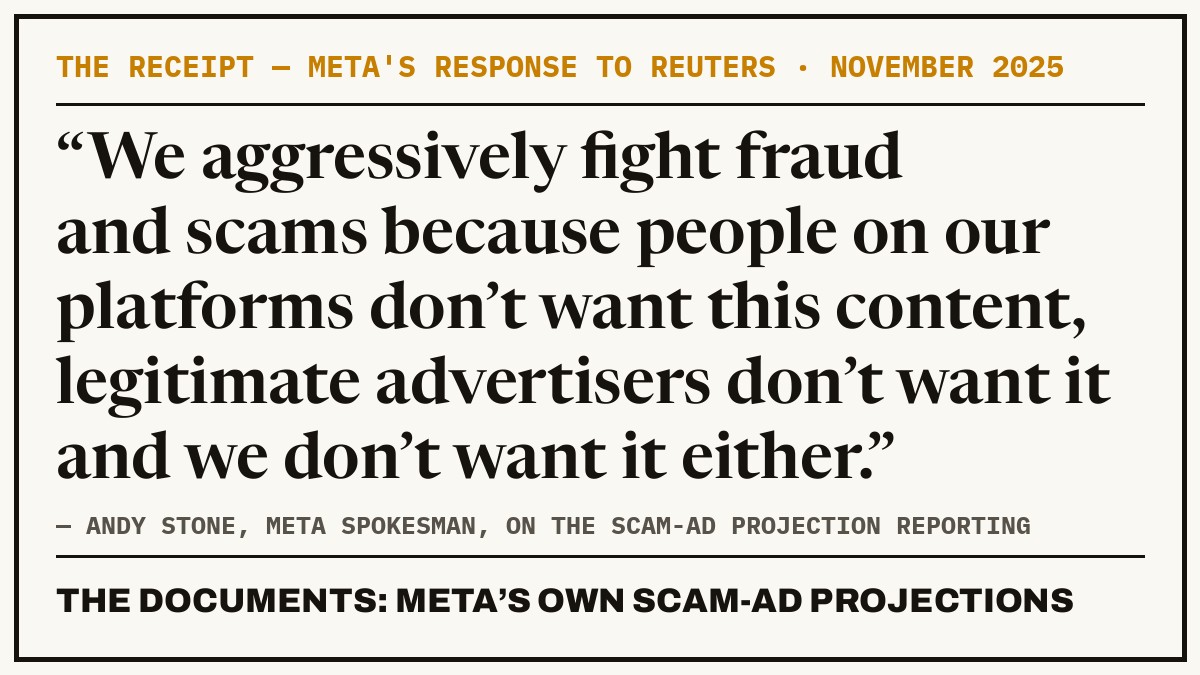
Meta answered the reporting on the record, and its answer runs here the way it was given. Spokesman Andy Stone told Reuters the documents “present a selective view that distorts Meta's approach to fraud and scams,” and called the 10% estimate “rough and overly-inclusive,” saying it swept in many legitimate ads. Stone said the company later revised the estimate downward, and that the assessment had been made to validate Meta's planned integrity investments, which it then made; Meta did not provide a lower estimate. He pointed to movement in the other direction: user reports of scam ads down 58% over the previous 18 months, and more than 134 million pieces of scam ad content removed in 2025. Meta's later materials put the 2025 removal figure at 159 million. The sentence on this story's receipt card is Stone's: “We aggressively fight fraud and scams because people on our platforms don't want this content, legitimate advertisers don't want it and we don't want it either.”
The reporting did not stay in the news pages; it joined a run of official paper. In June 2025, 42 state and territorial attorneys general had already written to Meta demanding action on fraudulent investment ads. In April 2026, the Consumer Federation of America sued, alleging the company allows scam advertising to proliferate because it earns revenue from it, penalty bids included. In May 2026, California's Santa Clara County sued under the state's false-advertising and unfair-competition laws; its complaint, quoting the documents, says Meta tracks the money from policy-violating ads — premiums included — under an internal label: “violating revenue.” And on October 22, 2026, Rhode Island became the first state to sue Meta over scam advertising, its complaint citing the Reuters documents directly. Meta called the Rhode Island suit “unfounded” and said it would fight it.
In May 2026, the reporting won the Pulitzer Prize for Beat Reporting — awarded to Reuters' Jeff Horwitz and Engen Tham “for inventive and revelatory reporting on Meta that detailed the technology company's willingness to expose users, including children, to scams and AI manipulation.” The regulatory file is open now. On September 24, 2026, the Federal Trade Commission voted to ask whether its Rule on Impersonation of Government and Businesses should be extended to the platforms whose ad-optimization practices, the Commission says, may be furthering impersonation scams. The advance notice was published in the Federal Register on October 1; it proposes no rule text and binds no platform today, and written comments close on November 30, 2026. It is the earliest stage of a rulemaking — and it is a public docket.
The reporting reached its widest audience a year after publication, when journalist Mariana van Zeller walked through it on The Joe Rogan Experience (episode #2567, October 16, 2026); a clip from the episode travelled widely on X in the days that followed. So the record, sorted. On paper: an internal projection, reported by Reuters from the company's own documents, putting roughly a tenth of Meta's 2024 revenue in ads for scams and banned goods; an enforcement system described as pricing suspicion below a 95% certainty line rather than banning it; and a corporate response that disputes the estimate's construction without supplying a different number. Around that core now sit a consumer group's lawsuit, a county's complaint, a state's case, a Pulitzer citation and an open FTC comment file. Not on paper: the internal documents themselves, which remain unpublished, and any current figure for what the category earns today. The receipts are below.
Think we got this one wrong?
Good. That's the job — yours and ours. Bring your own receipts, and if you're right, the correction runs on this story, in the open, with credit.
Challenge this story