You can't see the Great Wall of China from space. Astronauts keep saying so.
It's in every trivia book ever printed: the only human-made object visible from space. The people who have actually been to space — including Canada's Chris Hadfield — have been correcting it for decades.
By SmokeScreen Desk · Oct 30, 2026
🎧 Listen to this article
The claim is a classic of the genre: the Great Wall of China is the only human-made object visible from space — some versions say from the Moon. It has been printed in textbooks, trivia books, and museum displays for generations. It also has a tell that SmokeScreen's field guide warns about: the claim is older than the evidence. It was popularized in the 1930s — Richard Halliburton's 1938 travel book had it visible from the Moon — decades before any human being had been high enough to check.
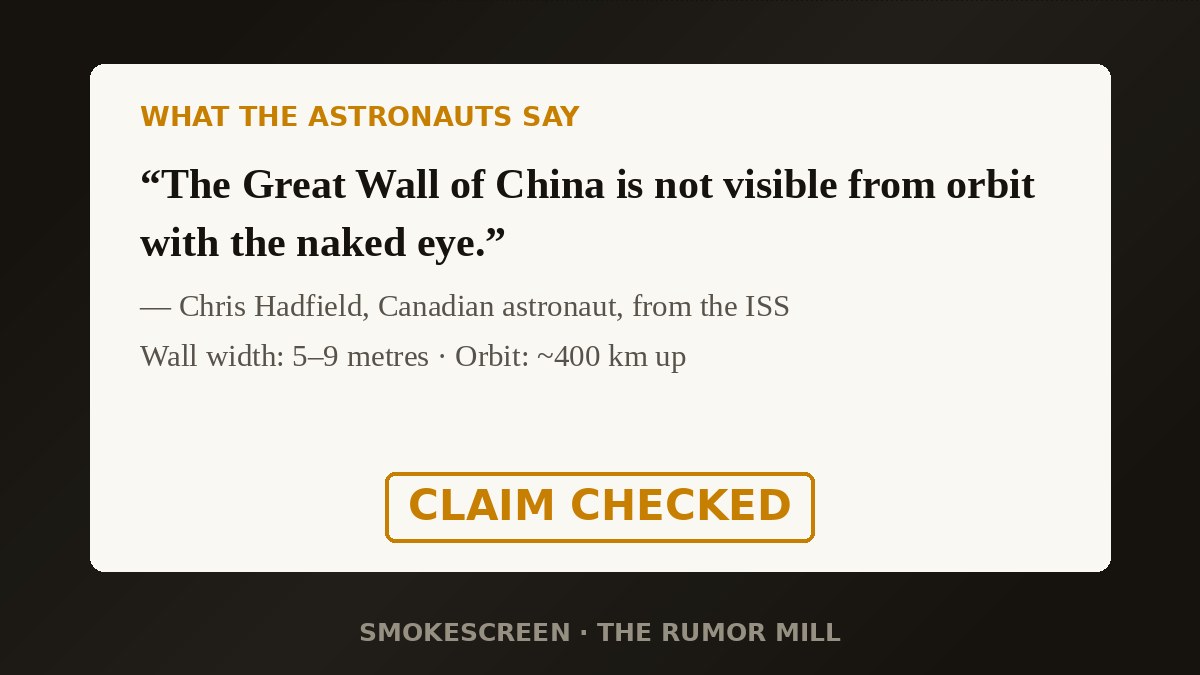
Start with the object itself. The Wall is stupendously long — thousands of kilometres of it — but visibility doesn't care about length. It cares about width and contrast, and the Wall has almost none of either. At its widest it is about 9 metres across; in many places 5 metres or less — the width of a two-lane road. It is built from local dirt, mud, and stone, so it's roughly the colour of the ground it stands on, and it follows the contours of mountains and valleys. From the International Space Station, about 400 kilometres up, a 6-metre line the colour of dirt is not a hard thing to miss. It is an impossible thing to see.
Then ask the witnesses — the step the trivia books skipped. China's first astronaut, Yang Liwei, orbited the Earth 14 times in 2003, looked for his country's most famous structure, and reported afterward: 'The Earth looked very beautiful from space, but I did not see our Great Wall.' Canadian astronaut Chris Hadfield, who lived on the ISS for five months, put it in writing: 'The Great Wall of China is not visible from orbit with the naked eye. It's too narrow, and it follows the natural contours and colours of the landscape.' He told CBC's Quirks & Quirks it would be 'hard to see from an airplane in a lot of places.' Apollo astronauts, from a quarter-million kilometres farther out, reported no human-made objects at all — just the blue marble.
Now the honest nuance, because this section checks claims rather than swapping one absolute for another. With a camera and a long zoom lens, in the right light, a section of the Wall can be photographed from orbit — NASA astronaut Leroy Chiao did it in 2004 over Inner Mongolia, while noting he couldn't see it with his unaided eyes and wasn't certain the photo showed it. Satellites image the Wall routinely. None of that rescues the claim, which is about the naked eye — and on that, every astronaut asked has given the same answer. Ironically, plenty of human-made things ARE visible from orbit unaided: cities, highways, airports, and city lights at night. The Wall's fame rests on being the spectacular exception that isn't.
Verdict: false. The Great Wall is not visible from space with the naked eye, was never checked before it was printed, and survives because it sounds like the kind of thing that ought to be true. The receipts here aren't documents — they're the testimony of the only people positioned to know, and they're unanimous.
Think we got this one wrong?
Good. That's the job — yours and ours. Dispute the verdict, bring your own receipts, and if you're right, the correction runs on this story, in the open, with credit.
Challenge this verdict