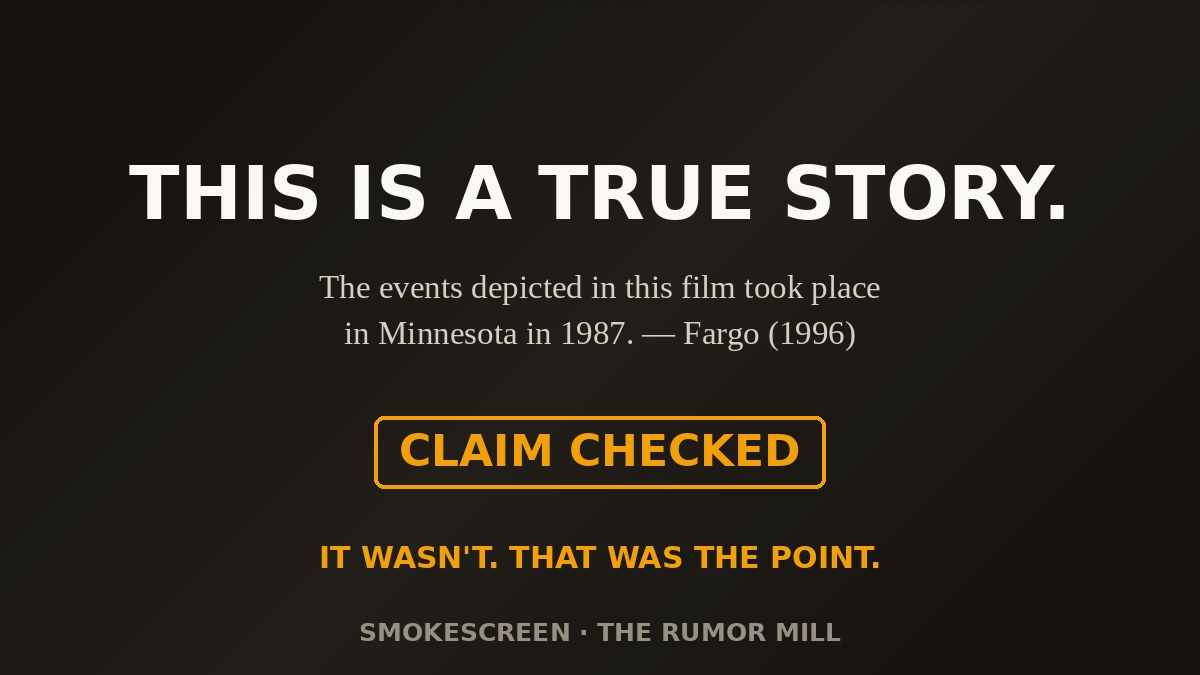
Fargo opens with 'THIS IS A TRUE STORY.' That was the trick.
The most famous claim in the Coen brothers' classic is printed on the screen itself — and it's false, on purpose. The receipts include the confession in the filmmakers' own interviews and a disclaimer hiding in the film's own credits.
By SmokeScreen Desk · Oct 30, 2026
🎧 Listen to this article
The Rumor Mill usually chases claims other people make. This one was made by a movie, about itself, in capital letters. Fargo (1996) opens with a title card that doesn't hedge: 'THIS IS A TRUE STORY. The events depicted in this film took place in Minnesota in 1987. At the request of the survivors, the names have been changed. Out of respect for the dead, the rest has been told exactly as it occurred.' Audiences believed it for years. It is, by the filmmakers' own account, the first fiction in a fictional film.
The Coen brothers have explained the card repeatedly, and cheerfully. Ethan Coen: 'We wanted to make a movie just in the genre of a true story movie. You don't have to have a true story to make a true story movie.' Joel Coen, on whether any of it happened: the story 'was completely made up. Or, as we like to say, the only thing true about it is that it's a story.' The reasoning was craft, not deception for its own sake — Joel again: 'If an audience believes that something's based on a real event, it gives you permission to do things they might otherwise not accept.' The card is a licence the film issues to itself.
Two fragments of the film do trace to real cases, and a fair check has to list them. Jerry Lundegaard's car-dealership fraud echoes a real case the Coens had heard of — a man who tampered with vehicle serial numbers to defraud the General Motors finance arm. And the film's most infamous scene borrows from a real and terrible crime: the 1986 murder of Helle Crafts in Newtown, Connecticut, whose husband Richard disposed of her body with a wood chipper and in 1989 became the first person in the state convicted of murder without a body. The film's special-edition DVD confirms the Crafts case inspired that scene. Two borrowed fragments do not make a true story — they make a story with two true ingredients, assembled into events that never happened, in a place they didn't happen, to people who didn't exist.
The neatest receipt, though, is inside the product itself. Run Fargo to the very end and the closing credits carry the standard legal disclaimer of a work of fiction: all persons fictitious. The film opens by swearing it's true and closes by swearing it isn't, and both statements are doing a job — the first buys your belief, the second covers the lawyers. The television series inherited the trick and the card; its creator Noah Hawley has said of the show's stories, on the record, 'It's all just made up. The whole cloth.'
Verdict: the claim is false — knowingly, artfully false, which is why it belongs in this section rather than the outrage file. Fargo's title card is the friendly version of a move this site exists to catch in the wild: a confident 'this really happened' used to lower your guard. In a movie, it's a magic trick, and a great one. The check is the same either way: when someone opens with 'true story,' ask for the receipts — and read the credits.
Think we got this one wrong?
Good. That's the job — yours and ours. Dispute the verdict, bring your own receipts, and if you're right, the correction runs on this story, in the open, with credit.
Challenge this verdict