Canada and the EU drop the 'associate member' label — and keep the partnership
Six weeks ago Brussels floated making Canada the EU's first 'associate member.' The Montreal declaration quietly buried the label and kept the partnership. Here's what actually happened, who framed it which way, and the receipts.
By SmokeScreen Desk · Oct 30, 2026
🎧 Listen to this article
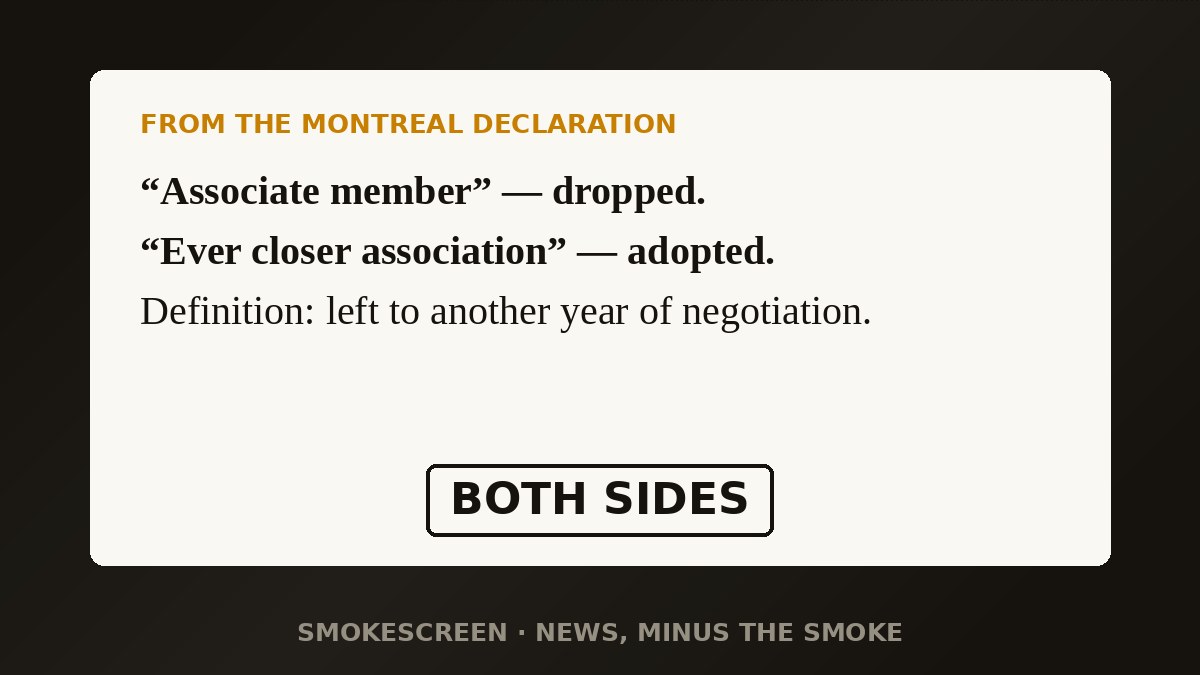
The Canada–EU summit closed in Montreal on Friday with a joint declaration that does the thing both sides spent two days insisting didn't matter: it changes the words. Gone is 'associate member' — the label European Commission President Ursula von der Leyen floated six weeks ago for Canada, which would have made Canada the first country to hold it. In its place, the declaration commits both sides to an 'ever closer association,' short of full membership, with the actual definition left to another year of negotiation and another summit.
What the declaration does contain is concrete: new subsea cable infrastructure linking Europe, Canada, and Asia; a joint feasibility study on Canadian liquefied natural gas exports to Europe; and expanded ways for young Canadians and Europeans to work across the Atlantic — all under a banner the leaders call the 'Alliance for the Future.' Prime Minister Mark Carney said the summit launches formal negotiations expected to run another year, and that any enhanced partnership would require approval from Canada's Parliament.
Why did the label die? Because it was never defined. 'Associate member' has no legal status in the EU, no precedent, and no agreed meaning, and Germany led a group of member states — France, Italy, and Greece also raised concerns — who argued they could not sign up to a concept nobody had fleshed out. Von der Leyen kept using the term on arrival in Montreal, calling the idea 'an association without accession,' but the member states who would have to live with the term removed it from the text.
The framings split the way they usually do. Ottawa and Brussels say the name is beside the point — Carney: 'The good news is it doesn't matter about specific names or nomenclature. What matters is the difference it will make to the lives of Canadians.' The sceptics inside the EU say an undefined status is a blank cheque, and they declined to sign it. And a former Canadian Finance Ministry adviser offered the footnote neither cheerful version includes, telling Reuters the summit was 'a bit of a show' and 'very ill-defined' — Canada sends nearly 70% of its exports to the United States, while the EU accounts for roughly 9% of Canada's total trade. A partnership announcement, on its own, does not rebalance that.
Washington supplied its own two versions in a single week. President Donald Trump previously called the associate-member proposal 'laughable' and said he could read it as a 'hostile act.' Then, at a rally on October 29, he said Canada has been 'treating us extremely nicely recently' and credited his tariffs for the improved mood — without announcing a deal or any tariff change. A warmer tone is a real signal, but it is not a signed agreement, and no tariff line moved.
What to watch from here is unglamorous: the published declaration text, a year of negotiations over what 'ever closer association' will actually mean, and whether anything that gets signed changes a tariff, a shipment, or a trade share. Until then, the accurate summary of this week is narrow: a word was proposed, a word was removed, and the work — all of it still ahead — continues.
Think we got this one wrong?
Good. That's the job — yours and ours. Dispute the verdict, bring your own receipts, and if you're right, the correction runs on this story, in the open, with credit.
Challenge this verdict