33 countries are telling people to stockpile. The paperwork says something quieter
A Newsweek map counted 33 countries whose governments advise keeping emergency food and water. Online, within days, it became a coordinated doomsday warning. The documents underneath are real — and mostly ask for three days of supplies.
By SmokeScreen Desk · Nov 1, 2026
🎧 Listen to this article
The claim travelled fast, and it grew as it went. On October 28, Newsweek published a map of countries whose governments advise households to keep emergency food and water, and counted 33. Within days the number was doing very different work. It was a segment on the Julian Dorey Podcast (October 31) and a talking point for former FBI deputy director Dan Bongino, who told Americans to take the warnings seriously and prepare for 30 days. Prepper channels posted competing tallies — 14 countries in one video, 17 in another — and one viral variant upgraded the advice into “blackout warnings” no government on the list has issued. SmokeScreen went to the documents underneath all of it.
Start with what the 33 actually is. Newsweek did not report an announcement, an agreement, or a coordinated warning — it compiled a list. Seventeen of the countries are in Europe: the United Kingdom, Ireland, France, Germany, the Netherlands, Denmark, Norway, Sweden, Finland, the three Baltic states, Poland, the Czech Republic, Austria, Switzerland and Croatia. North America contributes the United States, Canada and Mexico; South America, Chile, Colombia, Argentina and Brazil; then South Africa; Japan, Taiwan, Israel, India, the Philippines and Singapore in Asia; and New Zealand and Australia. Thirty-three flags — on a list assembled by a magazine, from guidance issued by different governments, in different years, for different reasons.
Read the guidance itself and the temperature drops. The most common number in it is 72 hours. The UK, France, Canada, Japan, Mexico and the Netherlands all advise three days of food and water. Sweden and Norway advise about a week. Germany's civil protection agency suggests up to ten days. The United States, through Ready.gov, says only “several days,” and has issued no new national stockpile campaign. India's disaster authority recommends an emergency kit and sets no timeframe at all. The kits are nearly identical everywhere: non-perishable food, water, medicines, a battery radio, a torch, batteries, a power bank, copies of documents, and some cash.
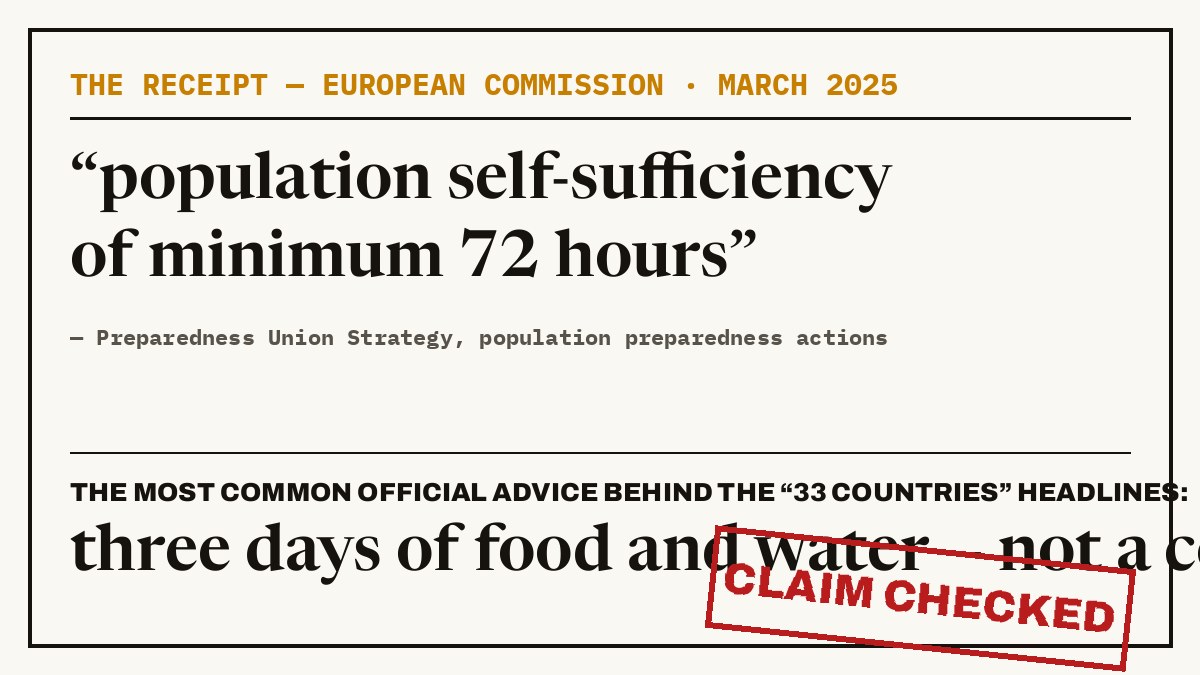
Europe dominates the list for a documented reason: one policy. On March 26, 2025, the European Commission adopted its Preparedness Union Strategy, which commits the EU to developing guidelines to reach “population self-sufficiency of minimum 72 hours.” The strategy's own framing is an all-hazards one — it names geopolitical tensions and conflicts, cybersecurity and hybrid threats, disinformation, climate change and natural disasters. It is a framework document, published with a press rollout, covering 27 member states at once. When one strategy produces most of a list, the list is not evidence of 27 separate alarms.
Timing cuts the same way. Some of the guidance is genuinely new: Britain launched its Be Ready campaign on October 22, 2026; the Czech Republic's “72 Hours” campaign has put printed guides into 5.2 million homes; Germany issued a revised national crisis guide in October 2025; and Japan begins urging every household to hold at least three days of supplies on November 2 — advice its disaster minister ties to earthquakes and natural disasters, Japan's standing risk. But much of the list is old. Canada's 72-hour advice has been its standard guidance for years. Sweden's crisis pamphlet, which asks households to manage on their own for at least a week, was updated and re-mailed in late 2024. One preparedness site that checks guidance against government pages counts 62 countries with advice of this kind. The total depends entirely on how far back you are willing to count — which is another way of saying that stockpile advice is normal statecraft, not a signal flare.
Folded into the same claim is a real military program, and it is the strongest document in the pile — so it gets its own paragraph. On September 30, 2026, US Defense Secretary Pete Hegseth announced FORTRESS (Federal Operations for Resilience, Troop Resources, Energy, Supply, and Survivability), which the Defense Department calls “a national insurance policy for the American homeland.” Hegseth's stated core, in his Quantico speech: “Every major military installation in America is going to generate its own power independent of the civilian grid.” On October 25, Fox News Digital reported, from internal planning documents, that the standard is 90 days of self-sufficiency — power, water, fuel and communications. Note the sourcing precisely: the Pentagon's chief spokesman shared that reporting publicly but has not confirmed the 90-day figure, and no budget or completion date has been published. The Army's related Janus microreactor program predates FORTRESS: five companies, up to $2.2 billion, reactors planned at Fort Bragg, Fort Campbell, Fort Hood, Fort Benning and Fort Drum, the first targeted to run by September 2028. It is a publicly announced wartime-resilience program for military bases. It is not a warning to households, quiet or otherwise.
Verdict: the list is real; the doomsday reading is not in the documents. No government among the 33 ties its advice to a specific predicted event. The stated reasons, in document after document, are the ordinary catastrophes — storms, blackouts, cyberattacks, and wars that have not happened. What is genuinely new, and worth watching on the record, is the direction of travel: Europe aligning its preparedness policy since 2025, and the Pentagon planning in public to run its bases off the grid. Both are on paper, in the open. Whether classified threat assessments are also driving the timing is a question no public document answers, so SmokeScreen marks it unknown — and notes that a claim nobody can check is not the same thing as a claim that has been checked. The receipts are below.
Think we got this one wrong?
Good. That's the job — yours and ours. Dispute the verdict, bring your own receipts, and if you're right, the correction runs on this story, in the open, with credit.
Challenge this verdict